

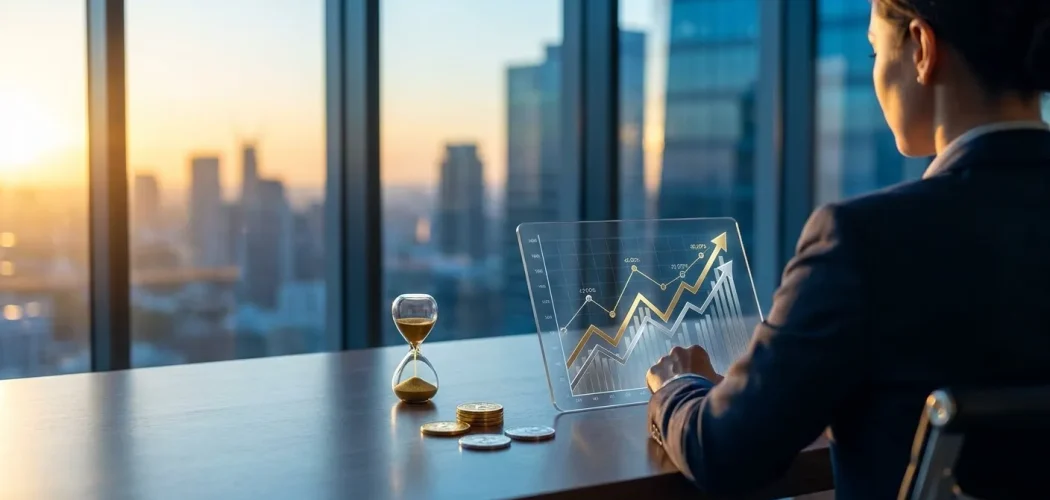
After witnessing the exhilarating highs of 2025 and early 2026, followed by significant corrections, new investors like Sarah might wonder: what’s next? Understanding the precious metals future outlook is essential for strategic planning. At Silver Price Gold, we look beyond the immediate headlines to provide a balanced perspective, helping you align current trends with your long-term investment goals. Our aim is to empower you with the knowledge needed to confidently navigate these dynamic markets.
Interpreting Current Trends and Past Volatility
Day 8 explored the unprecedented surges of 2025 (gold up 65%, silver up 149.1%) and the January 2026 peaks (gold near $5,600/oz, silver at $121.62/oz), along with the subsequent corrections (gold down 28%, silver down 52%). These events underscore that while precious metals offer significant upside potential, they are also subject to market dynamics and volatility. It’s crucial not to view these corrections as a failure of the asset class, but rather as a natural rebalancing after rapid growth, often presenting new entry points for patient investors. Historically, such pullbacks have often preceded renewed upward movements, offering opportune moments for strategic accumulation.
Many factors contribute to this volatility. For instance, global economic data and geopolitical events consistently influence investor sentiment. Understanding these underlying drivers helps in discerning short-term fluctuations from long-term trends. Consequently, a disciplined approach, focusing on fundamental value rather than daily price swings, remains paramount for success in this sector.
The Consensus on the Precious Metals Future Outlook for 2026
Despite recent pullbacks, the sentiment among market analysts for the remainder of 2026 remains remarkably bullish. An analysis of 26 different sources projects gold to average around $5,515/oz by the end of the year. Some institutional forecasts are even more optimistic, with J.P. Morgan, for instance, projecting gold to reach $6,000/oz by Q4 2026. These projections suggest that the underlying drivers for gold’s strength, such as sustained central bank demand and ongoing global economic uncertainty, are expected to persist. In fact, many experts believe the current consolidation phase is healthy, setting the stage for future appreciation.
For silver, the future outlook is similarly bright, albeit with continued potential for higher volatility due to its smaller market size. The average 2026 price for silver is projected near $97/oz, with a consensus range generally falling between $65 to $100. Intriguingly, some high-end outliers suggest silver could even reach $200/oz. BullionVault users, often a good gauge of retail investor sentiment, are particularly bullish, predicting silver to achieve over $80 per Troy ounce in December 2026. This optimism for silver is largely fueled by its strong industrial demand, especially from rapidly expanding sectors like solar energy, electric vehicles, and AI infrastructure. For more on silver’s performance, refer to our Silver News August 2026 report.
Key Factors Shaping the Road Ahead for Gold and Silver
Several critical factors will continue to influence the precious metals future outlook:
- Central Bank Accumulation: The continued strategic buying by central banks, averaging 1,000 tonnes annually for four years, provides a strong floor for gold prices. Their stated intent to increase reserves signals a long-term shift towards diversification away from traditional reserve currencies. This consistent demand acts as a significant stabilizing force.
- Inflation and Interest Rate Environment: While inflation can lead to higher short-term interest rates that may temper precious metals in the short term, a scenario where inflation remains elevated while economic growth slows could create a very favorable environment for gold and silver. Historically, precious metals have served as a hedge against inflationary pressures. For a deeper understanding, explore our article on Interest Rates and Gold: How Rates Affect Prices.
- Geopolitical Uncertainty and Economic Stability: Ongoing global tensions, trade disputes, and concerns about the stability of fiat currencies tend to drive investors towards safe-haven assets like gold. The increasing frequency of such events globally means this factor is unlikely to diminish soon. Therefore, precious metals remain a crucial component for portfolio diversification.
- Industrial Demand for Silver: Beyond its role as a monetary metal, silver’s industrial applications are expanding rapidly. Sectors like renewable energy (solar panels), electric vehicles, 5G technology, and artificial intelligence infrastructure are experiencing exponential growth, driving up demand for silver. This dual demand profile provides a unique advantage for silver’s price appreciation.
- Mining Supply Constraints: New discoveries of economically viable gold and silver deposits are becoming increasingly rare and more expensive to extract. This inherent supply limitation, coupled with rising production costs, supports higher prices over the long term. Consequently, any significant increase in demand will likely put upward pressure on prices. You can find more information about the industry in our Mining News, Mining Stocks, Junior Mining section.
Navigating Market Cycles: Corrections and Opportunities
Market corrections, while unsettling, are a natural and healthy part of any investment cycle. For precious metals, these periods often represent opportunities for investors to acquire assets at more favorable prices. For example, the significant correction in early 2026, though sharp, brought prices back to levels that many analysts consider attractive for long-term accumulation. Patient investors understand that these dips are not failures but rather strategic entry points. It’s about maintaining perspective and sticking to a well-defined investment strategy.
Consider the analogy of a tide: it ebbs and flows, but the ocean remains. Similarly, the long-term trajectory for gold and silver often shows resilience and upward momentum despite short-term fluctuations. Therefore, reacting impulsively to every market movement can be detrimental to long-term goals. Instead, focus on the underlying fundamentals and the broader economic landscape. This disciplined approach is a hallmark of successful precious metals investing.
The Role of Gold as a Monetary Anchor in the Future
Gold has historically served as a store of value and a hedge against economic instability. In an era of unprecedented global debt and aggressive monetary policies, gold’s role as a monetary anchor is gaining renewed prominence. Central banks’ continued accumulation is a testament to this, signaling a systemic shift towards greater diversification and a recognition of gold’s intrinsic value. This trend suggests a robust future for gold as a foundational asset in national reserves.
Furthermore, the discussion around a potential return to some form of gold-backed currency or a more prominent role for gold in the international financial system continues to simmer. While a full return to the gold standard may be unlikely, the increasing focus on gold’s stability in an otherwise volatile financial world underscores its enduring appeal. This reinforces its position as a critical component in a diversified investment portfolio, safeguarding wealth against currency debasement and economic shocks.
Silver’s Dual Nature: Industrial Demand Meets Investment Appeal
Silver’s unique position as both an industrial metal and a precious metal means its price is influenced by a broader range of factors than gold. Its industrial demand is surging due to its essential role in green technologies, electronics, and medical applications. This industrial utility provides a robust floor for its price and offers significant upside potential as these sectors expand. Consequently, silver often exhibits higher volatility, presenting both greater risks and greater rewards for investors.
From an investment perspective, silver is often referred to as

