

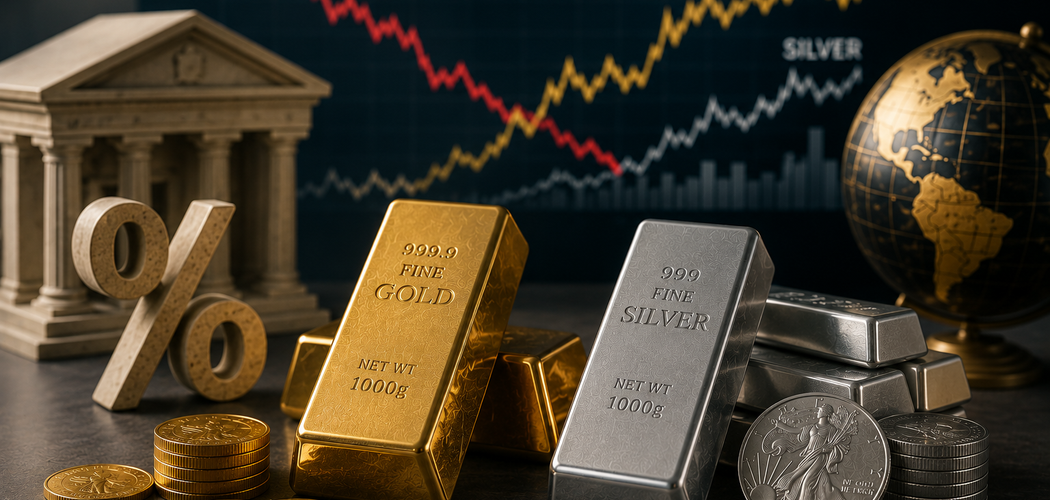
Interest rates influence nearly every major financial market. They affect borrowing costs, currencies, bonds, stocks, and investor behavior. Therefore, understanding interest rates and gold can help investors make sense of changing precious metal prices.
The basic relationship appears simple. Physical gold does not pay interest. When bonds and savings products offer higher returns, holding gold can become less attractive. When rates decline, that opportunity cost decreases.
However, reality is more complicated.
Inflation matters because investors care about what their interest income can actually buy. Currency movements also influence precious metals. Meanwhile, central bank expectations can move markets months before an official rate change.
Silver adds another layer. It responds to many of the same financial forces as gold, but industrial demand is much more important to its market. The Silver Institute reported industrial silver demand of 657.4 million ounces in 2025, showing why economic activity remains important when analyzing the metal.
Investors should therefore look beyond the headline policy rate.
Why Interest Rates Matter to Precious Metals
Gold and silver bullion do not generate interest.
This creates an opportunity cost.
Suppose an investor can hold gold or purchase a relatively safe bond paying a meaningful yield. If interest rates increase, the bond becomes more competitive because it produces income.
Gold still has other potential benefits, but the income difference becomes harder to ignore.
When yields fall, the situation changes.
Bonds provide less income, so investors sacrifice less by holding non-yielding assets.
This relationship helps explain why interest rates and gold frequently receive attention together.
World Gold Council research identifies opportunity cost as an important driver of gold and notes that higher rates can create headwinds. However, it also emphasizes that rising rates do not automatically produce weak gold returns because several other factors influence the market.
Therefore, investors should avoid treating rates as a perfect trading signal.
Nominal Rates Tell Only Part of the Story
A central bank may announce that its policy rate is 5%.
That number is a nominal rate.
However, investors also need to consider inflation.
Suppose a relatively safe investment yields 5% while inflation runs at 2%. The approximate inflation-adjusted return remains positive.
Now imagine inflation reaches 6%.
A 5% nominal yield suddenly looks much less attractive in real purchasing-power terms.
This is why real interest rates matter.
Real rates broadly compare investment yields with inflation.
For precious metals, this measure can be more informative than the headline policy rate alone.
High positive real yields may create greater competition for gold.
Low or negative real yields can reduce the opportunity cost of holding it.
Therefore, investors analyzing interest rates and gold should consider inflation and yields together.
Why Higher Real Yields Can Pressure Gold
Imagine an investor choosing between gold and an inflation-protected government security.
Gold provides no regular income.
If the government security begins offering an attractive positive real return, the investor receives compensation above expected inflation.
That can make the bond more appealing.
Some investors may therefore reduce gold exposure.
This does not mean gold must fall whenever real yields increase.
Central bank buying, geopolitical uncertainty, currency weakness, financial instability, and strong physical demand can counteract the effect.
In fact, World Gold Council research cautions against using a simple two-variable model of real rates and the U.S. dollar because gold has sometimes moved in the same direction as both.
Real yields are important, but they belong within a larger analytical framework.
Lower Real Rates Can Support Gold
The opposite environment can improve gold’s relative appeal.
Suppose nominal bond yields decline while inflation expectations remain stable.
Real yields fall.
Investors now receive less inflation-adjusted income from bonds.
As a result, the opportunity cost of holding gold becomes smaller.
Some investors may increase their precious metal exposure.
This can support prices.
However, interest rates and gold still do not have a mechanical relationship.
If rates are falling because inflation has collapsed and financial confidence is strong, gold may receive less support than expected.
Alternatively, falling rates during a severe financial crisis could increase defensive demand.
Investors therefore need to understand why rates are changing.
The Reason Behind Rate Changes Matters
A rate cut caused by declining inflation is different from an emergency rate cut during a banking crisis.
Both lower interest rates.
Yet the market implications can be very different.
Economic context helps investors interpret the signal correctly.
Central Banks Influence Rate Expectations
Central banks set important short-term policy rates.
The Federal Reserve, European Central Bank, Bank of England, Bank of Japan, and other institutions influence borrowing conditions across their economies.
However, markets do not wait for official decisions.
Investors continuously predict what central banks will do next.
If economic data suggests inflation is cooling rapidly, bond yields may fall because investors expect future rate cuts.
Gold can respond immediately.
Therefore, interest rates and gold often move based on expected monetary policy rather than today’s official rate.
The same process occurs when inflation unexpectedly rises.
Markets may anticipate tighter policy before a central bank acts.
Bond yields and currencies can adjust, potentially affecting gold and silver in advance.
Federal Reserve Policy Has Global Importance
The Federal Reserve receives particular attention in precious metal markets.
Gold and silver are commonly priced internationally in U.S. dollars.
Meanwhile, U.S. Treasury securities are among the world’s most important financial assets.
Changes in Federal Reserve expectations can therefore influence global bond yields, currency markets, and investor sentiment.
If markets expect tighter Fed policy, Treasury yields may increase.
The dollar may also strengthen under some conditions.
Both forces can create pressure on gold.
If markets anticipate rate cuts, yields may decline and the dollar may weaken.
That combination can become more supportive.
Still, these relationships change over time.
Investors should use Federal Reserve policy as one major indicator rather than the only indicator.
The U.S. Dollar Creates Another Connection
Interest rates can influence currency values.
When one country offers relatively attractive interest rates, global capital may move toward its financial assets.
This can support its currency, although many other factors also matter.
For gold and silver, the U.S. dollar is particularly important.
A stronger dollar can make dollar-denominated precious metals more expensive for international buyers.
A weaker dollar can make them relatively cheaper.
Therefore, rising U.S. rates may sometimes pressure precious metals through two channels.
First, higher yields increase the opportunity cost of holding bullion.
Second, a stronger dollar can affect global affordability.
However, the dollar and gold do not always move in opposite directions.
During severe uncertainty, investors may seek both simultaneously.
Inflation Can Complicate the Relationship
Investors frequently associate high inflation with rising gold prices.
There is some logic behind this idea.
Inflation reduces purchasing power, which can increase interest in assets viewed as stores of value.
However, central banks may respond to inflation by raising rates.
If rates increase faster than inflation expectations, real yields can rise.
That may pressure gold.
Therefore, interest rates and gold must be considered alongside inflation.
Imagine inflation jumps sharply.
Gold initially rises as investors worry about purchasing power.
The central bank then announces aggressive monetary tightening.
Bond yields increase, while the currency strengthens.
Gold could surrender some of its earlier gains.
The same inflation problem can therefore create both supportive and negative forces.
Rate Hikes Can Affect Silver Through Two Channels
Silver shares gold’s non-yielding characteristic.
Therefore, higher interest rates can also create competition for silver investment.
However, silver has another important connection to rates.
Industry uses large quantities of the metal.
Companies rely on credit to finance equipment, expansion, construction, inventory, and technology investments.
Higher borrowing costs can slow these activities.
Consumers may also reduce spending when mortgages, auto loans, and other forms of credit become more expensive.
This can weaken economic growth.
If manufacturing slows, industrial silver demand may face pressure.
Therefore, rate hikes can potentially affect silver through both investment demand and economic activity.
This dual exposure makes silver different from gold.
Rate Cuts Can Also Affect Silver Differently
Lower rates can reduce the opportunity cost of holding silver.
That may support investment demand.
At the same time, cheaper financing can eventually stimulate economic activity.
Businesses may invest more, while consumers may increase spending.
Improving manufacturing can strengthen demand for industrial materials.
Silver may therefore benefit from both monetary and economic channels.
However, the timing can differ.
Suppose a central bank cuts rates because a severe recession has begun.
Investment demand for precious metals may improve immediately.
Industrial demand, however, could remain weak until the economy begins recovering.
Therefore, silver’s response to rate cuts can be more complicated than a simple bullish signal.
Industrial Demand Makes Silver More Cyclical
Silver’s industrial importance has grown substantially.
The metal appears in electronics, electrical systems, automobiles, power infrastructure, solar technologies, and other applications.
The Silver Institute reported that industrial demand reached a record 680.5 million ounces in 2024 before declining 3% to 657.4 million ounces in 2025. It cited continued support from AI infrastructure, automotive applications, and power-grid investment, while photovoltaic demand faced pressure from thrifting and substitution.
This illustrates why interest rates can influence silver indirectly.
Tight monetary conditions can slow capital spending and economic activity.
Easier conditions may eventually encourage investment and expansion.
Therefore, investors should examine both monetary policy and the industrial cycle.
Economic Growth Changes the Impact of Rates
Interest rates cannot be analyzed without economic growth.
Consider a central bank raising rates because the economy is expanding rapidly.
Industrial activity may remain strong despite tighter policy.
Silver demand could therefore remain resilient.
Now consider rates rising during weak economic conditions because inflation remains stubbornly high.
Manufacturers and consumers may face greater pressure.
Silver could struggle more in this environment.
Gold might behave differently.
Weak economic conditions could increase defensive demand even while higher rates create competition.
Therefore, the same rate increase can produce different market outcomes depending on economic circumstances.
Investors need to ask why policy is tightening and how the broader economy is responding.
Recessions Can Shift the Balance Toward Gold
During recessions, central banks often consider reducing interest rates.
Lower yields can support gold.
At the same time, economic uncertainty may increase demand for defensive assets.
This combination can create favorable conditions.
Silver may also benefit from lower rates and precious metal investment demand.
However, weaker industrial activity can create a headwind.
Factories may reduce production, while businesses postpone investment.
Therefore, gold can sometimes have an advantage during the early stages of economic stress.
Later, when investors begin expecting recovery, silver may strengthen as industrial demand prospects improve.
This difference helps explain why the metals can perform differently even though both respond to interest rates.
Bond Yields Can Matter Before Policy Rates Change
Investors often focus on central bank policy rates.
However, market-determined bond yields can be equally important.
Government bond yields reflect expectations for inflation, economic growth, monetary policy, and investor demand.
They can change rapidly.
For example, Treasury yields may fall weeks or months before the Federal Reserve announces a rate cut.
Gold can respond to those movements.
This means interest rates and gold analysis should include bond markets rather than only central bank announcements.
Recent market action provides a clear example: in August 2026, gold moved sharply higher as long-term U.S. Treasury yields declined, reinforcing the importance of yield movements for non-yielding gold.
Still, one episode should not be treated as a permanent rule.
Quantitative Easing Can Influence Precious Metals
Central banks have tools beyond conventional rate changes.
Quantitative easing involves purchasing financial assets, commonly government bonds.
These purchases can push longer-term yields lower and increase financial-system liquidity.
Lower yields may support gold by reducing its opportunity cost.
Investors may also become concerned about currency purchasing power or future inflation during periods of substantial monetary expansion.
These concerns can increase precious metal demand.
However, quantitative easing does not guarantee rising prices.
Investors must consider the economic environment, inflation expectations, currencies, and broader market sentiment.
Silver may also respond positively if easier financial conditions eventually support industrial activity.
Quantitative Tightening Can Create Headwinds
Quantitative tightening generally reduces central bank balance sheets.
This can remove liquidity from financial markets and potentially contribute to higher longer-term yields.
Higher yields may increase competition for gold and silver.
However, the outcome depends on market conditions.
If tightening creates financial stress, investors may simultaneously increase defensive gold demand.
Again, the relationship is not mechanical.
This is why investors analyzing interest rates and gold should avoid simple formulas.
Monetary policy affects several markets simultaneously.
Bond yields, currencies, inflation expectations, liquidity, economic growth, and investor confidence can all change.
The final gold or silver price reflects how those forces interact.
Market Expectations Matter More Than Headlines
Suppose the Federal Reserve cuts rates by 0.25 percentage points.
At first glance, that sounds bullish for gold.
However, imagine investors expected a larger 0.50-point reduction.
The smaller cut could disappoint markets.
Bond yields might rise because investors revise their expectations for future policy.
The dollar could strengthen.
Gold might fall even though the Fed technically lowered rates.
This example demonstrates an important principle.
Markets react to the difference between expectations and reality.
Therefore, investors should understand what traders already expect before interpreting a central bank decision.
A widely expected rate cut may already be reflected in precious metal prices.
Hawkish and Dovish Language Can Move Metals
Central banks communicate extensively.
They release policy statements, economic projections, meeting minutes, and speeches.
Investors analyze these communications for clues.
“Hawkish” language generally suggests policymakers are more concerned about inflation and may favor tighter monetary conditions.
“Dovish” language usually suggests greater willingness to reduce rates or support economic activity.
Gold and silver can react immediately to changes in tone.
A central bank may leave rates unchanged but deliver a surprisingly dovish statement.
Bond yields could fall as markets price future cuts.
Precious metals may respond before any actual policy change.
Therefore, investors should monitor the expected path of rates rather than focusing solely on today’s decision.
Employment Data Can Affect Precious Metals
Labor markets influence central bank policy.
Strong employment can support consumer spending and economic growth.
However, an unusually strong labor market can also create wage and inflation pressure.
Central banks may respond by maintaining higher rates.
That can affect gold and silver.
Weak employment data may produce the opposite reaction.
Investors may anticipate rate cuts.
Bond yields can decline, potentially supporting precious metals.
However, silver may face concerns about weaker industrial activity.
This creates another example of the metals responding differently to the same economic information.
Investors should therefore connect employment data to both monetary policy and economic demand.
Do Not Assume Rate Cuts Always Mean Higher Gold
Rate cuts are often described as bullish for gold.
They can be.
However, several conditions can interfere.
Inflation may decline faster than nominal rates, keeping real yields attractive.
The U.S. dollar could strengthen for unrelated reasons.
Investment demand may weaken.
Central banks could reduce gold purchases.
Jewelry demand may decline because prices are already high.
Therefore, lower rates represent one supportive factor rather than a guarantee.
Likewise, higher rates do not automatically mean falling gold.
World Gold Council research has repeatedly emphasized that gold can remain resilient in rising-rate environments when other drivers are supportive.
Do Not Assume Rate Hikes Always Mean Lower Silver
Silver faces the same complexity.
Higher rates can pressure investment demand and slow economic activity.
However, industrial trends may remain strong.
For example, investment in AI infrastructure, automobiles, and electrical grids can support silver consumption even when some other industrial sectors weaken.
Supply conditions also matter.
The Silver Institute reported that the silver market remained in deficit for a fifth consecutive year in 2025 and projected another deficit in 2026.
Therefore, monetary tightening does not operate in isolation.
Strong physical fundamentals can offset part of the pressure from rates.
What Investors Should Monitor
Investors do not need to predict every central bank decision.
Instead, they can follow several indicators.
Start with policy rates from major central banks.
Next, monitor government bond yields, particularly real yields.
Inflation data provides context for those returns.
The U.S. dollar can reveal another important part of the monetary picture.
Economic growth and manufacturing indicators are particularly useful for silver.
Investors can also follow central bank gold purchases, precious metal investment flows, and physical supply-demand conditions.
Together, these variables create a stronger framework for understanding interest rates and gold than policy rates alone.
Use Rates as Part of a Broader Framework
A useful precious metal analysis can begin with monetary conditions.
Are real yields rising or falling?
Is the Federal Reserve becoming more hawkish or dovish?
Is the dollar strengthening?
Then consider economic growth.
Is manufacturing expanding or contracting?
Next, examine physical fundamentals.
Are central banks purchasing gold? Is investment demand strengthening? Is industrial silver demand improving?
Finally, evaluate market prices.
Are gold and silver confirming the economic story, or are they moving in an unexpected direction?
Unexpected price behavior can be valuable information.
It may indicate that another factor is becoming more important.
This framework prevents investors from relying on one indicator.
Conclusion
Interest rates are among the most important forces affecting precious metal markets, but their influence is more complicated than the simple idea that higher rates hurt metals and lower rates help them.
Physical gold and silver do not generate interest. Therefore, higher yields can increase the opportunity cost of owning them.
However, real rates matter more than nominal rates alone.
Inflation, currencies, central bank expectations, financial stress, and physical demand can all change the outcome.
For gold, understanding interest rates and gold requires particular attention to real yields and the U.S. dollar.
Silver shares those monetary influences but also depends heavily on industrial conditions. Higher borrowing costs can slow manufacturing and investment, while easier policy may eventually support economic activity.
Investors should also remember that markets are forward-looking.
Gold and silver can move before central banks officially change rates because investors continuously adjust expectations.
Ultimately, interest rates and gold should be analyzed as one part of a broader precious metal framework. Combining rates with inflation, currencies, economic growth, investment flows, and physical supply and demand provides a clearer picture of what may drive gold and silver prices.
FAQ
1. Do Higher Interest Rates Always Make Gold Fall?
No. Higher rates can create a headwind because gold does not produce interest. However, inflation, currencies, central bank demand, geopolitical risk, and financial uncertainty can offset that pressure.
2. Why Are Real Interest Rates Important for Precious Metals?
Real rates account for inflation. They help investors compare the inflation-adjusted return available from interest-bearing assets with non-yielding gold and silver.
3. How Do Rate Cuts Affect Silver Prices?
Lower rates can support investment demand and may eventually stimulate industrial activity. However, silver can still face pressure if economic growth and manufacturing remain weak.
4. Why Can Gold Move Before the Federal Reserve Changes Rates?
Markets anticipate future monetary policy. Bond yields and currencies can change as investors revise expectations, allowing gold to react before an official decision.
5. What Should Investors Watch Alongside Interest Rates?
Investors should monitor inflation, real yields, the U.S. dollar, central bank policy expectations, economic growth, investment flows, and physical demand. Together, these factors provide better context for interest rates and gold.

