

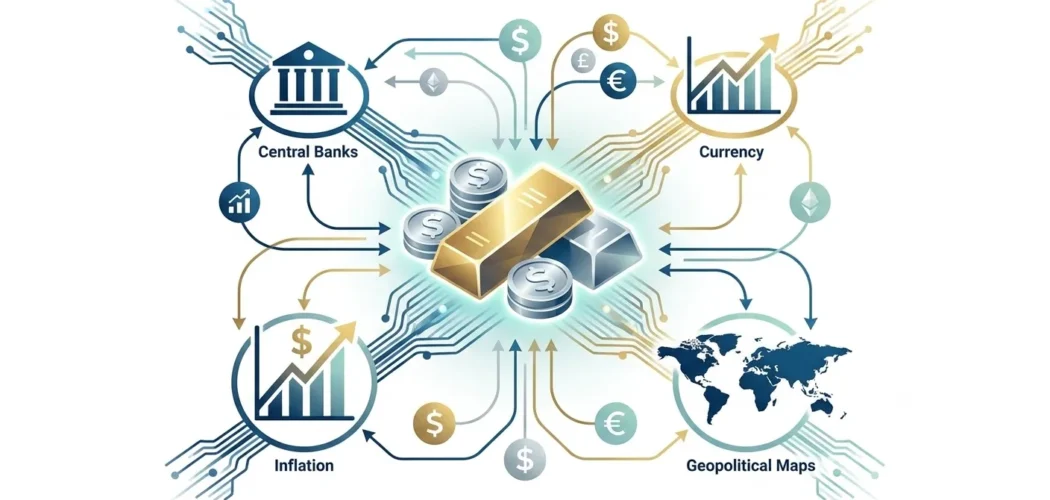
For investors like Sarah, understanding why gold and silver prices move the way they do is as important as knowing how they’ve performed. The macroeconomic impact precious metals experience is profound, with global economic indicators, central bank policies, and geopolitical events acting as powerful drivers. At Silver Price Gold, we demystify these complex forces, providing you with the context needed to make confident investment decisions. We aim to be your guiding mentor through the intricate world of precious metals investing, offering clarity and expert insights.
The Interplay of Global Economics and Precious Metals
Precious metals are not isolated commodities; they are integral players on the global economic stage, reacting to a confluence of forces. For example, the record-breaking price movements observed in 2025 and 2026 for both gold and silver were not random. In fact, they were a direct consequence of significant macroeconomic shifts. Understanding these underlying drivers helps to anticipate future trends and interpret market behavior more accurately. Consequently, a clear grasp of these dynamics empowers investors to make more informed choices.
Central Banks: A Pillar of Gold Demand
One of the most significant structural factors influencing gold prices is central bank accumulation. In 2026, an astounding 95% of central banks anticipated a rise in global gold reserves, demonstrating a strong, consistent demand from institutional players. Central banks often buy gold to diversify their reserves, hedge against currency fluctuations, and bolster financial stability, especially during periods of economic uncertainty. This consistent buying pressure provides a strong floor for gold prices and signals a long-term belief in gold’s value as a store of wealth. Furthermore, these actions highlight gold’s enduring role as a reliable asset.
Historically, central bank policies have played a pivotal role in shaping the demand landscape for gold. Their strategic purchases, often in response to global economic shifts or currency instability, can significantly influence market sentiment. For instance, when a nation’s currency faces devaluation pressures, its central bank might increase gold holdings to safeguard national wealth. This strategic behavior underscores gold’s function as a hedge against economic volatility, providing a tangible asset that retains value when fiat currencies waver. Therefore, monitoring central bank activities offers crucial insights into potential movements in gold prices.
Inflation, Geopolitical Uncertainty, and Currency Weakness
Inflation fears have been a persistent theme, particularly in 2025-2026, driving investors towards gold and silver as traditional hedges against the erosion of purchasing power. When currencies weaken, precious metals, which are finite and universally valued, tend to hold their value better. Geopolitical uncertainty, such as the ongoing Middle East conflict and the Russia/Ukraine war, further amplifies demand for safe-haven assets. In times of global instability, investors flock to gold and silver, viewing them as reliable stores of value when traditional markets appear risky. These factors collectively create a powerful tailwind for precious metals, influencing their significant price surges. For more context on such events, you can refer to our News section.
Consider, for example, the impact of rising interest rates on gold. While some might assume higher rates would deter gold investment, the reality is more nuanced. Often, rising rates are a response to inflationary pressures, which, in turn, can make gold more attractive as an inflation hedge. The relationship between Interest Rates and Gold is complex, but understanding it is vital for any investor. Consequently, investors must look beyond immediate headlines and consider the broader economic context.
The Dual Role of Silver: Industrial Demand Meets Investment Appeal
While gold is primarily seen as a monetary asset and safe haven, silver’s price dynamics are uniquely influenced by its dual demand base. Beyond its investment appeal, silver is indispensable in numerous industrial applications, including solar energy, electronics, and medical technology. Strong industrial demand for silver was a key factor in its explosive growth in 2025-2026. For example, the burgeoning green energy sector, with its reliance on silver for solar panels, creates a consistent demand stream that can significantly impact its price. This industrial utility provides a unique layer of support for silver prices, differentiating it from gold.
Furthermore, technological advancements continue to expand silver’s industrial footprint. New applications in areas like 5G technology and electric vehicles are constantly emerging, ensuring a robust demand outlook for the metal. This consistent industrial consumption, combined with its traditional role as an investment asset, means silver often exhibits higher volatility than gold. Investors looking into silver must therefore consider both its industrial utility and its investment characteristics. The Silver News August 2026 provides further insights into recent market developments.
Understanding the Macroeconomic Impact Precious Metals Face
To truly grasp the dynamics of gold and silver, one must consider a multitude of macroeconomic factors. These include, but are not limited to, global GDP growth, employment figures, manufacturing output, and consumer confidence. Each of these indicators, individually and collectively, contributes to the overall economic landscape that shapes demand and supply for precious metals. Therefore, a holistic approach to market analysis is essential. The latest market news often highlights these interconnections.
For instance, strong global economic growth typically correlates with increased industrial demand for silver, as manufacturing activities expand. Conversely, during periods of economic contraction, investors often seek the safe-haven appeal of gold. Understanding these cyclical patterns is crucial for anticipating price movements. The macroeconomic impact precious metals endure is a constant interplay of these forces, requiring continuous monitoring and informed interpretation.
Currency Fluctuations and Their Influence
The strength or weakness of major global currencies, particularly the U.S. dollar, has a profound macroeconomic impact precious metals experience. Since gold is primarily priced in U.S. dollars, a weaker dollar generally makes gold more affordable for investors holding other currencies, thereby increasing demand and pushing prices higher. Conversely, a stronger dollar can make gold more expensive, potentially dampening demand. This inverse relationship is a fundamental aspect of precious metals trading.
However, it is important to note that this relationship is not always straightforward. Other factors, such as interest rate differentials and global trade balances, also play a significant role in currency valuations. Therefore, while the dollar’s movement is a key indicator, it should be considered within the broader economic context. Moreover, other currencies like the Euro and Japanese Yen can also indirectly influence the global pricing of gold and silver.
The Role of Government Debt and Fiscal Policy
Rising government debt levels and expansive fiscal policies can also have a noticeable macroeconomic impact precious metals feel. When governments increase spending and accumulate debt, it can lead to concerns about inflation and currency debasement. In such scenarios, investors often turn to gold and silver as stores of value, perceiving them as more resilient than fiat currencies. This flight to safety can significantly boost demand for precious metals.
For example, sustained periods of quantitative easing or large-scale government stimulus packages often precede increased interest in gold. These policies, while intended to stimulate economic growth, can also dilute the purchasing power of currencies over time. Consequently, precious metals become an attractive hedge against such potential devaluation. The U.S. Treasury website provides data on government debt, which can offer insights into these trends.
Interest Rates and Opportunity Cost
Interest rates represent another critical component of the macroeconomic impact precious metals face. When real interest rates (nominal interest rates minus inflation) are low or negative, the opportunity cost of holding non-yielding assets like gold decreases. This makes gold more attractive compared to interest-bearing investments. Conversely, when real interest rates rise, the appeal of gold may diminish as investors opt for assets that provide a return.
However, this relationship is not always absolute. During periods of high inflation, even if nominal interest rates are rising, real rates might remain low or negative, keeping gold’s appeal intact. Therefore, it is the real interest rate, rather than just the nominal rate, that provides a more accurate picture of gold’s attractiveness. Understanding this dynamic is crucial for anticipating market shifts. The Federal Reserve’s stance on interest rates, often communicated through speeches and policy statements, is closely watched by precious metals investors. You can find more information on monetary policy from the Federal Reserve directly.
The Geopolitical Landscape: A Constant Influence
Geopolitical events, ranging from regional conflicts to global trade disputes, exert a substantial macroeconomic impact precious metals experience. In times of heightened political instability or military conflict, investors typically seek safe-haven assets. Gold, with its long history as a universal store of value, often benefits significantly from such uncertainty. Silver, while also a safe haven, tends to react more to industrial demand in these scenarios, though its investment appeal also strengthens.
The ongoing conflicts in the Middle East and Eastern Europe, for instance, have consistently underscored gold’s role as a crisis hedge. These events create a sense of global unease, prompting investors to reallocate capital towards assets perceived as more secure. Consequently, monitoring global political developments is an integral part of understanding precious metals market behavior. The perceived risk in the global system directly influences the demand for these tangible assets.
The Supply Side: Mining and Production
While demand-side factors often dominate discussions, the supply side also plays a critical role in the macroeconomic impact precious metals experience. Global mining output, discoveries of new deposits, and the cost of extraction all influence the availability of gold and silver. Significant disruptions to mining operations, whether due to political instability, labor disputes, or environmental regulations, can restrict supply and potentially lead to price increases.
For example, advances in mining technology can reduce extraction costs, potentially increasing supply. Conversely, declining ore grades in existing mines can make production more expensive, thus limiting supply growth. Therefore, analyzing Mining News provides valuable insights into the fundamental supply dynamics that underpin precious metals prices. The balance between global supply and demand ultimately dictates market equilibrium.
Commodity Cycles and Correlation
Precious metals are also influenced by broader commodity cycles. Their prices can correlate with other raw materials, reflecting general trends in global economic activity and inflation expectations. For example, during periods of strong global growth, industrial commodities tend to perform well, which can indirectly benefit silver due to its industrial applications. However, during downturns, gold’s safe-haven status often sees it decouple from broader commodity trends.
Understanding these correlations and divergences is key to developing a comprehensive investment strategy. The macroeconomic impact precious metals face is rarely isolated; instead, it is often intertwined with the performance of other asset classes. Therefore, a holistic view of the commodity market can provide additional context for precious metals investors.
Conclusion: Empowering Your Investment Journey
The macroeconomic impact precious metals undergo is a complex interplay of global forces. From central bank policies and inflation fears to geopolitical tensions and industrial demand, numerous factors shape the values of gold and silver. At Silver Price Gold, our goal is to empower you with the knowledge to confidently navigate these markets. By understanding these drivers, you gain a deeper appreciation for the intrinsic value and strategic role precious metals play in a diversified portfolio. We believe that clarity and confidence are the cornerstones of successful investing, and we are committed to being your trusted mentor on this journey.
FAQ
What are the primary economic factors influencing gold and silver prices?
The primary economic factors influencing gold and silver prices include central bank policies, inflation rates, interest rates, currency fluctuations (especially the U.S. dollar), and global economic growth. Geopolitical events and industrial demand for silver also play significant roles.
How do central banks affect precious metal values?
Central banks affect precious metal values primarily through their gold accumulation strategies. They buy gold to diversify reserves, hedge against currency instability, and enhance financial stability, creating consistent demand and providing a strong floor for gold prices.
Why are gold and silver considered hedges against inflation?
Gold and silver are considered hedges against inflation because they are finite assets that tend to retain their purchasing power when fiat currencies lose value. As the cost of goods and services rises, investors often turn to precious metals to preserve wealth.
What is the dual role of silver in the market?
Silver has a dual role as both an investment asset and an industrial commodity. Its industrial demand stems from applications in solar energy, electronics, and medical technology, which creates a unique demand base separate from its investment appeal.
How do geopolitical events impact the prices of gold and silver?
Geopolitical events, such as conflicts or political instability, increase uncertainty and fear in financial markets. This drives investors to seek safe-haven assets like gold and silver, leading to increased demand and often higher prices for these precious metals.
Does the strength of the U.S. dollar influence precious metal prices?
Yes, the strength of the U.S. dollar significantly influences precious metal prices. Since gold is typically priced in dollars, a weaker dollar makes gold cheaper for international buyers, boosting demand and often leading to higher prices. Conversely, a stronger dollar can make gold more expensive.

