

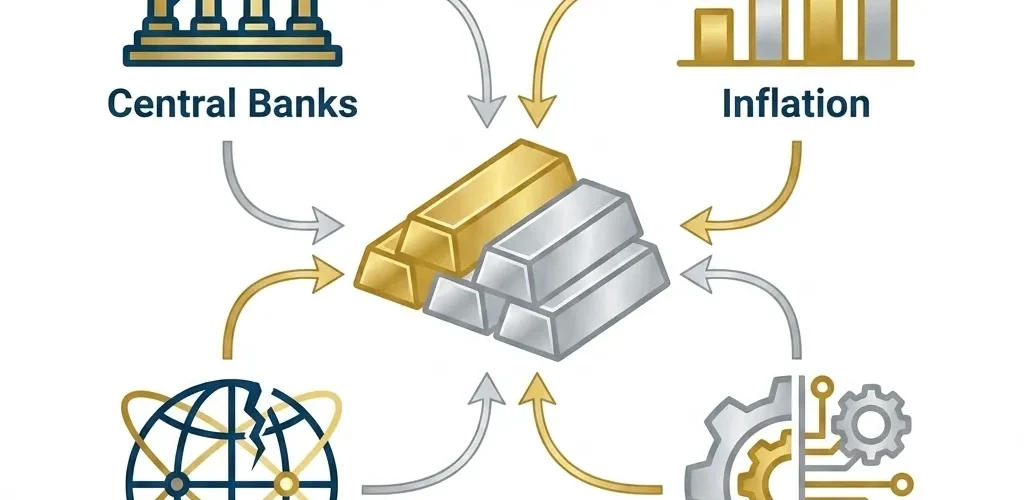
For any investor, especially a cautious newbie like Sarah looking to confidently navigate the world of gold and silver, understanding the larger economic currents is paramount. Precious metals do not exist in a vacuum; their prices are profoundly influenced by powerful macroeconomic forces precious metals investors must recognize. These forces dictate demand, supply, and investor sentiment, shaping the market’s direction.
The period of 2025-2026 offered a vivid illustration of these forces at play. Gold and silver experienced record-breaking price movements, driven by a confluence of economic, geopolitical, and industrial factors. Understanding these drivers transforms market noise into actionable insights, providing a structured and reliable foundation for your investment decisions.
Central Banks: The Quiet Giants of the Gold Market
One of the most significant structural factors influencing gold prices is central bank activity. Central banks globally have been steadily accumulating gold, a trend that accelerated in recent years. In fact, 95% of central banks expect their global gold reserves to rise in 2026. This consistent institutional demand provides a strong floor for gold prices and signals confidence in gold as a reserve asset.
Their actions are driven by a desire to diversify reserves, hedge against currency fluctuations, and stabilize national economies. When central banks buy, it sends a powerful message about gold’s enduring value, a signal that even new investors can interpret to their advantage.
Inflation Fears and Currency Weakness
Inflation has been a persistent concern, and this fear directly impacts precious metals. Gold is widely regarded as a hedge against inflation, meaning its value tends to rise as the purchasing power of fiat currencies declines. Similarly, a weakening U.S. dollar makes dollar-denominated gold and silver more attractive and affordable for international buyers, boosting demand. These are classic macroeconomic forces precious metals respond to.
The provided trends show that inflation fears were key drivers for price surges in 2025-2026, demonstrating this inverse relationship. For Sarah, recognizing this connection means understanding that gold and silver can act as a protective layer against economic instability. You can learn more about how gold looks to PCE inflation for direction.
Geopolitical Uncertainty: The Safe-Haven Appeal
Global instability, such as the Middle East conflict and the Russia/Ukraine war, consistently drives investors towards safe-haven assets. In times of geopolitical turmoil, confidence in traditional financial systems can waver, leading a flight to tangible assets like gold and silver. These metals offer a sense of security and stability when the world feels unpredictable.
This safe-haven demand was a significant factor behind the price surges observed in 2025-2026, illustrating how global events translate directly into precious metals markets. Notably, US support for the Iran war falls, which can influence geopolitical stability.
Interest Rates and Opportunity Cost
Interest rates are another critical component of the macroeconomic forces precious metals investors must track. Gold and silver do not offer interest or dividends, unlike bonds or savings accounts. Therefore, when interest rates rise, the opportunity cost of holding precious metals increases. Investors might prefer interest-bearing assets over non-yielding gold or silver, potentially reducing demand for the latter.
Conversely, low interest rates make precious metals more appealing. This is because the return on traditional fixed-income investments becomes less attractive, prompting investors to seek alternatives that can preserve or grow their wealth. The impact of interest rates on precious metals is a nuanced relationship that requires careful consideration. For a deeper understanding, explore our article on Interest Rates and Gold: How Rates Affect Prices.
The Role of Economic Growth and Industrial Demand
While gold is primarily an investment and store of value, silver has significant industrial applications. It is used in electronics, solar panels, and medical devices. Consequently, global economic growth directly impacts silver demand. A robust economy often translates to increased industrial production, which in turn boosts the need for silver. This interplay between economic expansion and industrial consumption is a key aspect of the economic factors influencing silver.
For gold, strong economic growth can sometimes temper its safe-haven appeal as investor confidence in other asset classes rises. However, sustained growth can also lead to inflationary pressures, which, as discussed, tends to support gold prices. These diverse economic factors influencing precious metals require careful observation.
Understanding Supply and Demand Dynamics
The fundamental principles of supply and demand also exert considerable influence. Mine production, recycling, and speculative trading all contribute to the supply side. Meanwhile, demand comes from jewelry, industrial use, central bank purchases, and individual investors. Disruptions in mining operations, for example, can restrict supply and potentially drive prices higher. Similarly, technological advancements that increase industrial demand for silver can significantly impact its market value.
These supply and demand dynamics are constantly shifting. Therefore, staying informed about mining news and overall market conditions is essential for making informed investment decisions. This is one of the more tangible economic influences on precious metals.
The Impact of Government Debt and Fiscal Policy
Government debt levels and fiscal policies are increasingly recognized as critical macroeconomic forces precious metals investors need to monitor. When governments accumulate large amounts of debt, it can lead to concerns about sovereign creditworthiness and the stability of national currencies. In such scenarios, investors often turn to gold as a hedge against potential economic instability and currency devaluation.
Fiscal policies, including government spending and taxation, also play a role. Expansionary fiscal policies, such as significant stimulus packages, can inject liquidity into the economy, potentially leading to inflation. This environment is typically favorable for gold and silver. Conversely, austerity measures might reduce inflationary pressures but could also signal slower economic growth, affecting industrial demand for silver. Thus, understanding these governmental decisions is vital for precious metals investors. For example, the US Treasury’s debt auction schedule offers insights into fiscal planning.
Financial Market Volatility and Risk Aversion
Periods of heightened volatility in global financial markets often lead to increased demand for precious metals. When stock markets experience significant downturns or bond markets show signs of stress, investors seek refuge in assets perceived as less risky. Gold and silver, with their long history as stores of value, frequently fulfill this safe-haven role.
Risk aversion, a psychological factor, drives this behavior. During uncertain times, investors prioritize capital preservation over high returns, and precious metals offer a tangible asset that can provide stability. These moments of market turbulence highlight the enduring appeal of gold and silver as protective assets. This is why many consider these metals crucial for mitigating risk in a diverse portfolio. These are indeed strong macroeconomic forces precious metals investors must consider.
Global Trade Balances and Currency Markets
Global trade balances, specifically current account deficits or surpluses, can influence currency valuations, which in turn affect precious metal prices. Countries with persistent trade deficits may see their currencies weaken, making dollar-denominated gold and silver more attractive to international buyers. Conversely, strong trade surpluses can bolster a currency, potentially making precious metals less appealing.
Furthermore, the U.S. dollar’s strength or weakness against other major currencies is a direct driver. A stronger dollar generally makes gold and silver more expensive for holders of other currencies, potentially dampening demand. Conversely, a weaker dollar typically makes them more affordable and boosts demand. These currency market dynamics are critical macroeconomic forces precious metals investors monitor closely. For instance, gold rises while silver slips sometimes due to these fiscal and currency dynamics.
The Influence of Commodity Prices
The broader commodity market also plays a role. While precious metals have unique characteristics, they are part of the larger commodity complex. Trends in energy prices, industrial metals, and agricultural commodities can sometimes signal broader inflationary or deflationary pressures, which then impact gold and silver. For example, rising oil prices can contribute to inflation, which is generally positive for gold.
However, the relationship is not always straightforward. Sometimes, capital flows into the broader commodity sector can lift all boats, including precious metals. At other times, a strong performance in one commodity sector might draw investment away from another. Therefore, observing the overall commodity landscape provides additional context for understanding the macroeconomic forces precious metals markets face.
Technological Advancements and Demand
Technological advancements, particularly in industries that heavily utilize silver, can significantly shift demand patterns. The rapid expansion of solar energy, for example, has increased the demand for silver in photovoltaic cells. Similarly, innovations in electronics and medical technology continue to find new applications for silver, creating a steady stream of industrial demand.
These technological developments represent an evolving aspect of the macroeconomic forces precious metals markets contend with. While not a traditional macroeconomic factor, the collective impact of these industry-specific demands can become a substantial driver for silver prices over the long term, offering a unique perspective on supply and demand dynamics.
Understanding Investor Sentiment and Psychology
Beyond the quantifiable economic data, investor sentiment and market psychology are powerful, albeit less tangible, macroeconomic forces precious metals investors must consider. Fear, greed, and confidence can drive significant capital flows into or out of precious metals. During periods of heightened fear or uncertainty, investors often flock to gold and silver, even if fundamental economic indicators don’t fully justify the movement.
Conversely, periods of extreme optimism in equity markets might divert attention and capital away from precious metals. Understanding these psychological currents, often reflected in market news and analyst commentary, provides a crucial layer of insight into market behavior. For example, after gold smashes $4,600/oz, investor sentiment can shift dramatically.
The Global Economic Outlook: A Comprehensive View
Ultimately, all these individual factors converge into a broader global economic outlook, which is perhaps the most encompassing of the macroeconomic forces precious metals investors navigate. Is the global economy expanding or contracting? Are trade tensions escalating or de-escalating? Are central banks signaling tighter or looser monetary policies?
The answers to these questions paint a picture of the overall economic environment. Precious metals often perform well during periods of economic uncertainty, high inflation, or geopolitical stress. Conversely, a stable, growing global economy with low inflation and rising interest rates can present headwinds. Therefore, maintaining a comprehensive view of the global economic landscape is essential for strategic precious metals investing.
Conclusion: Navigating the Economic Landscape with Confidence
For individuals like Sarah, who are embarking on their precious metals investment journey, recognizing these profound macroeconomic forces precious metals markets respond to is not just helpful; it is empowering. From the strategic gold accumulation by central banks to the protective appeal during geopolitical strife, and the intricate dance with interest rates and currency values, these forces are the unseen architects of market movements.
By understanding how inflation, economic growth, and global events shape the demand and supply of gold and silver, investors can move beyond reacting to daily price fluctuations. Instead, they can develop a structured, reliable, and expert-led approach to confidently navigate precious metals investments. This knowledge transforms market noise into clear signals, allowing you to make informed decisions and build a resilient portfolio. Equip yourself with this understanding, and you will be well-prepared to thrive in the dynamic world of gold and silver.
FAQ Section
How do global interest rates affect gold and silver prices?
Global interest rates impact the opportunity cost of holding precious metals. When rates rise, investors might prefer interest-bearing assets, potentially reducing demand for non-yielding gold and silver. Conversely, low rates make these metals more attractive as alternative investments.
Why are precious metals considered a hedge against inflation?
Gold and silver are seen as hedges against inflation because their value tends to increase as the purchasing power of fiat currencies declines due to rising prices. They act as a store of value, preserving wealth during inflationary periods.
What role do central banks play in the gold market?
Central banks are significant buyers of gold, accumulating it to diversify reserves, hedge against currency fluctuations, and stabilize national economies. Their consistent demand provides a strong floor for gold prices and signals confidence in its long-term value.
How does geopolitical instability influence demand for precious metals?
Geopolitical instability, such as conflicts or political crises, often leads investors to seek safe-haven assets. Gold and silver, being tangible assets, offer a sense of security and stability when traditional financial systems face uncertainty, thus boosting demand.
What is the relationship between the U.S. dollar and precious metal prices?
A weakening U.S. dollar typically makes dollar-denominated gold and silver more affordable and attractive for international buyers, increasing demand and potentially prices. Conversely, a stronger dollar can make them more expensive, dampening demand.

