

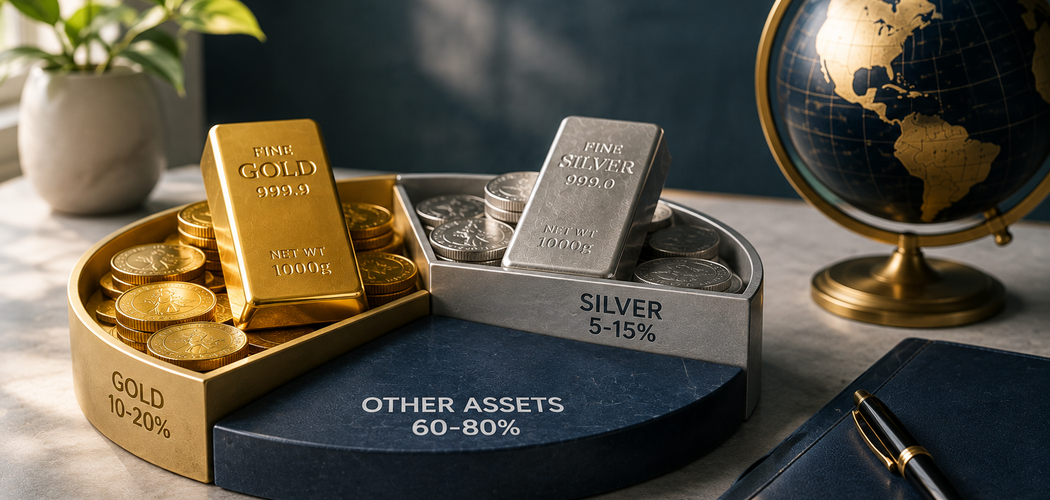
Gold and silver can provide diversification, but deciding to own precious metals is only the beginning. Investors must also determine how much exposure makes sense. A well-planned gold and silver allocation should reflect financial goals, risk tolerance, time horizon, liquidity needs, and the rest of the portfolio.
There is no universal percentage that works for everyone.
Someone focused on long-term growth may approach precious metals differently from a retiree seeking additional diversification. Likewise, an investor with substantial commodity exposure may need less than someone whose portfolio consists almost entirely of stocks and bonds.
Gold and silver also behave differently.
Gold has a stronger monetary and defensive role. Silver combines investment demand with extensive industrial use. Therefore, silver often experiences larger price swings.
The goal is not to find a perfect percentage. Instead, investors should build an allocation that has a clear purpose and remains manageable through changing market conditions.
Why Portfolio Allocation Matters
Asset allocation determines how an investor divides money among different types of investments.
Stocks may provide long-term growth. Bonds can offer income and relative stability. Cash provides liquidity, while property and other assets can add additional diversification.
Precious metals can serve another role.
Gold and silver respond to factors such as inflation expectations, real interest rates, currencies, geopolitical risk, physical supply, and investor sentiment.
Because these drivers differ from those affecting many traditional assets, precious metals may help diversify a portfolio.
However, adding too much can create concentration risk.
A gold and silver allocation should therefore complement other assets rather than replace them without a clear reason.
The appropriate amount depends on what investors want precious metals to accomplish.
Start by Defining the Purpose
Before choosing a percentage, ask why you want gold and silver.
Some investors want additional diversification.
Others worry about inflation or currency purchasing power. Some value physical bullion because it represents a tangible asset.
Another investor may simply expect precious metal prices to rise.
These motivations are different.
An investor seeking diversification may prefer a stable strategic allocation that remains in the portfolio for years.
Someone making a tactical price prediction may change exposure more frequently.
Mixing these objectives can create confusion.
Therefore, write down the purpose first.
If gold and silver are intended to support long-term diversification, allocation decisions should focus on portfolio structure rather than short-term headlines.
Understand Gold’s Role First
Gold generally has a stronger monetary identity than silver.
Central banks hold gold as part of their reserves. Investors also use it for diversification, while jewelry creates another major source of demand.
Physical gold does not generate interest or dividends.
However, it also does not represent ownership in a company or a promise from a borrower.
These characteristics make gold different from stocks and bonds.
As a result, some investors use gold to diversify financial asset exposure.
Still, gold can decline substantially.
It can also experience long periods when stocks or other productive assets outperform.
Therefore, increasing gold exposure involves a trade-off.
Investors gain different market characteristics but reduce the portion of capital available for income-producing or growth-oriented assets.
Understand Silver’s Different Risk Profile
Silver shares some of gold’s investment characteristics.
However, industrial consumption plays a much larger role.
Silver appears in electronics, electrical equipment, automobiles, solar technology, and other applications.
Therefore, economic growth can strongly influence demand.
This industrial exposure may provide additional upside during periods of strong manufacturing activity.
However, it can also increase downside risk during recessions.
Silver is generally more volatile than gold.
Consequently, a gold and silver allocation that divides money equally between the two metals may not divide risk equally.
A smaller silver position can still contribute significant volatility.
Investors should therefore consider the behavior of each metal rather than simply splitting their precious metal budget in half.
There Is No Perfect Percentage
Investors often search for one ideal precious metal percentage.
Unfortunately, personal finance rarely works that way.
The appropriate allocation depends on several variables.
A younger investor with stable income and decades before retirement may prioritize productive growth assets.
A retiree drawing money from investments may focus more heavily on liquidity and risk management.
Someone with a large emergency fund may have greater flexibility than someone with limited cash reserves.
Existing investments matter too.
For example, mining stocks already create sensitivity to precious metal prices, although mining companies are not substitutes for bullion.
Instead of asking for the perfect percentage, investors should ask how much precious metal exposure their broader financial plan can reasonably support.
A Small Allocation Can Still Matter
Investors do not necessarily need a large precious metal position for it to affect portfolio behavior.
Even a relatively modest allocation creates exposure to gold and silver price movements.
This can be useful for investors who primarily want diversification while keeping most of their capital in productive assets.
A smaller allocation may also be easier to maintain emotionally.
Precious metals can experience periods of weak performance while stocks are rising.
Investors with extremely large positions may become frustrated and abandon the strategy.
Conversely, a manageable allocation can remain part of the portfolio without dominating every financial decision.
Therefore, beginning conservatively can make sense for investors who are uncertain about their long-term precious metal strategy.
Moderate Exposure Can Increase Diversification
Some investors may choose a more meaningful precious metal position because they want stronger diversification.
This approach can increase the effect that gold and silver have on overall portfolio returns.
However, greater exposure also increases the consequences of precious metal declines.
That trade-off should be understood before investing.
Suppose gold and silver experience a prolonged bear market.
A portfolio with modest exposure may feel only a limited effect.
A portfolio with a very large gold and silver allocation could experience much greater pressure.
Therefore, increasing exposure should result from a deliberate financial plan rather than fear about the economy or excitement after a rally.
More Precious Metals Means Less of Something Else
Every allocation decision has an opportunity cost.
Money invested in bullion cannot simultaneously be invested in stocks, bonds, property, or cash.
Investors should evaluate what they are reducing when they increase precious metal exposure.
Age Can Influence the Decision
Age can affect portfolio construction, but it should not determine the allocation alone.
Younger investors often have longer time horizons.
They may be able to tolerate larger stock market fluctuations because they have decades before needing the money.
Productive assets can also compound over long periods.
Therefore, an excessive precious metal position could reduce long-term growth potential.
Investors approaching retirement face different challenges.
They may care more about diversification and avoiding severe losses shortly before withdrawals begin.
However, retirees still need growth because retirement can last decades.
Gold and silver can contribute diversification, but they do not automatically become more appropriate simply because someone is older.
The complete financial situation matters more than age alone.
Risk Tolerance Is Equally Important
Two investors of the same age can have very different risk tolerances.
One may remain calm during a 30% market decline.
Another may sell after a much smaller loss.
Precious metals do not eliminate volatility.
Silver, in particular, can experience substantial price movements.
Therefore, investors should consider whether they can maintain their allocation through difficult periods.
A strategy that looks excellent on paper can fail if the investor abandons it during the first major decline.
A sustainable gold and silver allocation should match both financial capacity and emotional tolerance for market fluctuations.
This is especially important when choosing the balance between gold and silver.
Time Horizon Changes the Strategy
When will the money be needed?
That question should influence nearly every investment decision.
Money required next month should generally not depend on volatile precious metal prices.
Long-term capital provides more flexibility.
An investor saving for retirement decades away may be able to tolerate temporary gold and silver declines.
Someone planning a major purchase next year has less flexibility.
Therefore, precious metals should generally be separated from money needed for near-term expenses.
The longer the investment horizon, the more time an investor has to experience complete market cycles.
Still, a long horizon does not guarantee positive returns.
It simply increases the ability to tolerate temporary volatility.
Emergency Savings Should Come First
Before building a significant precious metal position, investors should consider emergency savings.
Unexpected expenses are unavoidable.
Job loss, medical costs, repairs, family emergencies, and other financial shocks may require immediate liquidity.
Cash is usually better suited to these situations.
Physical bullion can be sold, but transaction spreads and price fluctuations create uncertainty.
Selling may also require contacting a dealer and transporting the metal.
Therefore, gold and silver should not automatically replace emergency cash.
Establishing a financial buffer first can make a long-term gold and silver allocation easier to maintain because investors are less likely to sell precious metals unexpectedly.
Debt Can Change the Calculation
High-interest debt deserves attention before aggressive precious metal investing.
Suppose an investor pays a very high annual interest rate on credit card debt.
Gold or silver would need to generate substantial returns simply to compete with the guaranteed cost of that debt.
Precious metal returns are uncertain.
Debt interest is contractual.
Therefore, reducing expensive debt may provide a stronger financial benefit than increasing bullion exposure.
Lower-cost debt creates a more complicated decision.
Mortgages and other loans may fit within a broader financial plan.
Still, investors should evaluate liabilities alongside assets.
Portfolio allocation cannot be separated completely from household finances.
Gold May Deserve a Larger Share Than Silver
Investors do not need to divide precious metal exposure equally.
Gold’s generally lower volatility and stronger monetary role may make it the core holding for investors focused on diversification.
Silver can then serve as a complementary position.
This structure may be particularly useful for conservative investors.
However, someone who expects strong industrial demand and can tolerate greater volatility might choose more silver.
The decision should reflect risk rather than the price per ounce.
Silver appearing cheaper than gold does not mean it is automatically undervalued.
A sensible gold and silver allocation considers each metal’s market behavior, demand structure, and volatility.
Physical Metals Require Special Planning
Physical bullion creates allocation challenges that financial products do not.
Investors must consider storage.
A small gold position can hold significant value in limited space.
Silver requires much more physical volume for the same dollar amount.
Security is another consideration.
Home storage provides direct access but creates theft risk.
Professional vaulting can improve security but introduces ongoing fees.
Dealer premiums also matter.
Coins and small bars generally cost more than the underlying spot value.
Therefore, investors should calculate their allocation using actual purchase costs rather than simply multiplying spot prices by ounces.
ETFs Can Simplify Allocation Management
Exchange-traded precious metal products can make portfolio management easier.
Investors can purchase precise dollar amounts through brokerage accounts.
They can also sell positions quickly when rebalancing becomes necessary.
This convenience can be useful for maintaining a target gold and silver allocation.
However, funds introduce their own considerations.
Management expenses can reduce returns over time.
Investors should also understand how each product obtains precious metal exposure.
Some hold physical bullion, while others may use different structures.
Mining funds are another category entirely.
They own shares in mining businesses rather than metal itself.
Therefore, investors should understand what they actually own before using a product as part of their allocation.
Mining Stocks Are Not the Same as Bullion
Mining companies can benefit significantly when gold or silver prices rise.
Higher metal prices may increase revenue and profit margins.
However, mining shares introduce business risks.
Companies face labor expenses, energy costs, debt, management decisions, equipment failures, political risks, and geological uncertainty.
A mine can perform poorly even when gold prices rise.
Likewise, a well-managed company can sometimes perform strongly while bullion prices remain relatively stable.
Therefore, investors should not count mining shares as identical to physical precious metals.
They can complement a gold and silver allocation, but their risk characteristics are different.
This distinction is especially important for investors who already own commodity or mining funds.
Dollar-Cost Averaging Can Build Exposure Gradually
Investors do not need to reach their target allocation immediately.
Dollar-cost averaging can spread purchases across several months.
Suppose an investor wants to build a precious metal position.
Instead of making one large purchase, the investor can contribute a fixed amount on a regular schedule.
This reduces dependence on one entry price.
However, gradual investing does not guarantee better returns.
If prices rise consistently, investing earlier would have produced stronger results.
Physical bullion buyers should also consider premiums and shipping costs.
Too many small purchases can become inefficient.
Therefore, the purchasing schedule should balance timing risk with transaction costs.
Rebalancing Keeps the Allocation on Target
Suppose an investor begins with a carefully selected precious metal percentage.
Gold then experiences a powerful rally.
After several years, precious metals represent a much larger portion of the portfolio.
The original risk profile has changed.
Rebalancing restores the intended structure.
Investors may sell part of an overweight position or direct new contributions toward other assets.
The opposite applies after precious metal declines.
If exposure falls below the desired range, new contributions can potentially rebuild it.
Rebalancing makes gold and silver allocation a disciplined process rather than an emotional reaction to market movements.
Calendar Rebalancing Is Simple
One method is to review the portfolio on a regular schedule.
For example, investors might examine allocations every six or twelve months.
This approach is easy to follow.
It also prevents constant trading.
A portfolio does not need to be adjusted whenever gold moves slightly.
Regular reviews provide enough structure to identify major changes without encouraging overreaction.
However, calendar rebalancing may sometimes require action even when allocations remain close to target.
Investors can therefore combine scheduled reviews with tolerance ranges.
The review occurs regularly, but trades happen only when the portfolio has moved meaningfully away from its intended structure.
Tolerance Bands Can Reduce Unnecessary Trading
A tolerance band establishes an acceptable range around the target.
Suppose an investor has a predetermined precious metal allocation.
Small movements within an acceptable range require no action.
A major rally or decline that pushes exposure beyond the range triggers a review.
This method can reduce unnecessary transactions.
It can also encourage disciplined behavior.
Investors naturally trim assets after strong relative performance and add to underweight areas after weakness.
However, transaction costs and taxes should be considered before selling.
In some cases, directing new contributions toward underweight assets can restore balance without selling existing holdings.
Inflation Concerns Should Not Control Everything
Inflation is one reason investors consider precious metals.
Gold has historically attracted interest when people worry about currency purchasing power.
However, gold does not track inflation perfectly.
It can decline during inflationary periods, particularly when central banks respond with higher real interest rates.
Silver faces additional industrial forces.
Therefore, investors should avoid building an oversized precious metal position solely because inflation is currently high.
Inflation can eventually fall.
Monetary policy can change.
A long-term gold and silver allocation should remain useful across several possible environments rather than depending on one economic forecast.
Do Not Build an Allocation Around Fear
Financial crises generate dramatic headlines.
Predictions of currency collapse, banking failures, runaway inflation, or stock market crashes can make investors feel that they must own enormous amounts of gold.
Fear can lead to concentration.
Even if the economic concern is legitimate, the investment response may still be excessive.
Precious metals can decline.
They also produce no dividends or interest when held physically.
Therefore, moving most financial assets into bullion introduces new risks while attempting to solve others.
A diversified portfolio acknowledges uncertainty.
It does not require investors to know exactly which crisis will occur next.
Do Not Chase Precious Metals After a Rally
Fear of missing out creates the opposite problem.
Suppose gold rises dramatically and financial media begins discussing new record prices.
Investors who previously had little interest may suddenly want a large position.
Buying after a major rally can expose the portfolio to a correction.
Silver can be particularly vulnerable because its movements are often more volatile.
Instead, investors should return to their target allocation.
If precious metals belong in the portfolio, purchases can follow the established plan.
If they do not, a rising price alone is not enough reason to change the strategy.
Allocation discipline helps separate investment planning from market excitement.
Consider Your Existing Portfolio
Precious metal exposure should not be evaluated in isolation.
An investor heavily concentrated in technology stocks may benefit differently from diversification than someone already holding commodities, real estate, and mining shares.
Likewise, a portfolio with significant international assets may already have meaningful currency diversification.
Investors should examine how gold and silver interact with what they already own.
The goal is not simply to add more assets.
The goal is to create a portfolio in which different holdings perform different jobs.
This broader perspective makes gold and silver allocation more useful because it connects precious metals to total portfolio risk.
Create a Simple Allocation Framework
Investors can follow a straightforward process.
First, define the purpose of precious metals.
Next, establish emergency savings and address expensive debt.
Review the current portfolio and identify existing commodity exposure.
Then consider risk tolerance and time horizon.
Decide whether gold should form the core precious metal position and whether silver should provide complementary exposure.
Choose between physical bullion, financial products, or a combination.
Establish a target range rather than obsessing over one exact percentage.
Finally, create rebalancing rules.
This framework keeps allocation decisions consistent even when markets become volatile.
Review the Strategy When Life Changes
A precious metal allocation should not remain unchanged simply because it worked in the past.
Life circumstances evolve.
Income can increase or decrease.
Investors may buy property, start families, inherit assets, retire, or experience major changes in expenses.
Risk tolerance can also change.
Therefore, portfolio reviews should consider personal circumstances alongside market performance.
A young investor may eventually need more liquidity.
A retiree may discover that income-producing investments deserve greater emphasis.
The objective is not constant adjustment.
Instead, investors should ensure that the portfolio continues supporting real financial goals.
Common Allocation Mistakes
One mistake is choosing an arbitrary percentage because someone online recommended it.
Another is dividing equally between gold and silver without considering their different volatility.
Some investors count mining stocks as direct bullion exposure.
Others invest money that should remain available for emergencies.
Failing to rebalance is another common problem.
A successful precious metal rally can quietly turn a modest position into a large concentration.
Investors may also underestimate premiums, storage expenses, taxes, and fund fees.
Finally, fear and excitement can cause sudden allocation changes.
Avoiding these mistakes can make precious metal investing more disciplined and sustainable.
Think in Terms of Portfolio Roles
Each asset should have a reason for being owned.
Stocks may provide growth.
Bonds can contribute income and stability.
Cash provides immediate liquidity.
Property may provide income and tangible asset exposure.
Gold can add monetary and defensive diversification.
Silver adds precious metal exposure combined with industrial sensitivity.
Thinking in roles makes portfolio construction clearer.
Instead of asking whether gold is better than stocks, investors can ask what each asset contributes.
A thoughtful gold and silver allocation then becomes one piece of a broader financial system.
No single asset needs to solve every problem.
Conclusion
There is no perfect amount of gold and silver for every investor.
The right allocation depends on financial goals, time horizon, risk tolerance, liquidity needs, existing investments, and the intended role of precious metals.
Gold generally offers a more defensive precious metal profile.
Silver brings greater industrial exposure and usually higher volatility.
Therefore, investors should not assume that equal dollar amounts create equal risk.
A successful gold and silver allocation should also leave room for other important assets.
Cash provides liquidity. Bonds can provide income, while stocks and other productive assets offer long-term growth potential.
Precious metals can complement these holdings through diversification.
Investors should establish their target before market excitement or fear influences decisions.
Gradual purchases can reduce timing pressure, while periodic rebalancing can prevent precious metals from becoming an unintended concentration.
Ultimately, the strongest gold and silver allocation is not the one with the most gold or silver. It is the one that supports a diversified portfolio, matches the investor’s financial circumstances, and remains sustainable across different market environments.
FAQ
1. How Much of a Portfolio Should Be in Precious Metals?
There is no universal percentage. The appropriate amount depends on risk tolerance, investment goals, time horizon, liquidity needs, and existing portfolio exposure.
2. Should I Own More Gold or Silver?
Gold generally has lower volatility and a stronger monetary role. Silver offers greater industrial exposure and can experience larger price swings. Your preferred balance should reflect your objectives.
3. Is It Better to Buy Precious Metals All at Once?
Not necessarily. Investors can build exposure gradually to spread entry points. However, dollar-cost averaging does not guarantee better returns than investing a lump sum.
4. How Often Should I Rebalance Gold and Silver?
Investors can review their portfolio periodically, such as every six or twelve months. Tolerance bands can also help identify when an allocation has moved far enough to require action.
5. Can Gold and Silver Replace Stocks and Bonds?
Precious metals serve different purposes and generally do not produce income when held physically. A gold and silver allocation is usually most useful when it complements a diversified mix of growth, income, and liquid assets.

