

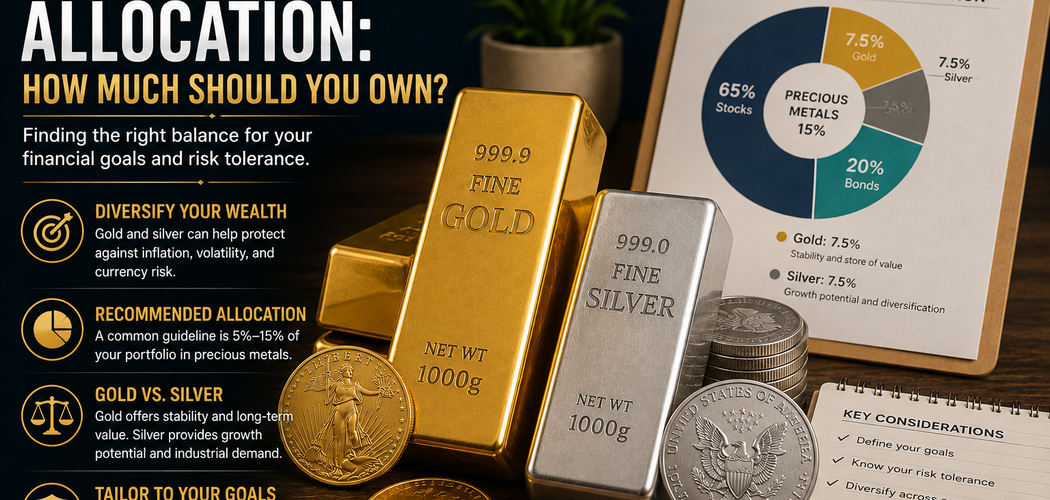
Gold and silver can provide valuable diversification, but deciding to own precious metals is only the first step. Investors must also decide how large their gold and silver allocation should be and how the two metals should fit alongside stocks, bonds, cash, real estate, and other assets.
There is no universal percentage that works for everyone. A younger investor seeking long-term growth may have different needs from someone approaching retirement. Income stability, liquidity needs, risk tolerance, and existing investments also matter.
Gold and silver themselves have different characteristics. Gold has a stronger monetary and defensive role. Silver combines precious metal demand with significant industrial use, which often makes its price more volatile.
Therefore, allocation decisions should begin with portfolio goals rather than predictions about the next gold or silver rally. Investors can then establish reasonable targets, monitor their exposure, and rebalance as markets and personal circumstances change.
Why Portfolio Allocation Matters
Asset allocation determines how an investor divides money among different investments.
This decision can significantly affect both risk and long-term returns.
For example, stocks may provide strong growth potential but can experience substantial declines. Bonds can offer income and stability, although inflation and changing interest rates create risks. Cash provides liquidity but may lose purchasing power.
Precious metals offer another set of characteristics.
Gold can respond to monetary conditions, currencies, central bank activity, and financial uncertainty. Silver shares some of those influences while also responding strongly to industrial conditions.
A gold and silver allocation can therefore add exposure to market forces that differ from those driving traditional investments.
However, adding an asset does not automatically improve a portfolio. The position must be appropriately sized.
Too little exposure may have almost no impact. Too much can create concentration risk.
There Is No Perfect Precious Metals Percentage
Investors often search for one ideal allocation.
Some may ask whether 5%, 10%, or 20% should be held in precious metals. Yet no fixed percentage can account for every financial situation.
Consider two investors.
The first has decades before retirement, stable income, significant emergency savings, and a diversified portfolio. The second plans to retire soon and expects to use investment assets for living expenses.
Their priorities are different.
Likewise, someone who owns substantial mining stocks already has indirect exposure to precious metal markets. Another investor may have none.
Therefore, the appropriate gold and silver allocation should reflect the entire financial picture.
Instead of asking what everyone else owns, investors can ask how precious metals change their own portfolio’s risk.
That question provides a more useful starting point.
Start With the Purpose of the Investment
Before choosing a percentage, determine why precious metals belong in the portfolio.
Possible goals include diversification, purchasing-power preservation, exposure to commodities, or reducing dependence on financial assets.
Different goals may justify different allocations.
Without a clear purpose, investors can easily increase their holdings simply because prices are rising.
Understand Gold’s Portfolio Role
Gold is widely viewed as both an investment asset and a store of value.
Its market responds to several forces, including real interest rates, the U.S. dollar, central bank purchases, geopolitical uncertainty, and investor demand.
Gold also differs from stocks.
Owning bullion does not represent ownership in a business. Therefore, gold prices do not depend directly on corporate earnings.
This difference can provide diversification.
During some periods of financial stress, gold has performed differently from equities. However, it does not rise during every stock-market decline.
Gold can also experience significant corrections.
Therefore, investors should view it as a diversifier rather than guaranteed insurance.
Within a gold and silver allocation, gold may serve as the more defensive component because its industrial exposure is relatively limited compared with silver.
Understand Silver’s Portfolio Role
Silver has a dual identity.
Investors purchase it as a precious metal, but manufacturers also consume large quantities.
Electronics, electrical systems, automobiles, solar technologies, and industrial equipment can all use silver.
This creates additional opportunities and risks.
Strong manufacturing activity may support demand. Technological development and electrification can also contribute to long-term consumption.
However, recessions can weaken industrial expectations.
Silver’s smaller market can amplify price movements as well. As a result, it often experiences larger percentage gains and losses than gold.
Investors should account for this volatility when designing their gold and silver allocation.
An equal dollar amount in each metal does not necessarily create equal risk.
A smaller silver position may still contribute significant volatility.
A Conservative Investor May Favor Gold
Risk tolerance should influence the mix between the two metals.
An investor primarily interested in defensive diversification may prefer a larger share of gold.
Gold’s deeper market and stronger monetary role can make it more suitable for investors who want precious metal exposure without taking as much of silver’s cyclical risk.
That does not make gold low-risk.
Prices can still decline substantially. Higher real yields, a stronger dollar, weaker investment demand, or changing market expectations can all create pressure.
However, silver’s additional industrial sensitivity usually makes its movements more aggressive.
Therefore, a conservative precious metal portfolio might place greater emphasis on gold while maintaining a smaller silver position.
The exact proportions should depend on personal circumstances rather than a universal formula.
Aggressive Investors May Accept More Silver
Some investors are willing to tolerate greater volatility in exchange for potentially stronger price movements.
Silver may appeal to this group.
During powerful precious metal rallies, silver can sometimes outperform gold on a percentage basis. Industrial growth can also provide another demand source.
However, higher upside potential comes with higher downside risk.
Silver can fall quickly when investor sentiment weakens or economic expectations deteriorate.
Therefore, increasing silver within a gold and silver allocation should be treated as an increase in risk rather than simply an increase in diversification.
Investors should consider whether they could remain committed after a major decline.
If a sharp correction would cause panic selling, the position may be too aggressive.
Your Age Is Only One Factor
Age often influences investment planning, but it should not determine precious metal exposure by itself.
Younger investors generally have more time to recover from market declines. Therefore, they may prioritize growth assets such as stocks.
However, a younger investor with low risk tolerance may still value diversification.
Older investors may prioritize capital preservation and liquidity. Yet they may also need growth to support a long retirement.
Income sources matter too.
Someone with stable pension income has different needs from someone relying entirely on investment withdrawals.
Therefore, age should be considered alongside income, expenses, time horizon, debt, savings, and financial objectives.
A gold and silver allocation should reflect how all these factors interact.
Emergency Savings Should Come First
Precious metals should not normally replace an emergency fund.
Cash serves an important purpose.
It can cover unexpected bills, income disruptions, repairs, medical expenses, or other urgent needs without requiring investors to sell long-term assets.
Gold and silver are liquid in many markets, but their prices fluctuate.
Physical bullion also involves buying and selling spreads.
An investor forced to sell during a temporary decline may receive less than expected.
Therefore, emergency savings should generally remain separate from precious metal investments.
This separation allows investors to maintain their long-term strategy during difficult periods.
It also reduces the temptation to treat bullion as a substitute for everyday financial liquidity.
Consider Your Existing Asset Exposure
Investors should examine what they already own before adding precious metals.
Someone with a portfolio heavily concentrated in technology stocks may benefit differently from diversification than someone holding substantial real estate and bonds.
Mining stocks deserve special consideration.
Shares of gold or silver miners are not the same as bullion, but they can still create significant exposure to precious metal prices.
Mining companies also face operational risks.
Energy costs, labor expenses, debt, management decisions, political conditions, and production problems can affect returns.
Therefore, investors with large mining positions should consider that exposure when determining their direct gold and silver allocation.
Looking at the complete portfolio prevents accidental concentration.
Physical Bullion and ETFs Create Different Considerations
Investors can gain exposure through physical metals or financial products.
Physical bullion provides direct ownership.
However, bars and coins can involve dealer premiums, storage, insurance, transportation, and selling spreads.
Silver creates an additional storage challenge because the same dollar value requires much more physical space than gold.
Exchange-traded products can simplify buying, selling, and rebalancing.
They may be particularly useful for investors who want to maintain precise portfolio percentages.
However, funds can have management expenses and structural differences.
Investors should understand exactly what they own.
The choice between physical and financial exposure can influence how easily an allocation can be adjusted over time.
Think About Allocation in Terms of Risk
Portfolio percentages tell only part of the story.
Suppose an investor owns equal dollar amounts of gold and silver.
At first glance, the exposure appears balanced.
However, silver generally experiences larger percentage price movements.
Consequently, it may contribute more volatility even though the dollar allocations are equal.
This is why risk-based thinking can improve a gold and silver allocation.
Investors should ask how each holding behaves during difficult markets.
How large have historical declines been? How would a similar decline affect the total portfolio?
Would the investor remain comfortable?
These questions provide more information than simply choosing attractive round percentages.
Dollar-Cost Averaging Can Build Exposure Gradually
Investors do not need to establish their entire precious metal position immediately.
Dollar-cost averaging offers another approach.
Suppose an investor decides that precious metals should eventually represent a specific portion of the portfolio.
Instead of reaching that target in one purchase, the investor can add exposure over several months.
This spreads purchases across different prices.
If metals decline, later contributions purchase more exposure. If prices rise, later purchases become more expensive.
Dollar-cost averaging does not guarantee better returns.
However, it can reduce the pressure associated with choosing one entry point.
Investors buying physical bullion should consider transaction costs because frequent small purchases can involve higher percentage premiums.
Rebalancing Keeps the Portfolio on Target
Precious metal allocations do not remain fixed after purchase.
Prices change.
Suppose gold and silver begin as a modest portion of a portfolio. A strong rally then causes their combined value to increase dramatically.
Without action, precious metals may become much larger than originally intended.
Rebalancing can restore the target.
An investor may sell part of an overweight position and direct the proceeds toward underweight assets.
The opposite can happen after a precious metal decline.
This process keeps the gold and silver allocation connected to the investor’s original risk plan.
Rebalancing can also encourage disciplined behavior.
Instead of buying more simply because metals are rising, investors may reduce exposure after unusually strong performance.
Likewise, declines may create opportunities to restore an underweight position.
Set Rebalancing Rules Before You Need Them
Emotions become stronger when markets move quickly.
Therefore, investors can benefit from establishing rebalancing rules in advance.
One method involves reviewing the portfolio on a fixed schedule.
For example, an investor might check allocations every six or 12 months.
Another method uses allocation bands.
Suppose an investor establishes a target percentage for precious metals and allows the position to fluctuate within a predetermined range.
Rebalancing occurs only when the allocation moves outside that range.
Neither approach is universally superior.
The important point is having a system.
Without predetermined rules, investors may make decisions based on fear after declines or excitement after rallies.
Do Not Increase Exposure Just Because Prices Rise
Rising gold and silver prices can attract new investors.
Headlines become more positive, forecasts become more ambitious, and fear of missing out can increase.
This is exactly when allocation discipline becomes important.
A strong rally does not automatically justify increasing the target percentage.
In fact, existing holdings may already have become overweight because of the price increase.
Investors should return to the original purpose of their precious metal position.
Has the financial situation changed? Has risk tolerance changed? Does the portfolio actually require more diversification?
If the answer is no, changing the gold and silver allocation solely because prices have risen may create unnecessary concentration.
Avoid Building the Portfolio Around One Forecast
Some investors buy precious metals because they expect a specific event.
They may predict severe inflation, a recession, currency weakness, a banking crisis, or rapidly falling interest rates.
These scenarios can occur.
However, the timing and market reaction are difficult to predict.
A portfolio designed entirely around one economic forecast becomes vulnerable if that forecast proves wrong.
For example, an investor expecting inflation may accumulate excessive gold and silver. If real yields rise instead, precious metals could face pressure.
A more durable approach prepares for several possible environments.
Stocks, bonds, cash, real estate, and precious metals can each respond differently.
Diversification acknowledges that investors cannot know the future with certainty.
Review Your Time Horizon
Time horizon describes how long an investor expects to keep money invested before needing it.
This matters for precious metals because prices can experience long cycles.
Someone who may need the money next year has different requirements from an investor planning for retirement decades away.
Short-term financial goals generally require greater stability and liquidity.
Long-term investors can potentially tolerate more volatility because they have additional time to recover from market declines.
Therefore, money intended for near-term expenses should generally not depend heavily on gold or silver prices.
A well-designed gold and silver allocation should use capital appropriate for the investor’s time horizon.
Account for Costs Before Choosing an Allocation
Precious metal investing involves costs that can affect returns.
Physical bullion buyers may pay premiums above spot prices.
Storage and insurance can add ongoing expenses.
When selling, dealer spreads can reduce proceeds.
Financial products may charge annual management expenses. Trading spreads can also create costs.
Taxes vary by jurisdiction and investment structure.
Therefore, investors should evaluate expected net returns rather than focusing only on changes in the metal price.
Costs become particularly important for smaller positions.
If transaction expenses are high, frequent buying and selling can reduce the benefits of rebalancing.
Investors should understand these practical issues before establishing their target.
A Sample Decision Framework
Investors can simplify allocation decisions by following a structured process.
First, establish emergency savings and address expensive debt.
Second, define why precious metals belong in the portfolio.
Third, review existing investments and identify concentration risks.
Next, determine how much total precious metal exposure fits the investor’s risk tolerance and time horizon.
Then decide how to divide that exposure between gold and silver.
After that, choose physical bullion, financial products, or a combination.
Finally, establish rules for future purchases and rebalancing.
This framework does not provide a universal percentage.
Instead, it helps investors build a gold and silver allocation around their actual financial situation.
When Should You Change Your Allocation?
Changing market prices alone may not justify changing a long-term target.
However, personal circumstances can.
A new job, retirement, marriage, inheritance, major purchase, or change in income can alter financial priorities.
Risk tolerance can also evolve.
An investor who was comfortable with substantial volatility at age 30 may prefer greater stability later.
Changes in the broader portfolio matter too.
Selling a business or property could significantly change asset concentration.
Therefore, investors should periodically review the purpose and size of precious metal holdings.
The target can change when financial circumstances change. It should not change simply because market sentiment becomes exciting or frightening.
Common Allocation Mistakes
One common mistake is copying another investor’s percentage without considering personal circumstances.
Another is assuming that more precious metal exposure always means greater safety.
Concentration in any asset creates risk.
Investors may also underestimate silver’s volatility. Equal gold and silver allocations can produce very different risk contributions.
Ignoring physical storage and transaction costs is another problem.
Finally, some investors never rebalance.
A modest position can become a major portfolio concentration after a powerful rally.
Avoiding these mistakes can make precious metal exposure more sustainable.
Conclusion
Gold and silver can provide useful diversification, but determining how much to own requires more than selecting an arbitrary percentage.
Gold offers stronger monetary and defensive characteristics. Silver combines precious metal investment demand with substantial industrial exposure, which can increase both opportunity and volatility.
Therefore, a gold and silver allocation should reflect financial goals, risk tolerance, time horizon, liquidity needs, and the rest of the portfolio.
There is no percentage that works for every investor.
Instead, investors can begin by defining why they want precious metals. They can then establish a manageable target, decide how to divide exposure between gold and silver, and choose suitable ownership methods.
Rebalancing is equally important.
Strong price movements can push precious metals far above or below their intended portfolio weight. Predetermined review rules can help investors maintain discipline.
Ultimately, the best gold and silver allocation is not the one based on the most dramatic market forecast. It is the one that supports a diversified financial plan while remaining manageable through both precious metal rallies and significant corrections.
FAQ
1. What Percentage of a Portfolio Should Be in Precious Metals?
There is no universal percentage. The appropriate amount depends on financial goals, risk tolerance, investment horizon, existing assets, liquidity needs, and the purpose of owning precious metals.
2. Should I Own More Gold or Silver?
Gold may suit investors seeking more defensive precious metal exposure. Silver can offer greater industrial exposure and potentially larger price movements, but it also tends to be more volatile.
3. Is a 50-50 Split Between Gold and Silver Balanced?
Not necessarily. Equal dollar amounts do not create equal risk because silver can experience larger percentage movements. Investors should consider volatility as well as dollar allocation.
4. How Often Should Precious Metal Holdings Be Rebalanced?
Some investors review allocations every six or 12 months, while others use predetermined allocation ranges. The best method is one that keeps the portfolio aligned with long-term goals without encouraging excessive trading.
5. Should I Increase My Precious Metals Position When Prices Rise?
Not automatically. A rally may already have increased your exposure beyond its target. Review your goals and overall portfolio first. A disciplined gold and silver allocation should be driven by financial needs rather than fear of missing out.

