

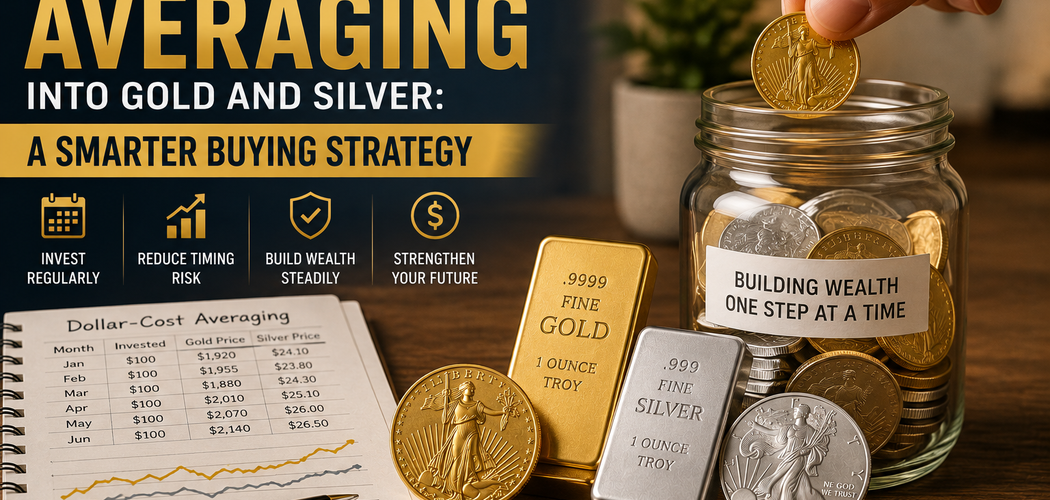
Buying gold or silver sounds simple until investors need to decide when to enter the market. Prices can rise quickly, fall after a purchase, or remain volatile for months. Dollar-cost averaging gold offers a structured alternative by spreading purchases across a predetermined schedule instead of relying on one large investment.
The strategy is straightforward. An investor chooses an amount and invests it regularly, regardless of whether gold is rising or falling. For example, someone could invest $200 every month rather than investing $2,400 at once.
When prices fall, the fixed contribution purchases more exposure. When prices rise, it purchases less.
This approach cannot guarantee profits. It also does not guarantee better returns than investing a lump sum immediately. However, it can reduce the emotional pressure associated with market timing.
For precious metals investors, discipline can be particularly valuable because gold and silver respond to unpredictable economic, monetary, and geopolitical developments.
What Is Dollar-Cost Averaging?
Dollar-cost averaging, often shortened to DCA, involves investing equal amounts at regular intervals.
The schedule might be weekly, monthly, quarterly, or another consistent period.
Suppose an investor plans to put $6,000 into gold.
Instead of investing the entire amount today, the investor could purchase $500 of exposure each month for one year.
Some purchases will occur at higher prices. Others may happen during market corrections.
Over time, the investor develops an average acquisition cost across several entry points.
Using dollar-cost averaging gold does not require predicting whether today’s price represents a market top or bottom.
That simplicity is one of its main advantages.
However, investors still need a broader plan. They should decide how much total precious metal exposure they want and whether gold and silver fit their financial goals.
DCA is a purchasing method, not a complete investment strategy.
Why Market Timing Is So Difficult
Gold prices respond to many variables.
Interest rates can change unexpectedly. Inflation reports can surprise markets, while currencies can move after central bank announcements.
Geopolitical events add another layer of uncertainty.
Even when investors correctly predict an economic event, they may incorrectly predict how gold will react.
For example, higher inflation may appear bullish for gold. However, if investors expect aggressive interest-rate increases in response, gold could face pressure.
Silver can be even more complicated because industrial demand matters alongside monetary conditions.
Therefore, waiting for the “perfect” entry price can become frustrating.
Some investors remain in cash while prices continue rising. Others buy aggressively after a rally because they fear missing further gains.
A systematic purchasing schedule can reduce both behaviors.
How Dollar-Cost Averaging Works With Gold
Consider a simplified example.
An investor wants to build a gold position over four months and invests $500 each month.
During the first month, the selected gold investment costs $50 per unit. The investor purchases 10 units.
The following month, the price falls to $40. The same $500 buys 12.5 units.
In month three, the price rises to $50, allowing another 10 units.
Finally, the price drops to $45, so the investor buys about 11.1 units.
The investor has committed the same dollar amount each month while purchasing different quantities.
This is the basic mechanism behind dollar-cost averaging gold.
The method naturally purchases more units when prices are lower and fewer when they are higher.
However, this example ignores transaction costs, taxes, premiums, and other real-world expenses that investors must consider.
Dollar-Cost Averaging Does Not Guarantee a Lower Cost
A common misconception is that DCA always produces a better purchase price.
It does not.
Suppose gold rises steadily for an entire year.
An investor who purchased the full intended position at the beginning would benefit from having all the capital invested before the increase.
Someone investing gradually would make later purchases at progressively higher prices.
Therefore, DCA can underperform lump-sum investing during consistently rising markets.
Its main benefit is not maximizing returns in every scenario.
Instead, it spreads timing risk and can make an investment plan easier to follow.
This distinction is important.
Investors should choose dollar-cost averaging gold because it matches their risk management and behavioral needs, not because they expect it to outperform every alternative.
Why DCA Can Reduce Emotional Decisions
Investment decisions become difficult when prices move rapidly.
After a major gold rally, investors may fear missing out.
They might abandon their original allocation plan and buy much more than intended.
After a sharp decline, fear can create the opposite reaction.
An investor who originally wanted gold may suddenly refuse to buy even though prices are lower.
A predetermined schedule can reduce these emotional responses.
The investor already knows how much to purchase and when.
Market movements still matter, but they do not control every decision.
This can be particularly useful for long-term investors who want precious metal exposure without constantly analyzing short-term charts.
Discipline does not eliminate investment risk. However, it can reduce the risk of making impulsive decisions based on excitement or fear.
Gold and Silver Need Different Considerations
Investors can apply dollar-cost averaging to both gold and silver.
However, the two metals behave differently.
Gold has a strong monetary and investment role. Central banks also hold it as part of their reserves.
Silver combines investment demand with extensive industrial use.
Manufacturing, electronics, automobiles, electrical infrastructure, and solar technologies can influence silver consumption.
As a result, silver can experience larger percentage price movements.
An investor using dollar-cost averaging gold alongside silver should therefore decide how much risk each metal contributes.
A 50-50 dollar split does not necessarily create equal risk because silver may be more volatile.
Investors focused primarily on wealth preservation may choose greater gold exposure. Those willing to accept additional volatility may allocate more toward silver.
Silver’s Volatility Can Make Gradual Buying Attractive
Sharp silver price swings can make choosing a single entry point difficult.
Gradual purchases can spread exposure across several market conditions.
However, physical silver also creates higher storage requirements, which investors should consider before accumulating large quantities.
Physical Bullion Changes the DCA Equation
Dollar-cost averaging sounds easiest when investments can be purchased without meaningful transaction costs.
Physical bullion is different.
Dealers generally sell coins and bars above the metal’s spot price. This difference is called a premium.
Small products can sometimes carry higher percentage premiums than larger bars.
Therefore, buying a very small amount of physical gold every week may be inefficient.
An investor could instead save the intended weekly contributions and make a larger purchase every few months.
The strategy still spreads purchases over time while potentially reducing transaction costs.
Investors should compare dealer premiums, shipping expenses, payment fees, storage costs, and selling spreads.
A successful dollar-cost averaging gold plan should account for the total acquisition cost rather than focusing only on spot prices.
ETFs Can Make Regular Purchases Easier
Exchange-traded products can simplify gradual precious metal investing.
Investors can purchase shares through brokerage accounts without personally storing bullion.
Some brokers also support fractional shares or automated recurring investments.
This can make precise regular contributions easier.
However, exchange-traded products have their own costs and risks.
Management fees can reduce long-term returns. Trading spreads may also apply.
Furthermore, investors should understand how a particular product gains exposure to gold or silver.
Physical bullion and financial products are not identical.
Someone who values direct possession may prefer physical metal despite the additional costs.
Another investor focused on liquidity and convenient rebalancing may prefer a fund.
The appropriate method depends on the purpose of the investment.
Choose a Contribution Amount You Can Maintain
Consistency is central to dollar-cost averaging.
Therefore, investors should choose an amount that fits comfortably within their finances.
An aggressive monthly contribution may look appealing initially. However, the plan becomes ineffective if the investor must stop after a few months because other expenses arise.
Start with the broader financial picture.
Emergency savings should generally come first.
High-cost debt also deserves attention because interest charges can exceed potential investment returns.
Next, consider retirement contributions and other important financial goals.
Precious metal purchases can then fit within the remaining investment budget.
A sustainable dollar-cost averaging gold plan should not create cash-flow problems or force investors to neglect more urgent financial priorities.
Determine Your Target Allocation First
Dollar-cost averaging should have a destination.
Without a target allocation, regular buying can continue indefinitely.
Eventually, precious metals may become a much larger portion of the portfolio than intended.
Suppose an investor decides that gold and silver should represent a defined portion of long-term investments.
The investor can then use DCA to gradually move toward that target.
Once the allocation is reached, contributions may be reduced, redirected, or used only when rebalancing requires additional precious metal exposure.
This approach separates two decisions.
The first decision is how much gold and silver the investor should own.
The second is how quickly to reach that allocation.
DCA answers the second question. It should not replace the first.
Pick a Schedule That Fits Your Finances
There is no universally best purchasing frequency.
Monthly contributions work well for many investors because salaries, bills, and budgets often operate monthly.
Quarterly purchases may be more practical for physical bullion because fewer transactions can reduce costs.
Weekly purchases can provide more entry points but may become inconvenient.
The appropriate schedule should balance consistency and efficiency.
Investors should also avoid constantly changing the schedule based on market predictions.
If purchases occur only when the investor feels optimistic, the strategy stops being true dollar-cost averaging.
A predetermined routine gives dollar-cost averaging gold its behavioral advantage.
The schedule can still be reviewed if financial circumstances change.
Do Not Stop Automatically When Prices Fall
A significant price decline can test investor discipline.
Suppose gold falls 15% after several scheduled purchases.
An investor may feel tempted to stop because the strategy appears unsuccessful.
However, lower prices allow each fixed contribution to purchase more exposure.
That mechanism is central to DCA.
Of course, investors should not continue blindly if the original investment thesis has changed.
A decline caused by ordinary market volatility differs from discovering that the investment no longer fits financial goals.
The important question is not simply whether the price fell.
Instead, ask whether the reasons for owning precious metals remain valid and whether the target allocation is still appropriate.
If those answers remain unchanged, abandoning the plan solely because of lower prices may undermine the strategy.
Avoid Increasing Purchases Because of FOMO
Rising markets create a different challenge.
Suppose gold suddenly gains strongly and receives extensive media attention.
An investor who planned to purchase $300 each month may become tempted to invest several thousand dollars immediately.
That decision changes the strategy.
It may also increase the risk of buying heavily after a large rally.
A disciplined dollar-cost averaging gold approach keeps contribution amounts connected to the original financial plan.
That does not mean investors can never adjust allocations.
Changes may be appropriate after major shifts in income, risk tolerance, investment goals, or overall portfolio composition.
However, price excitement alone is usually a weak reason to abandon a systematic approach.
Rebalancing and DCA Can Work Together
Dollar-cost averaging can become even more useful when combined with portfolio rebalancing.
Suppose an investor’s precious metal allocation falls below its target because stocks have risen strongly.
Instead of selling stocks immediately, the investor could direct new contributions toward gold and silver.
Over time, this may bring the portfolio closer to its intended allocation.
The opposite works as well.
If precious metals experience a major rally and become overweight, new investment contributions can be directed toward other assets.
This approach can reduce the need to sell existing investments.
It may also reduce transaction costs and potential tax consequences, depending on jurisdiction.
Rebalancing with new contributions creates a dynamic version of DCA that responds to the entire portfolio rather than one asset.
Use a Rules-Based Buying Plan
Investors can make DCA easier by writing down their rules.
The plan might specify the contribution amount, purchasing frequency, target precious metal allocation, gold-to-silver mix, and preferred investment vehicles.
It can also establish conditions for reviewing the strategy.
For example, the investor might perform a complete portfolio review every six months.
This reduces the temptation to change the plan after every market headline.
A rules-based dollar-cost averaging gold strategy creates consistency.
It also makes performance easier to evaluate.
Instead of asking whether the latest purchase was perfectly timed, investors can assess whether the overall process remains aligned with their long-term goals.
Keep Records of Every Purchase
Accurate records become increasingly important as the number of purchases grows.
Investors should track the date, quantity, purchase price, fees, premiums, and total cost of each transaction.
For physical bullion, product details may also be useful.
Good records help investors calculate their average acquisition cost.
They can also simplify future tax reporting.
Tax rules for precious metals vary by jurisdiction, so investors should seek appropriate professional guidance when necessary.
Recordkeeping also helps identify hidden costs.
For example, an investor may discover that frequent small bullion purchases are creating unusually high premiums.
The schedule can then be adjusted without abandoning the overall strategy.
Do Not Confuse DCA With Buying Every Dip
Buying the dip and dollar-cost averaging are different strategies.
DCA follows a predetermined schedule regardless of short-term price movements.
Buying dips requires deciding whether a particular decline represents an attractive opportunity.
The second approach involves market timing.
Investors can combine the two, but doing so changes the risk profile.
For example, an investor might maintain a regular monthly contribution while reserving a small amount of additional capital for unusually large declines.
However, clear rules are important.
Otherwise, “buying the dip” can become an excuse for emotional trading.
For beginners, a straightforward schedule may be easier to maintain and evaluate.
When Lump-Sum Investing May Be Better
Dollar-cost averaging is not automatically the best choice.
An investor who already has a large amount of cash available must consider the opportunity cost of keeping some of it uninvested.
If gold rises throughout the accumulation period, gradual investing will produce a higher average purchase price than investing immediately.
Lump-sum investing may also make sense when transaction costs strongly favor one larger physical bullion purchase.
However, investing everything at once creates greater timing risk.
A major decline shortly after the purchase can be psychologically difficult.
Therefore, the decision depends partly on financial circumstances and risk tolerance.
Some investors may choose a compromise by investing part of the intended amount immediately and gradually deploying the remainder.
DCA Does Not Replace Diversification
A systematic buying strategy cannot make an excessively concentrated portfolio safe.
An investor could perfectly execute dollar-cost averaging gold and still own too much gold.
Precious metals should be considered alongside stocks, bonds, cash, property, businesses, and other assets.
Gold does not generate corporate profits or dividends.
Physical silver does not produce rental income or interest.
Therefore, productive assets remain important for long-term wealth creation.
Precious metals may serve as diversification, a potential store of value, or exposure to different economic conditions.
Their exact role depends on the investor.
DCA improves the purchasing process. It does not remove the need for sensible asset allocation.
Common Dollar-Cost Averaging Mistakes
Several mistakes can reduce the effectiveness of the strategy.
The first is investing without a target allocation.
Another is choosing contributions that are too large to maintain.
Physical bullion investors may also make purchases so frequently that premiums and shipping costs become excessive.
Some investors stop buying immediately after prices fall, defeating one of DCA’s core mechanisms.
Others increase contributions dramatically after rallies because of fear of missing out.
Ignoring records is another common problem.
Finally, investors may assume regular purchasing guarantees profits.
It does not.
Precious metal prices can remain below an investor’s average acquisition cost for extended periods.
A successful strategy requires realistic expectations and patience.
A Simple DCA Framework for Beginners
Investors can create a straightforward process.
First, establish emergency savings and address urgent financial obligations.
Next, determine why gold and silver belong in the portfolio.
Then choose a target allocation.
Decide how much of that precious metal exposure should be gold versus silver.
Afterward, select the investment method, such as physical bullion, exchange-traded products, or a combination.
Choose a contribution amount and purchasing schedule that can be maintained consistently.
Track every purchase and periodically review total portfolio exposure.
Finally, rebalance when necessary.
This framework keeps dollar-cost averaging gold connected to a broader investment strategy rather than turning regular buying into an unlimited accumulation plan.
Think in Years Rather Than Weeks
DCA is generally more meaningful as a long-term discipline than a short-term trading technique.
Precious metal prices can fluctuate sharply over weeks or months.
Trying to judge the strategy after only a few purchases can therefore be misleading.
Instead, investors should evaluate whether the process helps them build the desired allocation at manageable costs.
Long-term thinking also reduces attention to daily market noise.
Interest-rate announcements, inflation reports, geopolitical headlines, and price forecasts can cause temporary volatility.
A predetermined plan allows investors to acknowledge these developments without reacting emotionally to each one.
Patience remains essential because no purchasing strategy eliminates market cycles.
Conclusion
Buying gold and silver does not require predicting the perfect market bottom.
A structured purchasing schedule can provide a simpler alternative.
Dollar-cost averaging gold involves investing a fixed amount at regular intervals. As prices fluctuate, investors automatically purchase more exposure at lower prices and less at higher prices.
The strategy can reduce timing pressure and help control emotional decisions.
However, it does not guarantee profits or superior returns. In a steadily rising market, lump-sum investing may perform better because more money enters the market earlier.
Costs also matter.
Physical bullion investors should account for premiums, shipping, storage, insurance, and selling spreads. Very frequent small purchases may be inefficient.
Most importantly, DCA should support a predetermined asset allocation.
Investors need to know why they own precious metals, how much exposure they want, and how gold and silver fit alongside other investments.
When combined with diversification, recordkeeping, and periodic rebalancing, dollar-cost averaging gold can provide a disciplined way to build precious metal exposure without making long-term financial success depend on one perfectly timed purchase.
FAQ
1. Is Dollar-Cost Averaging Good for Buying Gold?
It can be useful for investors who want to spread purchases over time and reduce the pressure of choosing one entry price. However, it cannot guarantee profits or prevent losses.
2. Can I Use the Same Strategy for Silver?
Yes. Regular purchases can also be used for silver. However, investors should consider its greater volatility, industrial exposure, physical storage requirements, and transaction costs.
3. Is Monthly or Quarterly Buying Better?
The best frequency depends on cash flow and costs. Monthly investing may be convenient for financial products, while less frequent purchases may reduce premiums and shipping costs for physical bullion.
4. Should I Stop Buying When Gold Prices Fall?
Not automatically. Lower prices allow a fixed contribution to purchase more exposure. However, investors should reconsider the plan if their financial circumstances or reasons for owning gold have materially changed.
5. Is Dollar-Cost Averaging Better Than Investing a Lump Sum?
Neither method is always better. Lump-sum investing can benefit when prices rise after the investment. Dollar-cost averaging gold may be preferable for investors who want to spread timing risk and follow a more gradual purchasing plan.

