

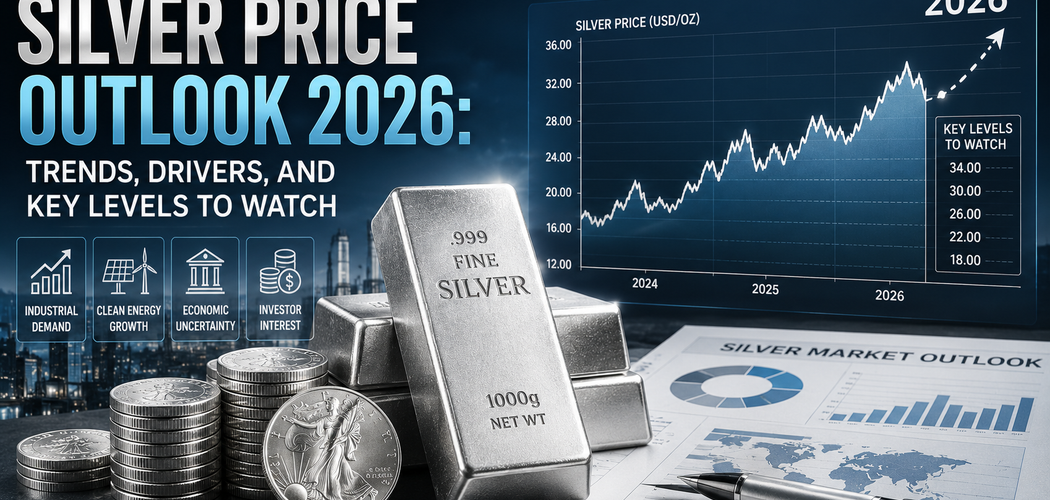
Silver has entered 2026 as one of the most closely watched precious metals. This silver price outlook 2026 examines the forces that could shape the market, including investment demand, industrial consumption, mine production, recycling, interest rates, and the U.S. dollar.
The market has already demonstrated how volatile silver can be. According to the Silver Institute, prices reached record territory early in 2026 before experiencing a sharp correction. Meanwhile, the broader market continues to face a structural supply deficit.
That combination creates an unusual environment. Strong investment interest and tight physical conditions can support prices. However, high prices can also reduce jewelry and industrial demand while encouraging recycling.
Therefore, investors should avoid focusing on one price target. Instead, they can watch the economic and physical market indicators that may determine silver’s direction throughout the year.
Why Silver Is Different From Gold
Silver and gold often move in the same direction because investors view both as precious metals. However, their underlying markets are significantly different.
Gold demand is strongly connected to investment, jewelry, and central bank reserves. Silver has those characteristics to some degree, but industrial demand plays a much larger role.
Manufacturers use silver because it offers exceptional electrical and thermal conductivity. Electronics, automobiles, power infrastructure, solar equipment, data centers, and other technologies all require the metal.
This gives silver two identities.
It can behave like a precious metal when investors worry about inflation, currencies, or financial stability. At the same time, it can behave like an industrial commodity when expectations for manufacturing and economic growth change.
Understanding this dual role is essential for any silver price outlook 2026.
It also helps explain silver’s volatility. Investment demand can rise while industrial demand weakens, or both forces can strengthen simultaneously.
The Silver Market Remains in Deficit
One of the most important fundamental trends is the balance between total supply and demand.
The Silver Institute’s World Silver Survey 2026 reported that demand exceeded supply for a fifth consecutive year in 2025. Its April outlook projected another structural deficit for 2026, with the gap expected to reach about 46.3 million ounces.
A market deficit means current supply does not fully cover current demand. Therefore, above-ground inventories can help fill the difference.
Persistent deficits can matter over time because readily available inventories are not unlimited.
However, investors should not assume that a deficit automatically produces higher prices every year.
Prices also respond to investor positioning, interest rates, currencies, economic growth, and expectations. Furthermore, higher prices can encourage recycling and reduce demand.
Still, the structural deficit remains an important component of the silver price outlook 2026 because it highlights the relatively tight physical balance underlying the market.
Why Deficits Matter Over Time
A single annual deficit may not transform a market. Existing inventories can often cover temporary shortages.
Repeated deficits are different.
If demand consistently exceeds new supply, the market becomes increasingly dependent on above-ground stocks. Consequently, physical availability and inventory location can become more important.
The Silver Institute reported that falling inventories and regional liquidity tightness contributed to extraordinary silver market conditions during 2025.
Investors should therefore monitor both annual supply-demand balances and available inventories.
Industrial Demand Remains a Major Driver
Industrial demand is one of silver’s most important long-term fundamentals.
The metal appears in electronics, electrical equipment, automobiles, solar technology, power infrastructure, and specialized applications.
However, the 2026 picture is mixed.
The Silver Institute expects industrial fabrication to decline this year, with photovoltaic demand facing pressure from manufacturers using less silver per product and substituting other materials where practical. At the same time, data centers, artificial intelligence infrastructure, automotive applications, and other technologies continue to provide structural support.
This creates an important distinction for investors.
Growth in solar installations does not necessarily mean silver consumption will increase at the same rate. Manufacturers continuously work to reduce material costs.
Therefore, the silver price outlook 2026 needs to account for both technological expansion and improvements in material efficiency.
Artificial Intelligence Could Support Silver Demand
Artificial intelligence may not seem directly connected to precious metals. However, the infrastructure behind AI requires significant electrical equipment.
Data centers contain servers, power systems, switches, connectors, and other electronic components. Silver’s conductivity makes it useful across many electrical applications.
The Silver Institute has identified AI-related technologies and data-center expansion as areas supporting industrial silver consumption.
This does not mean AI alone will determine silver prices.
Instead, it represents one part of a wider technological demand trend. Electrification, grid investment, automotive electronics, renewable energy, and digital infrastructure can collectively influence industrial consumption.
Investors should therefore examine technology demand as a multi-year theme rather than reacting to individual AI headlines.
Automotive Demand Creates Another Growth Area
Modern vehicles contain increasingly complex electrical systems.
Silver can appear in switches, contacts, safety systems, entertainment technology, battery management equipment, and other electronic components.
Electric vehicles can require even more electrical infrastructure.
Research published by the Silver Institute in late 2025 projected continued growth in automotive silver demand as electrification expands. The report estimated that battery-electric vehicles use substantially more silver than traditional internal-combustion vehicles.
Charging infrastructure can create additional demand.
Consequently, automotive electrification remains a potentially supportive long-term factor for the silver price outlook 2026, even if other industrial sectors experience weaker consumption.
However, economic conditions still matter. A significant slowdown in global vehicle production could temporarily weaken demand despite the longer-term electrification trend.
Solar Demand Is Becoming More Complicated
Solar power has been one of the most important sources of industrial silver demand.
Photovoltaic cells use silver in conductive applications. Therefore, rapid expansion in global solar installations helped support silver consumption.
Yet manufacturers have a strong incentive to reduce silver use because the metal represents a production cost.
This process is known as thrifting.
As silver prices rise, manufacturers may accelerate efforts to use smaller quantities. They may also investigate substitute materials.
The Silver Institute expects these changes to weigh on photovoltaic silver demand during 2026 even as global solar installations continue expanding.
This development is important because it demonstrates that end-market growth does not always translate directly into greater commodity consumption.
Investors should watch both solar installations and the amount of silver used per unit.
Mine Supply Cannot Change Quickly
Higher prices can encourage mining companies to increase production. However, silver supply has an unusual limitation.
A large share of silver is produced as a by-product of mining other metals, including lead, zinc, copper, and gold. Therefore, silver prices alone do not determine production decisions.
A copper miner may produce silver because it naturally occurs within the same deposit. Even if silver prices rise dramatically, the company may not increase production unless copper economics also support expansion.
Furthermore, new mines take years to develop.
Companies must discover deposits, complete feasibility studies, secure financing, obtain permits, build infrastructure, and construct processing facilities.
The World Silver Survey 2026 expects mine output to remain constrained, while recycling should increase as elevated prices encourage more material to return to the market.
This relatively slow supply response remains important for the silver price outlook 2026.
Recycling Could Limit Some Supply Pressure
Silver recycling responds more quickly to higher prices than mining.
Old jewelry, silverware, industrial scrap, electronics, and other products can provide secondary supply.
When prices rise substantially, owners have a greater incentive to sell. Businesses may also find previously uneconomic recycling processes more attractive.
The Silver Institute expects recycling to increase during 2026 as high silver prices encourage additional scrap flows.
That additional supply can help reduce pressure from a market deficit.
However, recycling has limitations.
Not every product containing silver is economical to process. Some applications contain only tiny quantities. Collection systems can also be inefficient.
Therefore, recycling can supplement mine production, but it cannot necessarily respond immediately to every increase in demand.
Investment Demand Can Move Prices Rapidly
Industrial demand changes gradually. Investment demand can change much faster.
Investors can purchase physical bars and coins, exchange-traded products, futures, and other forms of silver exposure.
When investor sentiment becomes strongly positive, large amounts of capital can enter the market quickly.
The Silver Institute expects physical investment to strengthen during 2026. Its February outlook projected physical investment around a three-year high, supported by renewed Western buying and continued interest in India.
That makes investor behavior an important part of the silver price outlook 2026.
However, investment flows can reverse.
Rapid price gains may attract momentum buyers, but sharp corrections can encourage selling. Consequently, investment demand can increase both upside momentum and downside volatility.
Interest Rates Remain Important
Silver does not generate interest simply because an investor owns the physical metal.
Therefore, interest rates influence its attractiveness relative to bonds, savings products, and other income-producing assets.
Higher real yields can create competition for precious metals. Investors may prefer assets that generate income when inflation-adjusted returns become attractive.
Lower real yields can have the opposite effect.
If interest rates decline while inflation remains elevated, the opportunity cost of holding silver may fall.
However, silver’s industrial role makes the relationship more complicated than it is for a purely monetary asset.
Lower rates may support precious metal investment while also stimulating economic activity. In that scenario, both investment and industrial demand could improve.
For this reason, monetary policy deserves close attention throughout 2026.
The U.S. Dollar Can Influence Silver
Silver is generally priced internationally in U.S. dollars.
Therefore, changes in the dollar can influence affordability for buyers using other currencies.
A stronger dollar can make silver more expensive internationally. Conversely, a weaker dollar can improve affordability.
However, the relationship is not perfect.
Silver and the dollar can sometimes strengthen simultaneously, particularly when other market forces dominate.
Investors conducting a silver price outlook 2026 should therefore examine why the dollar is moving.
Interest-rate expectations, economic growth, trade policy, inflation, and global risk sentiment can all influence currencies.
Understanding those underlying causes provides more information than simply watching the dollar index rise or fall.
Inflation Can Support Investment Interest
Inflation can increase investor interest in tangible assets.
When consumer prices rise, the purchasing power of money declines. Investors may therefore seek assets they believe can preserve value over longer periods.
Silver can benefit from this behavior because it has historically functioned as both money and a precious metal.
Still, inflation does not guarantee rising silver prices.
Central banks may respond to persistent inflation by raising rates or maintaining restrictive monetary policy. Higher real yields could then pressure precious metals.
At the same time, inflation can increase industrial production costs and reduce consumer purchasing power.
Investors should therefore consider inflation together with interest rates and economic growth.
Silver’s Volatility Requires Caution
Silver can move much faster than many traditional investments.
Its market is smaller than gold’s, while investment flows can change rapidly. Industrial demand adds another source of uncertainty.
Recent market behavior demonstrates this clearly. Silver surged to record levels early in 2026 before experiencing a major correction, highlighting how quickly sentiment and positioning can change.
Therefore, silver price outlook 2026 analysis should not be interpreted as a guarantee of steadily rising prices.
Even a fundamentally tight market can experience substantial corrections.
Investors should consider position size carefully and avoid assuming that strong long-term fundamentals eliminate short-term risk.
Key Price Levels Need Context
Technical traders often monitor previous highs, lows, support areas, resistance zones, and moving averages.
These levels can help identify where buyers or sellers previously became active.
However, technical levels are not permanent.
A major change in interest rates, investment flows, geopolitical conditions, or physical supply can push silver through a previously important price zone.
Therefore, investors should combine technical analysis with fundamentals.
Instead of asking whether one price represents guaranteed support, consider what economic conditions helped create that level.
Likewise, a breakout becomes more meaningful when improving fundamentals accompany it.
This approach can help investors avoid relying entirely on chart patterns.
What Could Push Silver Higher?
Several developments could create additional support.
Stronger investment demand would be one important factor. Large inflows into physical products or exchange-traded investments could tighten available supply.
Lower real interest rates could also improve the relative attractiveness of precious metals.
A weaker dollar may support international buying, while persistent inflation concerns could increase demand for tangible assets.
Industrial demand could strengthen if AI infrastructure, automobiles, electronics, and power-grid investment expand faster than expected.
Meanwhile, continued structural deficits could keep physical supply conditions tight.
Together, these factors create potential upside scenarios within the silver price outlook 2026.
However, investors should remember that markets often price expectations before economic data confirms them.
What Could Put Pressure on Silver?
Silver also faces meaningful downside risks.
Higher interest rates or real yields could reduce investment demand. A stronger dollar may create additional pressure.
Economic weakness could reduce industrial consumption, particularly if manufacturing slows significantly.
High silver prices themselves can also change the market.
Manufacturers may accelerate thrifting and substitution. Jewelry consumers may reduce purchases, while recycling can increase.
The Silver Institute’s 2026 outlook already anticipates weaker jewelry, silverware, and some industrial demand as high prices affect consumption.
Investment sentiment represents another risk.
Because silver can attract speculative capital during strong rallies, a shift in sentiment can trigger rapid selling.
Therefore, bullish fundamentals should always be considered alongside volatility and downside risk.
What Investors Should Watch During 2026
Investors do not need to follow every daily market headline.
Instead, several indicators can provide a useful overview.
First, monitor the global supply-demand balance. Continued deficits could maintain pressure on available inventories.
Second, follow industrial demand. Solar thrifting, AI infrastructure, automotive electrification, electronics, and power-grid development deserve particular attention.
Third, monitor physical investment and exchange-traded product flows.
Interest rates and real yields also matter because they influence the opportunity cost of holding precious metals.
The U.S. dollar provides another important signal.
Finally, investors should watch mine production and recycling. Higher recycling could provide additional supply if prices remain elevated.
Tracking these indicators together creates a stronger framework than relying on a single price forecast.
Conclusion
Silver enters the remainder of 2026 with powerful but competing market forces.
Structural supply deficits, investment demand, technological growth, electrification, and tight physical conditions can provide support. At the same time, high prices are encouraging recycling and reducing demand in several price-sensitive sectors.
Industrial demand remains particularly important. AI infrastructure, automobiles, electronics, and grid investment offer potential long-term growth. However, solar manufacturers are reducing the amount of silver required in photovoltaic technology.
Meanwhile, monetary conditions can quickly change investor behavior.
Interest rates, real yields, inflation expectations, currencies, and geopolitical uncertainty can all influence whether investors increase or reduce precious metal exposure.
Therefore, the silver price outlook 2026 should not be reduced to a single bullish or bearish price target.
Silver has the potential to benefit from a tight physical market and long-term technological demand. Yet its volatility remains substantial.
Investors who monitor supply, industrial consumption, investment flows, monetary conditions, and technical trends together will have a stronger foundation for understanding the market.
Ultimately, silver price outlook 2026 analysis is most useful when it helps investors understand changing risks and opportunities rather than promising an exact future price.
FAQ
1. What Is Driving Silver Prices in 2026?
Investment demand, industrial consumption, supply constraints, interest rates, currencies, inflation expectations, and geopolitical uncertainty all influence silver. The market’s continuing structural deficit is another important factor.
2. Why Is Industrial Demand So Important for Silver?
Silver is widely used in electronics, automobiles, power infrastructure, solar equipment, and other technologies. Therefore, changes in manufacturing and technological investment can materially affect total demand.
3. Could AI Increase Demand for Silver?
AI-related infrastructure can contribute to silver consumption through data centers, electrical equipment, power systems, and electronics. However, AI is only one part of a much broader industrial demand picture.
4. Why Is Silver More Volatile Than Gold?
Silver has a smaller market and greater industrial exposure. Consequently, changes in investment flows and economic expectations can create larger percentage price movements.
5. What Should Silver Investors Watch for the Rest of 2026?
Investors should monitor supply deficits, physical inventories, industrial consumption, recycling, investment flows, real yields, the dollar, and economic growth. Together, these indicators provide a clearer silver price outlook 2026 than any single price target.

