

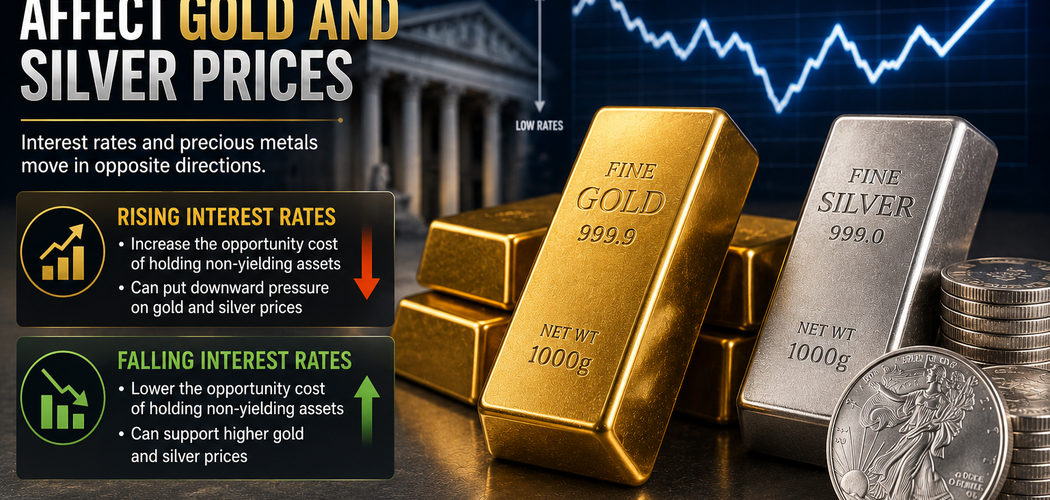
Interest rates influence nearly every corner of financial markets, including precious metals. Understanding interest rates and gold is especially important because physical gold does not pay interest. When yields on bonds and savings rise, investors have more income-producing alternatives. However, when rates fall, holding a non-yielding asset may become relatively more attractive.
Silver responds to many of the same monetary forces. Still, its large industrial market creates an additional layer of complexity. Manufacturing demand, technology growth, and economic conditions can sometimes outweigh the impact of monetary policy.
Therefore, the relationship is not as simple as “rates up, metals down.” Real interest rates, inflation expectations, the U.S. dollar, economic growth, and investor sentiment all influence the final outcome.
The World Gold Council notes that higher rates can create a short-term headwind because they increase gold’s opportunity cost. However, historical relationships vary, and other demand drivers can counteract the effect.
Why Interest Rates Matter to Precious Metals
Interest represents the return investors can earn by lending money or holding certain financial assets.
For example, government bonds may pay interest. Bank savings products can also provide a return. Gold and silver bullion do not.
If an investor owns one ounce of physical gold for a year, the amount of gold remains one ounce. The investment only produces a return if its market value increases.
Consequently, rising yields can create competition.
Imagine that low-risk bonds suddenly offer significantly higher returns. Some investors may decide that receiving regular interest is more attractive than holding a metal that produces no income.
This opportunity-cost relationship is fundamental to interest rates and gold.
However, investors should avoid treating it as an automatic trading rule. Gold has risen during some periods of increasing rates because other forces were stronger.
Silver behaves similarly, although supply and industrial demand can have greater influence. The Silver Institute identifies interest rates as one of several variables affecting silver alongside inflation, exchange rates, supply, and fabrication demand.
Nominal Rates vs Real Interest Rates
Investors often hear about interest rates without distinguishing between nominal and real rates.
The difference matters.
A nominal interest rate is the stated rate before considering inflation. A real interest rate adjusts that return for changes in purchasing power.
Consider a simplified example. Suppose an investment pays 5% annually while inflation is running at 4%. The approximate real return is only 1%.
Now imagine the investment still pays 5%, but inflation rises to 6%. The real return becomes negative using that simplified calculation.
For precious metal investors, real yields can therefore provide more information than nominal rates alone.
Historically, the connection between interest rates and gold has often been stronger when real yields are considered. Lower real yields reduce the relative advantage of holding interest-bearing assets.
Higher real yields can have the opposite effect.
Why Inflation Changes the Calculation
Inflation reduces purchasing power.
Therefore, investors care about how much their money can buy after earning interest, not simply the stated return.
This helps explain why gold can sometimes rise even while nominal rates are increasing.
If inflation rises faster than interest rates, real yields may remain low or negative. Under those conditions, investors may still seek alternative stores of value.
Conversely, falling inflation combined with elevated nominal yields can increase real returns. That environment may create stronger competition for precious metals.
How Rising Rates Can Pressure Gold
Higher rates can affect gold through several channels.
The first is opportunity cost. As bonds and other investments offer higher yields, holding a non-yielding asset becomes comparatively less attractive.
The second involves currencies.
Higher U.S. interest rates can sometimes support the U.S. dollar by attracting international capital. Because gold is commonly priced in dollars, a stronger dollar can make the metal more expensive for buyers using other currencies.
Third, higher rates can influence investor expectations.
If investors believe monetary policy will remain restrictive, they may expect real yields to remain elevated. This can reduce demand for precious metals.
These mechanisms explain the traditional inverse relationship between interest rates and gold.
Still, that relationship changes over time. World Gold Council research has found that other factors, including central bank purchases and demand for protection against geopolitical and financial risks, can counteract higher real rates.
Therefore, rate increases should be analyzed alongside broader market conditions.
How Falling Rates Can Support Gold
Falling interest rates generally reduce the returns available from newly issued fixed-income investments and savings products.
That can lower the opportunity cost of holding gold.
Furthermore, central banks often reduce rates when economic conditions weaken. Investors may interpret rate cuts as evidence that policymakers are concerned about recession, financial instability, or slowing growth.
Those concerns can independently increase demand for defensive assets.
Lower rates may also weaken a currency under certain conditions. If the U.S. dollar declines, dollar-priced gold can become more affordable to international buyers.
As a result, falling rates can influence interest rates and gold through several connected channels.
However, investors should again avoid assuming that every rate cut will produce a gold rally.
If policymakers cut rates because inflation has collapsed and economic confidence remains strong, investor behavior may differ from a crisis-driven rate-cutting cycle.
The reason behind the policy change matters.
Why Rate Expectations Can Matter More Than Decisions
Financial markets look forward.
Investors do not necessarily wait for a central bank to announce an interest-rate change before adjusting their portfolios.
Instead, they continuously analyze inflation, employment, economic growth, consumer spending, and statements from policymakers.
Suppose investors expect a central bank to cut rates six months from now. Bond yields may begin declining before the official cut.
Gold could respond immediately.
Then, when the central bank finally announces the expected decision, gold might barely move because markets already incorporated the information.
This concept is essential for understanding interest rates and gold.
Investors should therefore follow expectations as well as official policy rates.
Unexpected decisions often produce larger market reactions because traders must quickly adjust their assumptions.
The Federal Reserve Can Influence Global Metals
The Federal Reserve sets monetary policy for the United States, but its decisions can influence financial markets worldwide.
The U.S. dollar plays a major role in international trade and finance. Meanwhile, gold and silver are commonly priced globally in dollars.
Therefore, changes in U.S. monetary policy can affect bond yields, currencies, capital flows, and precious metals.
If investors expect tighter Federal Reserve policy, Treasury yields may rise. The dollar may also strengthen depending on broader conditions.
Those developments can pressure gold and silver.
Conversely, expectations of easier policy may reduce yields and weaken the dollar, potentially supporting metals.
Recent 2026 market movements illustrate how sensitive precious metals can be to yields. In August, gold and silver fell as Treasury yields surged, while gold subsequently rebounded as yields declined and the dollar weakened.
Still, monetary policy is only one part of the market.
Why Silver Responds Differently
Silver shares many monetary characteristics with gold.
It does not generate interest when held as physical bullion. Therefore, higher yields can increase its opportunity cost too.
However, silver is also an industrial commodity.
Manufacturers use it in electronics, electrical systems, automobiles, solar technologies, and other applications. Consequently, economic growth can influence demand much more directly.
Suppose central banks raise rates because an economy is expanding rapidly.
Higher yields could create pressure on precious metal investment. However, strong economic growth might support industrial silver consumption.
Those forces can partially offset each other.
Alternatively, aggressive rate increases may eventually weaken manufacturing activity. Silver could then face pressure from both higher yields and weaker industrial expectations.
This dual nature explains why interest rates and gold often have a clearer connection than rates and silver.
The Silver Institute emphasizes that no single factor consistently explains silver prices because the metal acts as both a financial asset and an industrial commodity.
Real Yields Can Be More Useful Than Policy Rates
Investors sometimes focus exclusively on a central bank’s official policy rate.
However, market yields can tell a different story.
Government bond yields reflect expectations about future inflation, monetary policy, economic growth, and risk. Therefore, they can change even when the central bank leaves its policy rate unchanged.
Real yields are particularly useful because they account for inflation expectations.
If real yields rise sharply, investors may receive a more attractive inflation-adjusted return from bonds.
That can create stronger competition for gold.
If real yields fall, the relative opportunity cost of holding gold decreases.
Research from the World Gold Council has historically found meaningful connections between real yields and gold performance, although it cautions against using interest rates as the sole explanation for price movements.
Therefore, investors examining interest rates and gold can benefit from watching bond markets rather than focusing solely on central bank announcements.
Inflation Can Complicate the Relationship
Inflation creates one of the biggest complications in precious metal analysis.
Gold is often described as an inflation hedge. Therefore, rising inflation may encourage investors to buy it.
However, persistent inflation can also cause central banks to raise interest rates.
The result is a tug-of-war.
Inflation concerns may increase demand for gold, while higher real yields may reduce its attractiveness.
Which force wins depends on market expectations.
Silver faces another complication. Inflation can increase manufacturing costs and potentially weaken consumer demand. At the same time, investors may buy silver because they are concerned about currency purchasing power.
The Silver Institute has documented periods when inflation supported physical silver investment while the resulting Federal Reserve rate increases pressured institutional demand.
Therefore, investors should never analyze inflation or rates in isolation.
The U.S. Dollar Creates Another Connection
Interest rates can influence precious metals indirectly through currencies.
Higher U.S. yields may attract capital from international investors. This can increase demand for dollar-denominated assets and potentially strengthen the U.S. dollar.
A stronger dollar often creates challenges for precious metals.
Imagine an international buyer whose local currency has not strengthened alongside the dollar. Gold and silver become more expensive for that buyer even if their dollar prices remain unchanged.
A weaker dollar can produce the opposite effect.
However, currency relationships are not fixed.
During periods of severe global uncertainty, investors may seek both dollars and gold. Therefore, both assets can sometimes rise together.
This is another reason interest rates and gold cannot be understood through a single formula.
Investors need to examine what is driving currency movements and whether other sources of gold demand are strong enough to offset them.
Central Bank Gold Buying Can Offset Higher Rates
Central banks do more than set monetary policy.
Many also hold gold as part of their reserves.
Their motivations can include diversification, liquidity, risk management, and reducing dependence on individual reserve currencies.
Strong central bank purchases can therefore support gold even when interest rates create unfavorable conditions.
This has become an important example of why traditional relationships can break down.
The World Gold Council has noted that since 2022, higher real rates have sometimes occurred alongside rising gold prices as central bank buying and demand for protection against broader risks counterbalanced opportunity-cost pressures.
This does not make interest rates irrelevant.
Instead, it demonstrates that interest rates and gold represent one relationship inside a much larger market.
Investors should consider central bank activity, investment flows, jewelry demand, and physical market conditions alongside monetary policy.
Economic Growth Changes the Rate Story
Why interest rates are moving can matter as much as the direction.
Consider a strong economy.
Businesses are expanding, employment is healthy, and consumer spending remains resilient. A central bank may maintain higher rates because economic conditions can tolerate them.
Such an environment could pressure gold through higher yields.
Silver might react differently because strong economic activity can support industrial demand.
Now consider another scenario.
Inflation remains high while economic growth deteriorates. Policymakers may hesitate to cut rates because inflation remains a concern.
Gold could receive support from economic uncertainty even while rates stay elevated.
Silver may face more pressure because weak manufacturing conditions threaten industrial consumption.
Therefore, investors should identify the economic environment behind every major rate move.
Rate Cuts Do Not Guarantee Higher Metal Prices
Investors sometimes assume that rate cuts automatically create a precious metal bull market.
That conclusion is too simple.
Markets may have anticipated the cuts months earlier. If so, gold and silver could already reflect easier monetary conditions before policymakers act.
Furthermore, other factors may overwhelm the effect.
A strengthening dollar, falling inflation expectations, weak investment demand, or increased physical supply could limit price gains.
Silver may also suffer if rate cuts occur during a severe industrial downturn.
For interest rates and gold, context remains essential.
Instead of asking whether rates are simply rising or falling, investors should ask several questions.
Are real yields increasing? Is the dollar strengthening? Why is monetary policy changing? What are investors expecting next?
These questions provide a stronger analytical framework.
How Investors Can Monitor Interest Rates
Investors do not need to become professional bond traders to understand monetary conditions.
They can begin by following central bank policy decisions.
Next, they can monitor government bond yields, particularly medium- and long-term yields. These can reveal changing expectations for inflation and economic growth.
Real yields deserve special attention.
Investors can also follow inflation data because it affects both real returns and monetary policy expectations.
Currency movements provide another clue. A major change in the U.S. dollar can amplify or offset the impact of changing yields.
Finally, investors should compare these indicators with actual precious metal behavior.
If gold rises despite increasing yields, another source of demand may be dominating the market.
This approach helps investors understand interest rates and gold without assuming that historical correlations must always hold.
Common Mistakes When Analyzing Rates
One common mistake is focusing only on nominal rates.
A 5% interest rate can mean something very different when inflation is 1% compared with inflation at 6%.
Another mistake is reacting only to central bank announcements.
Markets often move based on expectations long before policymakers make official decisions.
Investors may also assume that gold must decline whenever rates rise.
History shows that other forces can counteract higher yields.
Silver investors face an additional mistake: ignoring industrial demand.
Interest rates matter, but silver’s supply-demand fundamentals, technology consumption, and economic growth can produce independent price movements.
The Silver Institute’s research specifically describes silver price formation as multi-factor rather than driven by any single variable.
Understanding these limitations can prevent overly simplistic investment decisions.
Conclusion
Interest rates are an important driver of precious metals, but their influence is more complicated than a simple inverse relationship.
Higher rates can increase the opportunity cost of holding non-yielding assets. Rising real yields may therefore create pressure on gold and silver.
Falling rates can reduce that opportunity cost. They may also weaken currencies or signal economic stress, potentially increasing precious metal demand.
However, interest rates and gold do not move according to a fixed formula.
Inflation, the U.S. dollar, central bank purchases, geopolitical uncertainty, investment flows, and physical demand can all modify the relationship.
Silver introduces even more complexity because industrial consumption represents a major source of demand. Strong economic growth can support silver even when higher rates create monetary pressure.
Investors should therefore focus on real yields, market expectations, currencies, and the reasons behind monetary policy changes.
Understanding interest rates and gold provides an important foundation for precious metal analysis. Yet the strongest conclusions come from combining rate analysis with supply, demand, inflation, currency trends, and investor behavior.
FAQ
1. Do Higher Interest Rates Always Cause Gold Prices to Fall?
No. Higher rates can create pressure by increasing the opportunity cost of holding gold. However, central bank demand, inflation concerns, geopolitical risk, currencies, and investor sentiment can outweigh that effect.
2. Why Are Real Interest Rates Important for Precious Metals?
Real rates account for inflation. They provide a better indication of the purchasing-power return available from interest-bearing investments and can therefore influence the relative appeal of gold and silver.
3. Do Lower Rates Usually Help Silver?
Lower rates can support silver by reducing the opportunity cost of holding it. However, industrial demand, economic growth, mine supply, and investor flows can also significantly influence silver prices.
4. Why Can Gold Rise Before an Interest Rate Cut?
Financial markets anticipate future events. If investors expect rate cuts, bond yields and currencies may adjust months before the official decision. Gold can therefore respond to changing expectations rather than waiting for the actual cut.
5. What Should Precious Metal Investors Watch Alongside Rates?
Investors can monitor real yields, inflation, the U.S. dollar, central bank activity, investment flows, economic growth, and physical demand. Combining these factors with interest rates and gold analysis provides a more complete view of precious metal markets.

