

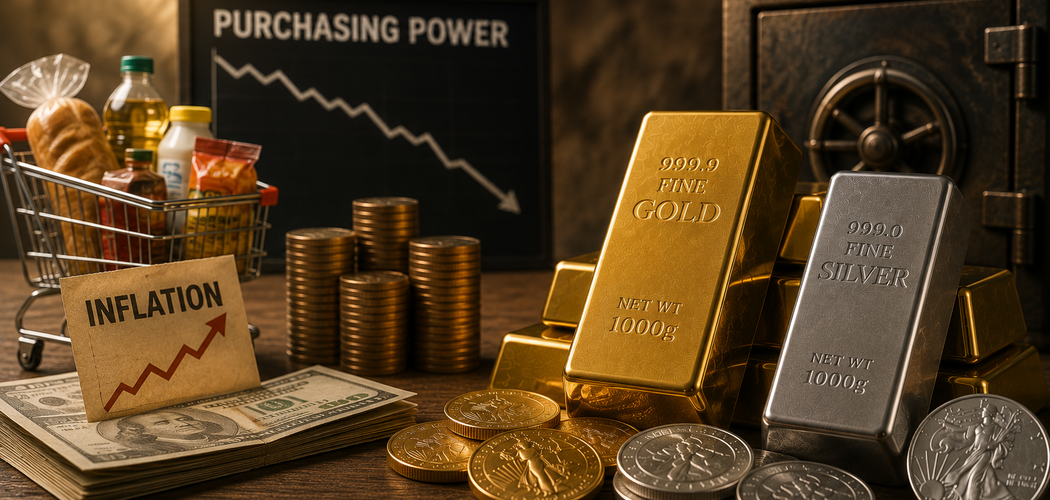
Inflation affects nearly every part of personal finance. Food, housing, transportation, healthcare, and other expenses can become more costly over time. As prices rise, each unit of currency buys fewer goods and services. This is why inflation and precious metals are frequently discussed together by investors looking for ways to preserve purchasing power.
Gold has a long history as a store of value. Silver also has monetary characteristics, although modern industrial demand plays a much larger role in its market.
However, neither metal provides perfect protection from inflation.
Gold can decline even while consumer prices rise. Silver can experience even greater volatility because manufacturing demand, economic growth, and technology trends affect its price.
World Gold Council research supports this distinction. Gold has historically performed well during many high-inflation environments, yet its short-term relationship with consumer price inflation has been inconsistent.
Therefore, investors should understand how inflation affects precious metals before treating either gold or silver as an automatic hedge.
What Inflation Does to Purchasing Power
Inflation measures how prices for goods and services change over time.
Suppose something costs $100 today.
If its price eventually rises to $120, a person needs more money to purchase exactly the same item.
This means the purchasing power of each dollar has declined.
The effect may seem small from year to year. However, it can become significant over decades.
For example, retirement savings held entirely in cash may maintain the same nominal balance while losing real purchasing power.
This is one reason investors purchase assets.
Stocks, property, inflation-linked securities, commodities, and precious metals may respond differently to rising prices.
Understanding inflation and precious metals therefore requires focusing on real purchasing power rather than simply looking at the number in a bank account.
Why Gold Is Associated With Inflation Protection
Gold has several characteristics that support its reputation as a potential store of value.
Its supply cannot be expanded quickly.
Producing additional gold requires exploration, mining equipment, labor, financing, permits, and years of development.
Gold is also durable and globally recognized.
Unlike currency, physical gold does not depend directly on a central bank’s monetary policy.
These characteristics can become attractive when investors worry that currency purchasing power is declining.
Historical evidence also provides some support.
World Gold Council data through 2025 found that gold has outpaced U.S. and global consumer price indexes over the long term. Its analysis also found stronger average gold performance during periods of elevated inflation.
However, the relationship becomes less reliable over shorter periods.
Gold Does Not Track Inflation Perfectly
A common mistake is assuming that higher inflation automatically means higher gold prices.
History shows a more complicated relationship.
World Gold Council research found that changes in U.S. consumer inflation explained only a relatively small portion of gold price variation in historical data since 1971. The relationship has changed considerably across different periods.
Why?
Because gold responds to much more than inflation.
Real interest rates matter.
The U.S. dollar matters.
Central bank purchases, investment flows, financial stress, geopolitical uncertainty, jewelry demand, and market sentiment can also affect prices.
Therefore, inflation and precious metals cannot be analyzed using the Consumer Price Index alone.
An inflation report provides useful information, but investors need to understand how financial markets and policymakers respond to it.
Real Interest Rates Can Change Everything
Interest rates are one of the most important variables for gold.
Physical bullion does not pay interest.
Therefore, investors compare gold with interest-bearing alternatives such as government bonds.
However, nominal interest rates do not tell the entire story.
Investors should also consider inflation.
Suppose a bond yields 5% while inflation runs at 2%. The investor receives a positive return after roughly accounting for inflation.
Now suppose inflation rises to 6% while the bond still yields 5%.
The inflation-adjusted return becomes negative.
Gold may become more attractive in that environment.
However, if the central bank responds by raising rates aggressively, real yields could rise again.
That can create stronger competition for gold.
Central Banks Respond to Inflation
Inflation does not occur in isolation.
Central banks often change monetary policy when price pressures become excessive.
They may increase policy rates to reduce borrowing, spending, and economic demand.
Higher rates can influence precious metals through several channels.
Bond yields may rise.
The currency may strengthen.
Economic growth can slow.
These developments can create pressure on gold and silver.
Therefore, an investor analyzing inflation and precious metals should ask two questions.
First, how severe is inflation?
Second, how are central banks likely to respond?
A period of rising inflation combined with falling real rates can create a very different precious metal environment from rising inflation accompanied by aggressive monetary tightening.
Inflation Expectations Matter Too
Markets often move before official inflation data changes dramatically.
Investors continuously form expectations about future prices.
If inflation expectations rise, bond yields, currencies, and precious metals can respond before actual consumer inflation reaches those levels.
Therefore, expectations can sometimes matter as much as current inflation.
Why the U.S. Dollar Matters
Gold and silver are commonly priced internationally in U.S. dollars.
Consequently, currency movements can affect global demand.
A stronger dollar can make precious metals more expensive for buyers using other currencies.
A weaker dollar can make them relatively more affordable.
Inflation can influence this relationship.
If U.S. inflation rises but the Federal Reserve responds aggressively, higher rates may support the dollar.
Gold could then face pressure despite elevated inflation.
Conversely, concerns that monetary policy is too loose may weaken confidence in the currency.
That environment could become more supportive for gold.
This explains why investors should examine inflation, rates, and currencies together.
Gold Can Help With Long-Term Purchasing-Power Diversification
The strongest argument for gold as an inflation-related asset is generally long term rather than month to month.
Over decades, currencies experience substantial changes in purchasing power.
Gold’s limited supply and global market provide characteristics that differ from cash.
World Gold Council research argues that gold’s role extends beyond hedging consumer prices alone. It may also help investors diversify against broader erosion of purchasing power, including currency debasement and asset-price inflation.
This does not guarantee that gold will preserve purchasing power over every five-year period.
Instead, it suggests gold may contribute to a diversified long-term strategy.
That distinction is important.
Silver Is More Complicated Than Gold
Silver is also considered a precious metal, but its market behaves differently.
Investors purchase silver bars and coins as stores of value.
However, manufacturers consume large amounts of silver.
The metal is valuable because of its electrical and thermal properties.
It appears in electronics, automobiles, electrical infrastructure, solar applications, and other technologies.
Therefore, silver prices respond to both monetary and industrial forces.
The Silver Institute notes that silver prices can be influenced by inflation, currency values, deficits, interest rates, fabrication demand, and available supply.
This makes the relationship between inflation and precious metals particularly complex when silver is included.
Industrial Demand Can Support Silver
Silver’s industrial role can provide an additional source of demand.
In 2024, global industrial silver demand reached a record 680.5 million ounces. Growth came partly from electrical and electronics applications, grid infrastructure, vehicle electrification, photovoltaic technology, and AI-related uses.
However, industrial demand is not guaranteed to grow every year.
The Silver Institute reported that industrial demand declined to 657.4 million ounces in 2025. It attributed part of the weakness to photovoltaic manufacturers reducing silver use and adopting substitution as prices increased.
This demonstrates an important principle.
Higher silver prices can eventually change consumer and manufacturer behavior.
Therefore, inflation-related investment demand represents only one part of the silver market.
Inflation Can Hurt Industrial Demand Too
High inflation can create problems for silver.
Businesses face higher costs for labor, energy, transportation, and materials.
Consumers may also reduce discretionary spending as everyday expenses increase.
Central banks may respond with higher rates.
Higher borrowing costs can slow construction, manufacturing, vehicle purchases, and corporate investment.
These conditions may reduce industrial demand.
Therefore, inflation can create competing forces for silver.
Investors may buy the metal because they worry about purchasing power.
At the same time, manufacturers may face weaker economic conditions.
Gold does not have the same degree of industrial exposure.
This helps explain why gold may sometimes provide a cleaner defensive precious metal position.
Silver May Offer More Upside and More Risk
Silver generally experiences greater price volatility than gold.
Its smaller market and industrial sensitivity can amplify movements.
During strong precious metal bull markets, silver may outperform dramatically.
However, declines can also become severe.
Investors interested in inflation and precious metals should therefore distinguish between potential protection and volatility.
An asset that eventually performs well can still experience large temporary losses.
Someone who may need the money soon could be forced to sell during an unfavorable period.
Therefore, precious metal exposure should reflect time horizon and risk tolerance.
Different Types of Inflation Matter
Not every inflationary period develops for the same reason.
Demand-driven inflation can occur when consumers and businesses spend aggressively.
Supply-driven inflation can result from shortages, energy disruptions, wars, or supply-chain problems.
Monetary conditions can also contribute.
These environments may affect precious metals differently.
Strong demand combined with economic growth may support industrial silver consumption.
Supply shocks that damage economic activity could favor gold’s defensive characteristics.
Likewise, persistent inflation accompanied by declining confidence in monetary policy could create different results from temporary inflation that central banks quickly control.
Investors should therefore identify the source of inflation rather than focusing solely on the headline rate.
Stagflation Can Create a Unique Environment
Stagflation combines high inflation with weak economic growth.
This creates a difficult environment for policymakers.
Raising rates may control inflation but further weaken economic activity.
Keeping policy loose may support growth while allowing inflation to remain elevated.
Gold can attract attention during such periods because investors face both purchasing-power concerns and economic uncertainty.
Silver’s outlook can become more complicated.
Inflation-related investment demand may support the metal.
However, weak industrial activity can create a competing headwind.
Therefore, stagflation provides another example of why gold and silver should not automatically be expected to perform identically.
Deflation Can Also Matter
Investors often focus entirely on inflation, but falling prices can create risks too.
Deflation may accompany recessions, declining demand, financial stress, and falling interest rates.
At first glance, this environment may seem negative for gold because purchasing power is increasing.
However, financial uncertainty and extremely low interest rates can increase gold investment demand.
World Gold Council research notes that gold has historically shown an ability to perform during some deflationary environments because such periods often involve low rates and financial stress.
This illustrates why gold should not be viewed only as an inflation trade.
Its role can change across economic environments.
Physical Gold Has Costs
Investors seeking inflation protection through physical bullion should consider transaction costs.
Dealers generally sell gold coins and bars above spot prices.
This difference is called a premium.
Investors may also face storage, insurance, shipping, and selling spreads.
These expenses reduce real returns.
Suppose gold rises 5% while inflation is 4%.
At first glance, purchasing power appears to have increased slightly.
However, transaction and storage costs could eliminate that advantage.
Therefore, a successful inflation and precious metals strategy should evaluate returns after costs.
Spot-price performance alone does not determine whether purchasing power has actually been preserved.
Physical Silver Has Additional Challenges
Silver bullion also carries premiums and transaction costs.
However, storage can become a bigger issue.
Silver has a much lower value per unit of weight than gold.
Therefore, storing a large dollar amount of silver requires significantly more physical space.
Insurance and transportation can also become more complicated.
These factors do not make silver unsuitable.
However, they should influence the decision between gold and silver.
Investors primarily interested in compact long-term wealth storage may prefer gold.
Those seeking additional industrial exposure and willing to accept greater volatility may choose some silver.
Precious Metal Funds Offer Another Option
Investors do not need to own physical bullion to gain precious metal exposure.
Exchange-traded products can provide convenient access through brokerage accounts.
They can also make portfolio rebalancing easier.
However, funds introduce different costs.
Management fees can reduce returns over time.
Investors should also understand how each product obtains exposure.
Some products hold physical bullion, while others use different structures.
Mining funds are different again.
Mining companies face operating expenses, debt, management decisions, energy costs, political risks, and production problems.
Therefore, mining shares should not automatically be treated as substitutes for gold or silver bullion.
Precious Metals Should Not Replace Emergency Cash
Inflation reduces the value of cash over time.
However, cash still serves an essential purpose.
Emergency savings provide immediate liquidity.
Unexpected medical expenses, repairs, job loss, or other financial problems may require money quickly.
Gold and silver prices can be volatile.
Physical bullion also needs to be sold before it can pay ordinary expenses.
Therefore, replacing all emergency savings with precious metals can create unnecessary risk.
Investors should distinguish between short-term liquidity and long-term purchasing-power diversification.
Both are important.
Stocks Can Also Help Fight Inflation
Precious metals are not the only potential response to inflation.
Businesses can increase prices when their costs rise.
Successful companies may grow revenue and profits over long periods.
Stocks therefore provide another possible source of purchasing-power growth.
Property may also benefit from rising rents and replacement costs.
Inflation-linked bonds are specifically designed to adjust with changes in consumer prices.
Commodities can respond to rising input costs.
Therefore, inflation and precious metals should be considered within a broader inflation-resilient portfolio rather than as an all-or-nothing choice.
Different assets can provide protection under different conditions.
Diversification Is Stronger Than One Inflation Bet
Nobody knows exactly how future inflation will develop.
Prices could remain stable.
Inflation could accelerate, or a recession could create disinflation.
Central banks may respond differently than investors expect.
Therefore, concentrating an entire portfolio in one inflation hedge creates substantial risk.
Diversification prepares for several possible outcomes.
Stocks can support long-term growth.
Bonds can provide income.
Cash offers liquidity.
Property and commodities add additional economic exposure.
Gold can contribute monetary diversification.
Silver combines precious metal exposure with industrial demand.
This structure reduces dependence on one economic forecast.
Dollar-Cost Averaging Can Reduce Timing Pressure
Investors concerned about inflation may feel pressure to buy precious metals immediately.
However, emotional urgency can lead to poor timing.
Dollar-cost averaging provides another approach.
An investor can spread purchases across several months.
This reduces dependence on one entry price.
However, gradual buying does not guarantee better returns.
If gold or silver rises continuously, investing earlier would have produced better performance.
Physical bullion buyers must also consider premiums.
Very small frequent purchases can create unnecessary transaction costs.
Therefore, the purchasing schedule should balance timing risk with efficiency.
Rebalancing Can Keep Exposure Under Control
Suppose precious metals begin as a modest portfolio allocation.
Inflation concerns then trigger a powerful gold and silver rally.
Their combined value may become much larger than originally intended.
The portfolio is now more concentrated.
Rebalancing can restore the target allocation.
Investors may reduce overweight positions and direct capital toward other assets.
The opposite may happen after a large precious metal decline.
New contributions can potentially restore underweight exposure.
A disciplined rebalancing strategy makes inflation and precious metals part of portfolio management rather than an emotional reaction to economic headlines.
Avoid Buying Only Because Inflation Is in the News
Inflation headlines can create fear.
Investors may believe they need to buy gold immediately before prices rise further.
However, markets are forward-looking.
If inflation has been widely discussed for months, investors may already have adjusted positions.
Gold prices could already reflect much of the concern.
The same principle applies when inflation begins declining.
Precious metals may move before official statistics clearly confirm the trend.
Therefore, investors should avoid making major allocation changes based solely on one inflation report.
A long-term financial plan provides a stronger foundation.
Watch More Than the CPI
Consumer price indexes are useful, but they represent only one part of the economic picture.
Investors can also monitor inflation expectations, wage growth, producer prices, commodity costs, real interest rates, currencies, and central bank policy.
For gold, the dollar and real yields deserve particular attention.
For silver, manufacturing and industrial demand should also be monitored.
Current Silver Institute research highlights this dual nature. Its 2026 outlook expects silver to remain influenced by both investment demand and major industrial applications, while high prices are also encouraging thrifting and substitution in some uses.
Using several indicators provides better context than relying on one inflation number.
Build a Simple Inflation Framework
Investors can use a straightforward process.
First, determine whether inflation is accelerating or slowing.
Next, examine central bank policy.
Are policymakers raising or lowering rates?
Then look at real yields.
Consider whether the currency is strengthening or weakening.
For silver, add industrial growth and manufacturing demand.
Next, evaluate precious metal investment flows and physical market conditions.
Finally, consider your portfolio.
Does it already contain assets that may respond well to inflation?
This process makes inflation and precious metals easier to analyze without assuming that higher consumer prices automatically guarantee higher gold or silver prices.
Think in Terms of Real Returns
Nominal returns can be misleading during inflation.
Suppose an investment gains 6% while inflation is 7%.
The account balance increased, but purchasing power declined before considering taxes and costs.
Investors should therefore think in real terms.
Gold that rises faster than the cost of living may contribute to purchasing-power preservation.
However, premiums, fees, taxes, and storage expenses must also be considered.
The same principle applies to stocks, bonds, property, and silver.
The goal of long-term wealth management is not simply to accumulate larger numbers.
It is to maintain or increase what those assets can actually purchase.
Conclusion
Inflation can quietly reduce wealth by making everyday goods and services more expensive.
Gold and silver may help investors address this risk, but neither provides guaranteed protection.
Gold has historically demonstrated useful long-term purchasing-power characteristics and has often performed strongly during periods of elevated inflation. However, its short-term relationship with consumer inflation is inconsistent.
Silver adds another dimension.
It can attract investment demand during periods of inflation concern, yet industrial consumption remains a major driver. This can make silver more sensitive to economic growth and manufacturing conditions.
Therefore, understanding inflation and precious metals requires more than watching consumer prices.
Real interest rates, central bank policy, currencies, investment demand, economic growth, and physical supply all matter.
Investors should also consider transaction costs, liquidity needs, diversification, and risk tolerance.
Ultimately, inflation and precious metals work best within a diversified financial strategy. Gold and silver can provide valuable exposure to different economic forces, but protecting purchasing power over decades usually requires several assets working together rather than relying on one perfect inflation hedge.
FAQ
1. Does Gold Always Rise When Inflation Increases?
No. Gold can perform well during inflationary periods, but real interest rates, currencies, monetary policy, investment demand, and other factors can outweigh inflation.
2. Is Silver a Good Inflation Hedge?
Silver may benefit from inflation-related investment demand. However, its significant industrial role makes it more sensitive to manufacturing activity and economic growth than gold.
3. Is Gold Better Than Cash During Inflation?
Gold may help preserve purchasing power over long periods, while cash typically loses real value when prices rise. However, cash provides liquidity that gold cannot fully replace.
4. What Other Assets Can Help With Inflation?
Investors may consider stocks, inflation-linked bonds, property, commodities, and other real assets. Each responds differently to inflation and carries different risks.
5. Should I Buy Precious Metals When Inflation Is High?
High inflation alone should not determine an investment decision. Consider real yields, monetary policy, currencies, your portfolio, and financial goals. A disciplined inflation and precious metals strategy should focus on long-term diversification rather than reacting to headlines.

