

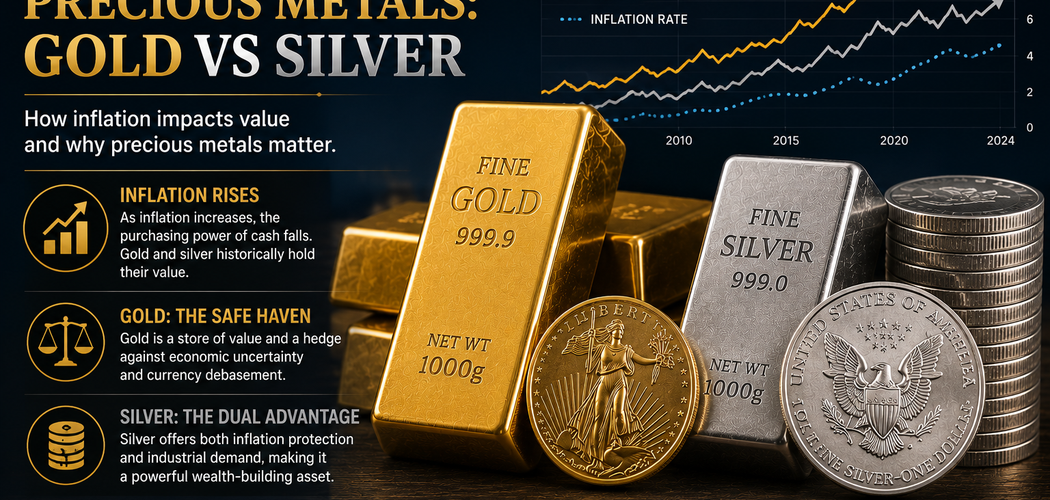
Inflation affects almost every part of an economy. Food, housing, transportation, wages, and business costs can all rise as purchasing power changes. For investors, understanding inflation and precious metals is important because gold and silver are often considered potential stores of value during inflationary periods.
However, neither metal automatically rises whenever consumer prices increase.
Gold has historically outpaced U.S. and global consumer price indexes over the long term, according to World Gold Council research. Yet its short-term relationship with inflation is less consistent.
Silver adds another complication. Besides being an investment metal, it has extensive industrial uses. Manufacturing activity, electronics, automobiles, power infrastructure, and solar technology can influence demand.
Therefore, investors should not assume that gold and silver will respond identically to inflation.
Understanding interest rates, real yields, currencies, investment flows, and industrial conditions provides a much clearer picture.
What Inflation Actually Means for Investors
Inflation describes a broad increase in the prices of goods and services over time.
When prices rise, each unit of currency generally purchases less than it did before.
Suppose someone holds $10,000 in cash while prices rise significantly over several years. The account may still display $10,000, but that money may purchase fewer goods and services.
This loss of purchasing power matters to long-term investors.
They often seek investments capable of generating returns that exceed inflation. Stocks, real estate, inflation-linked bonds, commodities, and precious metals can all play different roles.
This is where inflation and precious metals become connected.
Gold and silver are finite physical resources. Their supply cannot simply expand through a central bank decision.
However, limited supply does not guarantee rising prices. Demand must also remain strong.
Therefore, investors should evaluate metals within the wider economic environment rather than treating scarcity as sufficient protection.
Why Gold Is Associated With Inflation Protection
Gold has a centuries-long history as money and a store of value.
Today, investors continue to purchase bullion, while central banks hold gold as part of their reserves.
These monetary characteristics help explain why investors may become interested in gold when they worry about purchasing power.
World Gold Council data through 2025 shows that gold has outpaced U.S. and global consumer price indexes since 1971. Its research also found stronger average gold performance during periods of higher inflation.
However, that does not mean gold tracks inflation closely every year.
The World Gold Council has also found that changes in U.S. CPI alone explain relatively little of gold’s short-term price variation.
Therefore, gold may work better as a long-term purchasing-power consideration than as a precise short-term hedge against every inflation report.
Gold Does Not Track Consumer Prices Directly
Imagine that inflation unexpectedly rises from 2% to 5%.
An investor might assume gold should immediately increase by a similar amount.
Markets do not work that simply.
Investors will also ask how the central bank might respond. If policymakers aggressively raise interest rates, bond yields could increase.
The currency might strengthen as well.
Those developments could create pressure on gold even while inflation remains elevated.
Consequently, inflation and precious metals should always be analyzed alongside monetary policy.
Real Interest Rates Are Crucial
One of the most important concepts for gold investors is the real interest rate.
Nominal rates are the rates investors see quoted on loans, savings accounts, and bonds.
Real rates account for inflation.
Consider a simplified example. A bond yields 5%, while inflation is 2%. Its approximate real yield is positive.
Now suppose inflation rises above the bond’s yield. The inflation-adjusted return becomes much less attractive.
This matters because physical gold does not pay interest.
When real yields are high, investors can earn attractive inflation-adjusted returns from interest-bearing assets. Gold may face stronger competition.
When real yields fall, the opportunity cost of holding gold decreases.
World Gold Council research has found that rising real rates can create headwinds for gold, although other forces can offset that pressure.
Therefore, investors studying inflation and precious metals should watch both inflation and yields.
Central Bank Responses Can Change Everything
Inflation rarely exists in isolation.
Central banks often respond when price growth becomes too high.
One common response is raising interest rates.
Higher borrowing costs can slow spending, investment, housing activity, and economic growth. Policymakers hope that weaker demand will eventually reduce inflation.
For precious metals, this creates competing forces.
Inflation concerns can increase demand for tangible stores of value. At the same time, higher rates can make bonds and cash products more attractive.
Gold’s reaction depends partly on which force investors consider more important.
Silver faces the same monetary pressures. However, aggressive rate increases can also slow industrial activity.
That creates another potential source of weakness for silver.
Consequently, a central bank’s response can help explain why the two metals react differently during the same inflation cycle.
Why Silver Is Different From Gold
Silver is both a precious metal and an industrial commodity.
Investors buy silver bars, coins, and financial products. However, manufacturers also consume significant quantities.
The metal’s conductivity makes it valuable in electrical and electronic applications.
Silver is also used across automobiles, power grids, solar technologies, and other industrial markets.
In 2025, industrial silver demand totaled 657.4 million ounces despite declining 3% from the previous year. The Silver Institute reported continued support from AI infrastructure, automobiles, and power-grid investment.
This industrial role changes how silver reacts to inflation.
Rising prices can increase investment demand from people worried about purchasing power. Yet inflation can simultaneously increase manufacturing expenses and reduce consumer demand.
Therefore, silver can face both supportive and negative forces.
Industrial Costs Can Pressure Silver Demand
Inflation can raise the cost of energy, labor, transportation, raw materials, and financing.
Manufacturers then face a difficult choice.
They can absorb higher costs, reduce margins, raise prices, or find ways to use fewer expensive materials.
When silver itself becomes expensive, manufacturers have another incentive to reduce usage.
The solar industry provides a useful example.
Manufacturers have been working to reduce the amount of silver used in photovoltaic applications. The Silver Institute expects ongoing thrifting and substitution to reduce silver consumption in that sector during 2026 despite continued growth in global solar installations.
Therefore, high commodity prices can eventually change demand.
This feedback effect is particularly important when comparing silver with gold.
Investment Demand Can Support Both Metals
Inflation can change investor psychology.
If households see everyday prices rising quickly, concerns about purchasing power may increase.
Some investors respond by purchasing physical precious metals.
Historical silver data provides examples of this behavior. The Silver Institute reported that inflationary concerns helped drive strong physical silver investment in 2021.
However, institutional investors can react differently.
During 2022, inflation supported strong retail bar and coin demand. Yet the resulting Federal Reserve rate increases and higher U.S. yields created pressure on institutional silver investment.
This illustrates an important lesson about inflation and precious metals.
Different groups can react differently to the same economic environment.
Retail investors may focus on purchasing-power protection, while institutional investors may respond more strongly to yields and monetary policy.
Currency Movements Also Matter
Gold and silver are commonly quoted internationally in U.S. dollars.
Therefore, currency movements can affect precious metal demand.
Suppose U.S. inflation rises and the Federal Reserve responds with aggressive rate increases.
Higher yields might attract international capital and support the dollar.
A stronger dollar can make gold and silver more expensive for buyers using other currencies.
That may reduce some international demand.
However, the opposite can happen if investors believe inflation is damaging confidence in the currency.
For investors outside the United States, local currency movements create another layer.
Gold could decline in dollars but rise in another currency if that currency weakens enough.
Therefore, inflation and precious metals should be evaluated from both global and local perspectives.
Purchasing power ultimately matters in the currency an investor actually spends.
Supply Cannot Respond Immediately
Gold and silver mining projects require significant time and investment.
Companies must explore deposits, complete feasibility studies, obtain permits, secure financing, build infrastructure, and construct mining operations.
Therefore, higher metal prices do not immediately create large increases in supply.
This can become important during inflationary commodity cycles.
If demand rises rapidly while mining output changes slowly, prices may experience additional upward pressure.
Silver faces another complication because much of its production comes as a by-product of mining other metals.
As a result, silver production decisions may depend partly on copper, lead, zinc, or gold economics.
However, recycling can respond faster.
Higher prices encourage households and businesses to sell old jewelry, silverware, industrial scrap, and other recoverable material.
For example, silver recycling reached a 12-year high in 2025 as elevated prices encouraged additional selling.
Gold May Behave More Defensively
Gold’s demand structure gives it a stronger monetary profile.
Central banks hold gold. Institutional and retail investors purchase it. Jewelry also represents a major source of global demand.
Industrial consumption is comparatively less important.
Therefore, a slowdown in manufacturing does not affect gold in the same way it can affect silver.
This difference becomes important during stagflation.
Stagflation describes an environment with elevated inflation and weak economic growth.
Gold may receive support from inflation concerns, financial uncertainty, or falling confidence.
Silver can receive similar investment demand. However, weak industrial activity may create a competing negative force.
This helps explain why inflation and precious metals can produce different outcomes even when both metals initially respond to the same inflation concerns.
Silver Can Benefit During Strong Economic Inflation
Not every inflationary environment involves weak growth.
Sometimes inflation rises while economic activity remains strong.
Businesses expand production. Consumers continue spending, and manufacturers require more raw materials.
This type of environment may provide silver with an additional advantage.
Investment demand can respond to inflation while industrial consumption remains healthy.
For example, silver industrial demand reached a record 680.5 million ounces in 2024, supported by grid infrastructure, vehicle electrification, photovoltaic applications, and AI-related uses.
However, strong growth can eventually encourage central banks to maintain higher interest rates.
Therefore, the environment can change.
Investors need to distinguish between inflation caused by strong demand and inflation accompanied by economic weakness.
Deflation Can Also Affect Precious Metals
Inflation receives most of the attention, but falling prices can matter too.
Deflation generally involves declining prices across an economy.
It may accompany weak demand, falling investment, high debt burdens, and financial stress.
At first, deflation may appear negative for gold because cash gains purchasing power.
However, severe deflation can also encourage central banks to lower interest rates or introduce monetary stimulus.
Financial instability may increase defensive investment demand as well.
World Gold Council research notes that gold has the capacity to perform during deflationary periods because low rates and financial stress can support investment demand.
Silver may face greater challenges if deflation accompanies a major industrial contraction.
Again, the metals’ different demand structures influence their behavior.
Inflation Expectations Can Move Markets Early
Financial markets are forward-looking.
Gold and silver do not necessarily wait for official inflation statistics before moving.
Investors continuously analyze energy prices, wages, supply chains, economic growth, government spending, and central bank policy.
If traders expect inflation to accelerate, they may adjust positions months before official data confirms the trend.
The same happens when inflation is expected to decline.
Therefore, a surprisingly high inflation report does not guarantee that precious metals will rise that day.
The market may have anticipated the number.
Alternatively, investors may focus more heavily on what the report means for future interest rates.
Understanding expectations is essential when analyzing inflation and precious metals because current prices already reflect many assumptions about the future.
Gold Can Protect Purchasing Power Without Moving With CPI
Investors sometimes misunderstand what an inflation hedge should do.
They may expect gold to rise every month that consumer prices increase.
However, long-term purchasing-power preservation does not require a perfect short-term correlation.
World Gold Council research emphasizes this distinction. Gold has historically performed well over long periods of inflation, but its direct relationship with short-term CPI changes has been relatively weak.
This means investors should judge gold over appropriate time horizons.
A one-month or one-year comparison may provide little information about its long-term role.
The same principle applies to many real assets.
Prices respond to expectations, interest rates, risk premiums, currencies, supply, and demand rather than mechanically following inflation statistics.
Avoid Treating Precious Metals as Guaranteed Hedges
Gold and silver can both lose value during inflationary periods.
That fact does not necessarily invalidate their potential portfolio roles.
Instead, it demonstrates that many variables influence market prices.
Investors should avoid making oversized purchases simply because inflation has increased.
Another mistake is assuming that silver must outperform because its price per ounce is lower than gold.
Price per ounce does not determine whether an asset is cheap or expensive.
Likewise, investors should not assume that gold’s historical reputation guarantees future returns.
A responsible inflation and precious metals strategy recognizes uncertainty.
Position size, diversification, investment horizon, liquidity, and costs remain important regardless of the inflation outlook.
How Investors Can Monitor Inflation Conditions
Investors can follow several indicators rather than relying on one inflation number.
Consumer price indexes provide information about household prices.
Producer prices can reveal cost pressures earlier in supply chains.
Wage growth may indicate whether inflationary pressures are becoming persistent.
Interest rates and government bond yields show how monetary policy and financial markets are responding.
Real yields can provide additional insight into the opportunity cost of owning precious metals.
The U.S. dollar deserves attention because currency movements influence international gold and silver prices.
For silver, investors should also monitor manufacturing activity and industrial demand.
Finally, precious metal investment flows can reveal how other investors are responding.
Combining these indicators creates a stronger framework than buying or selling based on a single CPI release.
Gold and Silver Can Serve Different Portfolio Roles
Investors do not necessarily need to choose between gold and silver.
The metals can serve complementary purposes.
Gold may provide greater exposure to monetary conditions, central bank demand, and defensive investment behavior.
Silver can add industrial exposure and potentially greater upside during periods when strong economic activity combines with precious metal demand.
However, silver’s higher sensitivity to economic conditions can increase volatility.
Therefore, equal dollar allocations do not necessarily create equal risk.
An investor primarily concerned about long-term purchasing power may emphasize gold. Someone seeking additional exposure to industrial commodity trends may include more silver.
The appropriate combination depends on the entire portfolio rather than one economic forecast.
Think Beyond a Single Inflation Cycle
Long-term investors will experience many economic environments.
Inflation may rise, decline, or remain stable. Interest rates will change. Recessions and expansions will occur.
A portfolio designed only for one predicted scenario can become vulnerable when conditions change.
Therefore, precious metals should be evaluated as part of a diversified long-term strategy.
Gold may perform differently during inflation, deflation, financial stress, and economic expansion.
Silver’s industrial role adds another source of diversification but also greater cyclicality.
Understanding these characteristics can help investors decide what role each metal should play.
The goal should not be predicting every inflation report correctly.
Instead, investors can build portfolios capable of operating across several possible economic environments.
Conclusion
Inflation can increase interest in gold and silver because investors worry about declining purchasing power. However, the relationship is far more complicated than simply assuming higher inflation means higher precious metal prices.
Gold has historically preserved purchasing power over long periods, although its short-term relationship with consumer inflation is inconsistent. Interest rates, real yields, currencies, central bank demand, and investor sentiment can all influence performance.
Silver responds to many of those same forces. Yet industrial demand adds another major variable.
Strong economic activity can support silver consumption, while a slowdown can weaken it. Manufacturers may also reduce silver usage when prices become expensive.
Therefore, inflation and precious metals should be understood through a broad economic framework.
Investors can monitor inflation expectations, real yields, currencies, industrial demand, monetary policy, and supply conditions rather than focusing on CPI alone.
Most importantly, neither metal should be treated as guaranteed protection.
A disciplined approach uses precious metals alongside other assets, maintains reasonable position sizes, and considers long-term financial objectives.
Understanding inflation and precious metals in this way helps explain why gold and silver can react differently even when they face exactly the same inflationary environment.
FAQ
1. Does Gold Always Rise When Inflation Increases?
No. Gold can benefit from inflation concerns, but interest rates, real yields, currencies, central bank activity, and investment demand can offset or amplify the effect.
2. Why Can Silver React Differently From Gold?
Silver has substantial industrial demand. Manufacturing activity, technology, automobiles, power infrastructure, and solar applications can influence its price alongside monetary factors.
3. Are Real Interest Rates Important During Inflation?
Yes. Real rates account for inflation and help show the inflation-adjusted return available from interest-bearing assets. Higher real yields can increase competition for non-yielding precious metals.
4. Can Silver Benefit From High Inflation?
It can, especially when investment demand rises while industrial activity remains strong. However, high inflation can also increase manufacturing costs and trigger interest-rate increases.
5. Should Investors Buy Precious Metals Only Because Inflation Is Rising?
Not necessarily. Inflation is only one market driver. Investors should consider diversification, risk tolerance, costs, interest rates, currencies, and investment horizons when building an inflation and precious metals strategy.

