

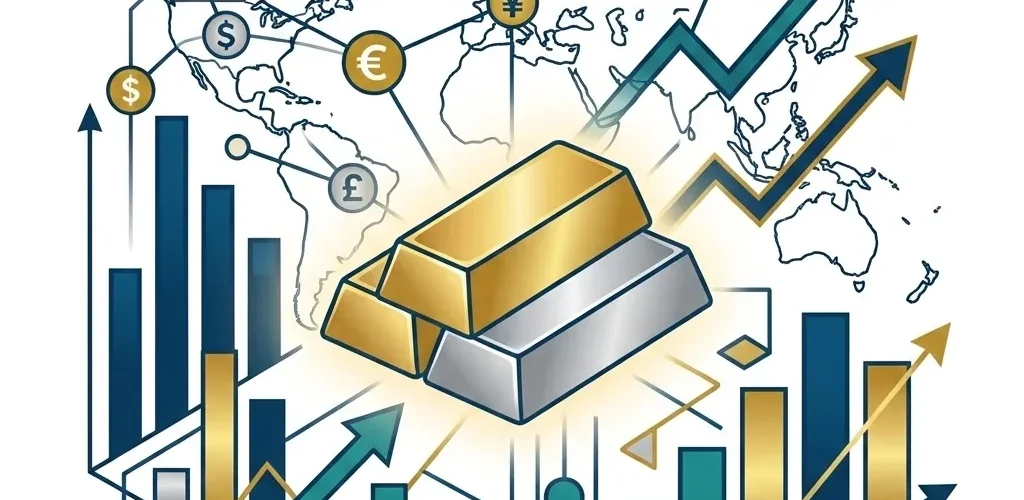
The precious metals market has been a whirlwind of activity, especially in 2025 and early 2026. We saw gold repeatedly hit new all-time highs, briefly surpassing $5,000 per ounce, and silver demonstrated explosive growth, reaching $111.36 per ounce by January 2026. Such dramatic movements often leave investors, particularly cautious newcomers like Sarah, wondering: what exactly is fueling these shifts? This article will delve into the multifaceted factors driving gold silver prices, providing clarity and empowering you to understand the market’s underlying mechanics.
For individuals seeking foundational knowledge or experienced investors looking for advanced insights, comprehending these market dynamics is essential. We aim to simplify complex topics, acting as your guiding mentor in the world of precious metals investments. By the end, you will possess a clearer picture of how various global forces converge to influence these valuable assets.
Macroeconomic Influences on Precious Metals
Precious metals are highly sensitive to broader economic conditions. Several macroeconomic elements played a pivotal role in recent market surges. Understanding these overarching trends is crucial for any investor.
Inflation Fears and Currency Weakness
When inflation looms or the purchasing power of fiat currencies (like the U.S. dollar) weakens, gold historically shines as a hedge. Investors, therefore, seek tangible assets that retain value. The weakening U.S. dollar was a significant influence in the 2025-2026 rallies, consequently making dollar-denominated gold and silver more attractive to international buyers. This phenomenon highlights gold’s role as a traditional inflation hedge, a characteristic that remains relevant across economic cycles.
Interest Rates and Central Bank Policy
Interest rate decisions by central banks profoundly impact gold. Higher interest rates typically increase the opportunity cost of holding non-yielding assets like gold, potentially dampening demand. Conversely, lower rates make gold more appealing. A crucial structural influence in recent years has been central bank accumulation of gold, with 95% of central banks expecting global gold reserves to rise in 2026, signaling a strong institutional belief in gold’s enduring value. For more on this, consider exploring our article on Interest Rates and Gold: How Rates Affect Prices.
Mounting Government Debts
Concerns over mounting government debts globally also propelled investors towards precious metals in 2025-2026. High debt levels can signal potential economic instability or future inflation, reinforcing gold’s role as a safe haven asset. This is because investors often view precious metals as a secure store of wealth when confidence in government fiscal health wavers. In fact, sovereign debt issues frequently correlate with increased demand for gold and silver.
Geopolitical Landscape and Safe-Haven Demand
Geopolitical uncertainty is a powerful catalyst for precious metals. Conflicts like those in the Middle East and the Russia/Ukraine war create an environment of global instability, driving investors to traditional safe havens. Gold, in particular, is often seen as the ultimate store of value during times of crisis, explaining its consistent appeal even amidst market corrections. This flight to safety underscores gold’s enduring psychological importance in volatile times. For context on past events, our Warsh’s Hawkish Jackson Hole Speech Sends Gold Sharply Lower article provides insight into how policy statements can interact with market sentiment.
The Unique Role of Industrial Demand (Especially for Silver)
While gold is primarily an investment and jewelry metal, silver boasts significant industrial demand. It’s a critical component in solar panels, electric vehicles, electronics, and medical devices. Strong industrial demand for silver was a key factor driving gold silver prices for silver’s explosive growth of 149.1% in 2025. This dual nature means silver can benefit from both safe-haven investment flows and economic expansion, contributing to its higher volatility but also its remarkable upside potential. Consequently, the global push towards green energy and technological advancement directly impacts silver’s market value.
Understanding Market Sentiment and Speculation
Beyond fundamental economic and geopolitical forces, market sentiment and speculative trading also play a significant role in influencing precious metal valuations. Investor psychology, often driven by fear or greed, can amplify price movements. For example, widespread bullish sentiment can lead to increased buying, pushing prices higher, sometimes even beyond what fundamentals might suggest. Conversely, negative sentiment can trigger sell-offs. This emotional aspect of the market, therefore, requires careful consideration.
The Influence of Futures Markets
Futures markets are particularly influential in setting short-term precious metal prices. Large institutional investors and hedge funds actively trade contracts for future delivery of gold and silver. Their collective positions and speculative bets can create significant price momentum. When these large players take a strong directional stance, it can notably impact the spot price. Thus, monitoring these markets provides valuable clues about potential price movements.
Retail Investor Participation
Retail investors, though individually smaller, collectively represent a substantial force. Social media trends, investment forums, and easily accessible trading platforms have empowered more individuals to participate in the precious metals market. Surges in retail buying can sometimes create localized demand spikes, particularly for physical bullion. This broad participation, in turn, contributes to the overall market dynamics and the factors driving gold silver prices.
Supply-Side Dynamics: Mining and Production
The supply of gold and silver is another critical element determining their market value. Unlike fiat currency, precious metals have a finite supply, primarily sourced through mining operations. Changes in mining output, discoveries of new deposits, or disruptions to existing operations can all impact the global supply. For example, a significant new gold discovery could, in theory, increase supply and put downward pressure on prices, while a major mining strike could have the opposite effect. Our section on Mining News, Mining Stocks, Junior Mining offers further insights into this sector.
Mining Costs and Sustainability
The cost of mining also plays a role. As easily accessible deposits are depleted, miners must explore more challenging and expensive extraction methods. These rising production costs can set a floor for precious metal prices, as miners need to cover their expenses to remain profitable. Furthermore, growing concerns about environmental sustainability and ethical sourcing can influence mining practices and, consequently, supply. These considerations are becoming increasingly important for investors.
Recycling and Secondary Supply
Beyond newly mined metals, recycling contributes significantly to the overall supply. Gold and silver from old jewelry, industrial scrap, and electronic waste are continually re-entering the market. The volume of recycled metal often increases when prices are high, as it becomes more economically viable to recover these materials. This secondary supply, therefore, acts as a dynamic component of the total available metal, further impacting the factors driving gold silver prices.
Technological Advancements and Demand Shifts
Technological advancements are continuously reshaping demand for certain precious metals, especially silver. As mentioned, silver’s role in solar technology and electric vehicles is expanding rapidly. Innovations in these fields can lead to increased demand for silver, even as other industrial applications might evolve. For instance, new battery technologies or advancements in photovoltaic cells could significantly alter future demand projections for silver. This evolving technological landscape means that the industrial demand component is not static.
Gold’s Role in Emerging Technologies
While silver’s industrial applications are more diverse, gold also finds its place in high-tech components, particularly in electronics where its conductivity and corrosion resistance are invaluable. Miniaturization and the increasing complexity of electronic devices mean that even small amounts of gold per unit can add up to substantial overall demand. Thus, the continuous march of technological progress is among the subtle but persistent factors driving gold silver prices.
Investment Demand: ETFs, Bullion, and Digital Gold
Investment demand remains a cornerstone for precious metal pricing. This demand comes in various forms, from physical bullion to exchange-traded funds (ETFs) and even emerging digital gold platforms. Each avenue offers different benefits and attracts different types of investors, yet all contribute to overall market demand.
ETFs and Institutional Investment
Gold and silver ETFs provide an accessible way for institutional and retail investors to gain exposure to precious metals without holding physical assets. Large inflows into these funds can significantly boost demand, affecting spot prices. Moreover, institutional investors often utilize ETFs as a strategic allocation tool within diversified portfolios. This institutional interest is a powerful factor driving gold silver prices.
Physical Bullion and Retail Demand
The demand for physical gold and silver bullion (coins and bars) also remains strong, particularly among retail investors and those seeking a tangible hedge against economic uncertainty. During times of crisis or high inflation, there is often a noticeable surge in demand for physical assets. This direct investment in tangible assets reflects a deep-seated trust in precious metals as a store of value.
The Interplay of All These Elements
Ultimately, the price of gold and silver is not determined by a single factor but by a complex interplay of all these elements. Macroeconomic trends, geopolitical events, industrial applications, supply-side dynamics, and investor sentiment all converge to create the dynamic market we observe. Understanding how these forces interact is key to making informed investment decisions. For example, while rising interest rates might typically dampen gold demand, severe geopolitical instability could override this effect, pushing prices higher despite the rate hike. This intricate dance of variables makes the precious metals market both challenging and rewarding to navigate.
As an investor, your ability to discern these connections will empower you. Instead of reacting to headlines, you will comprehend the underlying currents. This holistic perspective is precisely what allows for confident, strategic participation in the precious metals market, transforming uncertainty into informed opportunity.
Conclusion
The journey to confidently navigate precious metals investments begins with a clear understanding of the forces at play. We’ve explored the significant factors driving gold silver prices, from macroeconomic indicators like inflation and interest rates to geopolitical stability, industrial innovation, and diverse investment channels. Gold and silver, while sharing some common drivers, also possess unique characteristics that influence their individual price trajectories. By appreciating this multifaceted landscape, you are better equipped to interpret market movements and make strategic decisions. Remember, knowledge is your most valuable asset in the world of precious metals. Continue to seek reliable, expert-led information, and you will build a solid foundation for your investment success.
FAQ
What are the primary influences on precious metal valuations?
The primary influences include macroeconomic conditions such as inflation and interest rates, geopolitical stability, industrial demand (especially for silver), and investor sentiment. Supply-side factors like mining output and recycling also play a significant role.
How do interest rates affect the value of gold?
Typically, higher interest rates increase the opportunity cost of holding non-yielding assets like gold, making it less attractive. Conversely, lower interest rates tend to make gold more appealing as an investment. However, other factors can sometimes override this general trend.
Why is silver often more volatile than gold?
Silver’s higher volatility stems from its dual nature as both an investment metal and an industrial commodity. Its significant industrial demand means its price can be heavily influenced by economic cycles and technological advancements, in addition to safe-haven demand, leading to larger price swings.
How do central banks impact gold prices?
Central banks impact gold prices through their monetary policies, which affect currency values and interest rates. Additionally, their direct purchases or sales of gold reserves can significantly influence global demand and market sentiment, signaling institutional confidence in the metal.
What role does industrial demand play for silver?
Industrial demand is crucial for silver, as it is a vital component in many high-tech applications like solar panels, electric vehicles, and electronics. Strong growth in these sectors can lead to increased demand for silver, providing a unique price driver compared to gold, which is primarily an investment and jewelry metal.

