

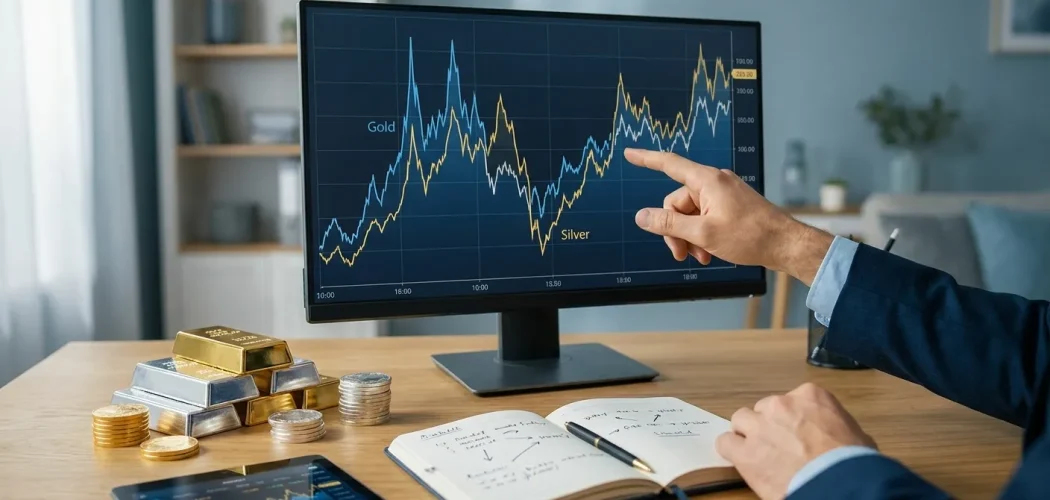
For new investors like Sarah, the recent headlines about gold and silver’s meteoric rises and subsequent corrections can be both exciting and daunting. Understanding gold silver price volatility is key to managing expectations and building a resilient investment strategy. At Silver Price Gold, we believe that informed investors are confident investors, even amidst market swings. Consequently, we aim to provide clarity on these complex market movements, empowering you to make sound decisions.
The Record-Breaking Surge of 2025 and Early 2026
The years 2025 and early 2026 were truly remarkable for precious metals. Gold surged above $4,000 per ounce in 2025, setting a new all-time high. It then continued its ascent, surpassing $5,000/oz for the first time in January 2026, even briefly peaking near $5,600 per ounce. This represented an approximately 65% gain for gold in 2025 alone, its strongest annual performance since 1979. Many market observers were caught off guard by the sheer pace of this appreciation. Indeed, the sentiment was often expressed as, “Gold: ‘You’re Not Bullish Enough’” during this period.
Silver’s performance was even more astonishing. It surpassed $60 per ounce in 2025, with some reports indicating a surge of 149.1% for the year. This momentum carried into 2026, with prices reaching over $80 by the end of 2025 and hitting an all-time high of $121.62 in January 2026. These incredible gains captured global attention. Furthermore, they highlighted the immense potential of precious metals as a strategic asset. The market was abuzz, and many new participants entered, drawn by the rapid appreciation.
The Inevitable Correction: What Happened After the Peaks?
As with any rapidly appreciating asset, significant corrections often follow periods of intense growth. Both gold and silver experienced notable pullbacks after their January 2026 peaks, demonstrating the inherent gold silver price volatility. Gold fell approximately 28% from its high of $5,589.38 on January 28, 2026, settling around $4,046 by July 2026. Silver, being a smaller and less liquid market, saw an even deeper correction, dropping over 52% from its peak of $121.62 to roughly $58 by July 2026. These movements illustrate the dynamic nature of these markets.
These corrections, while significant, are not uncommon in volatile markets. They often represent profit-taking by early investors, a re-evaluation of market conditions, or a shift in broader economic sentiment. For new investors, understanding that such corrections are a natural part of market cycles, rather than a sign of inherent weakness, is crucial. It reinforces the importance of a long-term perspective rather than reacting to short-term fluctuations. Consequently, maintaining a steady hand is paramount.
Why Such Volatility? The Dynamics at Play
The intensity of gold and silver price fluctuations can be attributed to several factors. Each plays a role in shaping the market’s movements.
- Market Size and Liquidity: The silver market, in particular, is significantly smaller and less liquid than gold’s. This means that relatively smaller amounts of capital moving in or out can have a more pronounced effect on prices, leading to sharper swings. Therefore, silver often exhibits greater percentage swings than gold.
- Investor Sentiment and Speculation: Periods of rapid price appreciation often attract speculative interest, where investors buy with the expectation of quick gains. When prices begin to falter, these speculative positions can unwind rapidly, exacerbating downward pressure. This contributes significantly to precious metals price swings.
- Economic Indicators: Macroeconomic data, such as inflation reports, interest rate decisions, and employment figures, profoundly influence investor perceptions of gold and silver. For instance, strong economic growth or rising interest rates can diminish gold’s appeal as a safe haven, while inflation concerns typically bolster it. Our article on “Interest Rates and Gold: How Rates Affect Prices” provides further insights into this relationship.
- Geopolitical Events: Global instability, conflicts, or major political shifts historically drive investors towards safe-haven assets like gold. However, resolution of such events can lead to a reversal of these flows. This directly impacts the stability of precious metals prices.
- Industrial Demand: Silver, unlike gold, has significant industrial applications. Demand from sectors like solar panels, electronics, and medical devices can influence its price. This adds another layer of complexity to silver’s price movements. Consequently, a downturn in industrial activity can depress silver prices.
- Currency Fluctuations: Gold and silver are typically priced in U.S. dollars. A stronger dollar makes precious metals more expensive for international buyers, potentially dampening demand, and vice versa. This inverse relationship is a key driver of price movements.
Understanding Gold and Silver Price Volatility: A Deeper Look
Delving deeper into the factors affecting gold silver price volatility reveals a complex interplay of forces. The gold market, while also subject to swings, often acts as a more stable store of value due to its larger market size and established role in global finance. Silver, often called

