

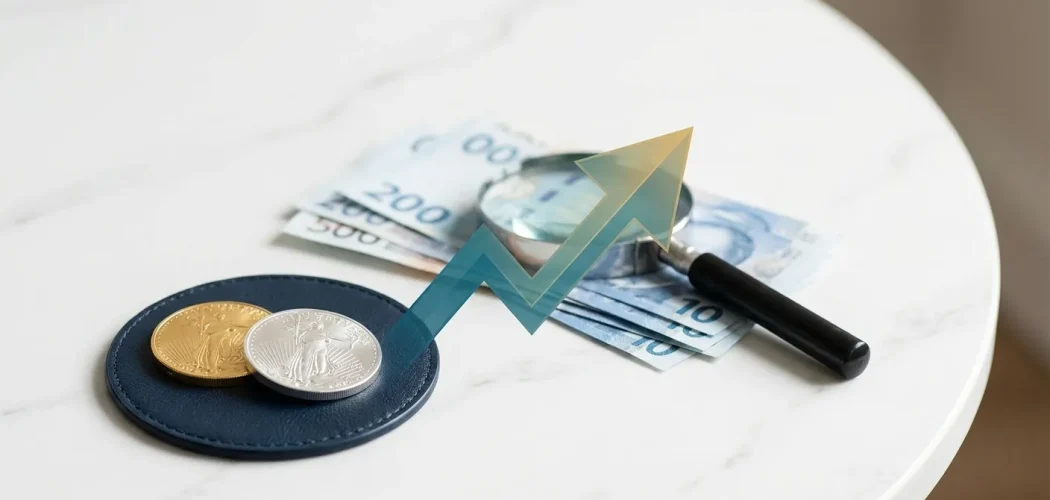
One of the most common questions new investors like Sarah have about precious metals is: “Do gold and silver truly protect against inflation?” The answer, while often presented as a simple ‘yes,’ is more nuanced. Understanding the inflation impact on gold and silver requires looking beyond the headlines and into the underlying economic mechanics. At Silver Price Gold, we simplify these complexities so you can invest with confidence, not confusion.
Precious metals are traditionally seen as inflation hedges because, unlike fiat currencies, their supply cannot be arbitrarily increased by governments. When the purchasing power of money erodes due to inflation, tangible assets like gold and silver tend to hold their value, or even increase, as more devalued currency is needed to buy the same amount of metal. This intrinsic characteristic makes them attractive during periods of rising prices. Furthermore, the finite nature of these metals provides a foundational stability that paper assets often lack during periods of economic uncertainty. Historically, civilizations have turned to gold and silver during times of monetary instability, reinforcing their role as reliable stores of value.
The Nuance: Inflation, Interest Rates, and Market Dynamics
While the general principle holds, the relationship isn’t always linear. Here’s where it gets interesting: accelerating inflation can sometimes lead to expectations of higher short-term interest rates. When central banks raise interest rates to combat inflation, it can paradoxically make non-yielding assets like gold less attractive compared to interest-bearing investments. This explains why, in some scenarios, gold prices might face downward pressure even amidst rising inflation. For a deeper understanding of this dynamic, explore our article on Interest Rates and Gold: How Rates Affect Prices.
However, the tide can turn. If interest rates decline while inflation remains elevated – a scenario often described as ‘stagflation’ or a period of ‘real negative interest rates’ – conditions become highly favorable for gold and silver. In such an environment, the return from traditional savings or bonds is outpaced by inflation, making precious metals shine as a superior store of value. Consequently, investors often reallocate capital into assets perceived as safer havens. This complex interplay between monetary policy and market sentiment is crucial for understanding the true hedging capabilities of precious metals.
2025 Insights: Gold’s Performance Amidst Persistent Inflation
The year 2025 offered a powerful demonstration of gold’s role as an inflation hedge. Despite initial market volatility, gold’s performance amidst persistent inflation became particularly evident, helping it surge above $4,000 per ounce and establish a new all-time high. This wasn’t just a coincidence; it reflected investors’ flight to safety and tangible assets as concerns about the long-term erosion of currency value mounted. Moreover, this period underscored the market’s growing distrust in conventional monetary solutions.
This period highlighted that when inflation is a sustained and significant concern, and particularly when real interest rates are low or negative, gold tends to perform strongly. For a cautious investor like Sarah, seeing gold rise approximately 65% in 2025, its strongest annual gain since 1979, provides compelling evidence of its potential to preserve wealth during inflationary times. Similarly, many investors were asking, “Gold: ‘You’re Not Bullish Enough’,” reflecting broad market sentiment.
Silver’s Role: Industrial Demand and Inflation
Silver also plays a role in inflation protection, though its market dynamics are slightly different due to its significant industrial demand. While gold is primarily a monetary metal, silver serves a dual purpose: a store of value and a critical industrial component. Its use in solar panels, electronics, and medical applications means that its price is also influenced by global economic growth and technological advancements. Therefore, when industrial demand is robust, silver can perform well even in periods of moderate inflation.
However, during periods of high inflation, silver’s monetary characteristics often come to the forefront. Investors seeking protection from currency devaluation often turn to silver alongside gold. The relatively smaller market size of silver, compared to gold, can sometimes lead to greater price volatility, both upwards and downwards. Nevertheless, its affordability and dual demand profile make it an attractive option for diversifying a precious metals portfolio. Many track silver’s performance closely, as seen in Silver News August 2026.
Understanding Real Interest Rates and the Inflation Impact on Gold
To truly grasp the inflation impact on gold, it’s essential to understand real interest rates. Real interest rates are simply nominal interest rates minus the rate of inflation. When real interest rates are negative, meaning inflation is higher than the interest earned on savings or bonds, the opportunity cost of holding non-yielding assets like gold decreases. In fact, gold becomes more attractive as traditional investments lose purchasing power. This environment often encourages investors to seek tangible assets.
Consider a scenario where a savings account offers a 2% nominal interest rate, but inflation is running at 4%. Your real return is -2%. In this situation, your money is losing value simply by sitting in the bank. This makes the prospect of holding gold, which maintains its intrinsic value, much more appealing. Consequently, demand for gold tends to rise, pushing its price higher. This inverse relationship between real interest rates and the value of gold is a cornerstone of understanding its role as an inflation hedge. The market closely watches indicators like PCE inflation, as discussed in Gold looks to PCE inflation, Jackson Hole for direction next week.
Historical Context: Gold’s Performance During Past Inflationary Eras
Examining historical periods of high inflation provides valuable insights into how gold behaves. During the 1970s, for example, the United States experienced significant inflation, and gold prices surged dramatically. From 1971 to 1980, gold rose from approximately $35 per ounce to over $800 per ounce, demonstrating its potent ability to protect wealth during times of monetary instability. This historical precedent offers a compelling case for gold’s hedging capabilities.
Similarly, during periods of economic uncertainty and currency debasement, central banks and individual investors alike have historically turned to gold. It acts as a universal currency, recognized and valued across cultures and geopolitical boundaries. This enduring trust in gold’s value, especially when fiat currencies are under pressure, solidifies its position as a reliable safe-haven asset. Moreover, these historical patterns are often studied by those seeking to predict future market movements.
The Role of Investor Sentiment and Supply Constraints
Beyond economic fundamentals, investor sentiment plays a significant role in the inflation impact on gold and silver prices. When confidence in government fiscal policies or central bank actions wanes, investors often flock to precious metals. This ‘flight to safety’ can create strong upward momentum, irrespective of short-term interest rate fluctuations. Fear and uncertainty, therefore, can be powerful drivers of demand.
Furthermore, the finite supply of gold and silver is a constant factor. Unlike paper money, which can be printed endlessly, the amount of gold and silver available is limited by geological realities and mining capabilities. This inherent scarcity provides a floor to their value and contributes to their long-term stability. While mining operations continue, the rate of new discoveries and extraction is relatively slow, ensuring that supply remains constrained compared to ever-expanding fiat money supplies. This fundamental scarcity is a key reason for their enduring appeal, especially during inflationary periods. Mining News, Mining Stocks, Junior Mining provides further insights into the supply side.
Understanding Different Types of Inflation and Their Effects
It is also important to differentiate between various types of inflation, as their effects on precious metals can vary. Demand-pull inflation, often caused by too much money chasing too few goods, tends to be more straightforwardly supportive of gold and silver prices. As purchasing power erodes, people seek tangible assets. On the other hand, cost-push inflation, driven by rising production costs, might have a more complex impact, especially if it leads to an economic slowdown or recession.
Stagflation, a particularly challenging economic environment characterized by high inflation and stagnant economic growth, is historically one of the most favorable scenarios for precious metals. In such a climate, traditional investments often struggle, making gold and silver stand out as robust protectors of wealth. Therefore, understanding the underlying causes and characteristics of inflation is crucial for making informed investment decisions. This deeper insight helps investors navigate complex economic landscapes with greater clarity.
The Long-Term Perspective: Gold and Silver as Wealth Preservers
For individuals seeking to preserve wealth over the long term, the inflation impact on gold and silver is a critical consideration. While there can be short-term volatility, the historical trend shows that precious metals have consistently maintained their purchasing power across centuries. They act as a hedge against the inevitable debasement of fiat currencies over extended periods. This makes them a fundamental component of a diversified portfolio.
Investing in gold and silver is not merely about chasing speculative gains; it is about establishing a foundation of stability for your financial future. They offer a tangible, universally recognized form of wealth that is independent of any single government or financial institution. As such, they provide a powerful sense of security, particularly for those concerned about systemic risks and the long-term erosion of currency value. This enduring appeal makes them more than just commodities; they are guardians of purchasing power. The recent surge above $4,600/oz further reinforces this perspective, as seen in Wall Street bereft of bears after gold smashes $4,600/oz.
Navigating Market Volatility with Precious Metals
Market volatility is an inherent part of investing, and understanding how precious metals respond to it is key. During periods of heightened uncertainty, whether due to geopolitical tensions, financial crises, or inflationary pressures, gold and silver often act as safe havens. Investors tend to reallocate assets from riskier ventures into these tangible stores of value, providing a stabilizing force within a portfolio. This behavior is a testament to their perceived reliability in turbulent times.
However, it is important to remember that even precious metals can experience short-term price fluctuations. The goal is not necessarily to avoid all volatility, but to position your portfolio to withstand economic shocks. By including gold and silver, investors can mitigate the overall risk of their holdings, especially against the backdrop of an uncertain economic future. This strategic allocation helps to smooth out returns and protect against unforeseen events. For example, even hawkish speeches can impact prices, as noted in Warsh’s Hawkish Jackson Hole Speech Sends Gold Sharply Lower.
Conclusion: Confidently Understanding the Inflation Impact on Gold and Silver
The relationship between inflation and precious metals is complex, yet undeniably significant for investors. While not a simple, linear correlation, gold and silver have consistently demonstrated their ability to act as powerful hedges against the erosion of purchasing power, particularly during periods of sustained inflation and negative real interest rates. The inflation impact on gold can be profoundly positive under the right economic conditions.
At Silver Price Gold, we empower you with the knowledge to navigate these complexities. By understanding the interplay of inflation, interest rates, and market dynamics, you can make informed decisions and confidently integrate gold and silver into your investment strategy. Whether you are a beginner investor like Sarah or an experienced market participant, our goal is to provide clarity and confidence in your journey through precious metals. We encourage you to continue learning and building a resilient portfolio. For further research, consider resources like the World Gold Council or the Kitco News for additional perspectives on gold’s role in the economy.
FAQ: Demystifying Precious Metals and Inflation
Does gold always rise during inflation?
Not always. While gold is generally considered an inflation hedge, its performance is also influenced by real interest rates. If nominal interest rates rise faster than inflation, making traditional investments more attractive, gold might face downward pressure. However, during periods of high or persistent inflation with low or negative real interest rates, gold typically performs strongly.
How does silver’s role as an inflation hedge differ from gold’s?
Silver shares gold’s monetary characteristics, acting as a store of value against currency debasement. However, silver also has significant industrial demand. This dual nature means its price can be influenced by both inflation concerns and global economic growth. In strong industrial economies, silver can benefit from increased demand for its practical uses, in addition to its appeal as an inflation protector.
What are ‘real negative interest rates’ and why are they good for precious metals?
Real negative interest rates occur when the rate of inflation is higher than the nominal interest rate offered on savings or bonds. In this scenario, your money loses purchasing power over time in traditional accounts. Precious metals become more attractive because they are non-yielding assets that tend to maintain or increase their intrinsic value, thereby preserving wealth more effectively than depreciating cash or low-yielding bonds.
Should I invest in gold and silver only when inflation is high?
While gold and silver often perform well during inflationary periods, they serve as long-term wealth preservers and portfolio diversifiers regardless of the immediate economic climate. Many investors include them as a hedge against unexpected economic shocks and currency debasement over time, not just in anticipation of high inflation. A balanced approach often includes precious metals as a core component.
What other factors influence the price of gold and silver besides inflation?
Beyond inflation and interest rates, several factors influence gold and silver prices. These include geopolitical stability, the strength of the U.S. dollar, investor sentiment (fear and greed), global supply and demand dynamics, mining output, and central bank policies. Each of these elements contributes to the complex market movements of precious metals.

