Silver Price Gold

Partner News

Partner News

Economist who called the 2008 crash says the AI bubble has “less than a year to go”

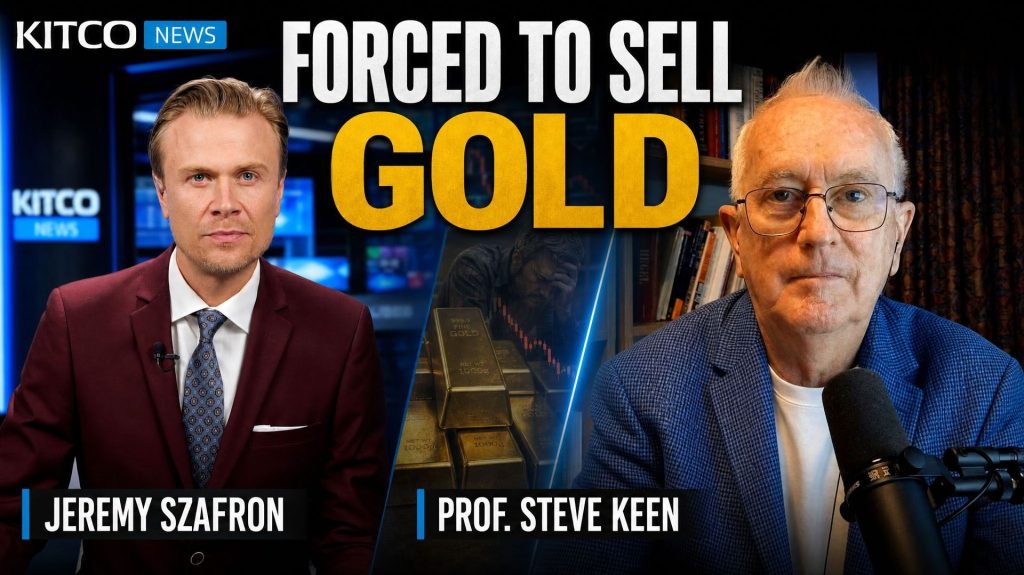
(Kitco News) – Steve Keen has spent two decades telling anyone who’ll listen that markets watch the wrong debt. This week he put a clock on it.”I would give the bubble in AI less than a year to go,” the Australian economist told Kitco News..embed-container { position: relative; padding-bottom: 56.25%; height: 0; overflow: hidden; max-width: 100%; } .embed-container iframe, .embed-container object, .embed-container embed { position: absolute; top: 0; left: 0; width: 100%; height: 100%; }The number at the centre of that call is difficult to verify from outside the companies themselves, and Keen did not provide the underlying data during the interview. His estimate is that revenue from users who’ll actually stick around runs at about a fifth of what these firms are spending.”Those frivolous users are disappearing, and the revenue from serious users, which may be sustained over time, looks like about one-fifth of the cost levels that these firms are caught up in,” he said. “So I expect massive losses coming out of that.”In 2010, readers of the Real-World Economics Review voted on which economist had warned earliest and most clearly about the coming financial crisis. Keen came first. Nouriel Roubini came second. He wrote “Debunking Economics,” built the modelling software Minsky and Ravel, and is writing How Economists Will Destroy Capitalism, which he said Polity Press plans to publish.Not a rerun of 2008Before going further, a qualification Keen made himself, and it matters more than anything else in the interview.He is not forecasting another banking-led collapse.”I’m not expecting a debt crisis this time round in the same way I did back in 2007, because the level of credit demand is quite low, relatively speaking,” he said. Using a series that extended only through the first quarter of 2025, Keen put the share of spending funded by new borrowing at roughly 4% to 6% of GDP. On his data it peaked at 15.4% in the third quarter of 2006.The trigger he’s watching comes from outside the financial system, from disrupted physical supply working its way into company cash flows.”It’s not a financial crisis like 2007. It’s a crisis of being able to service the financial sector debts because you’ve damaged the productive system,” he said. “We’re going to find companies which would normally be able to service their debts quite comfortably, suddenly find they won’t be able to get the inputs to produce the outputs.”What follows, he said, is “a patchwork” of bankruptcies.”Pickleball courts”The comparison he reaches for isn’t 2008. It’s the 1840s.”I think we’re about to see the bursting of a very large bubble on the scale of the railway bubbles back in the 19th century,” he said. “Because so many firms have thrown large amounts of money into data centers and AI.”Companies have borrowed more than $410 billion this year for data centres and other AI investments, according to data compiled by Bloomberg. QTS Realty sold $3.9 billion of bonds to fund a Georgia facility tied to Microsoft at a yield of about 7.23%, Bloomberg reported, noting the investment-grade paper yielded more than some mid-tier junk-rated debt. For context, the U.S. government borrows for 10 years at roughly 4.7%.Keen thinks the lenders will wish they’d charged more. “A lot of those data centres are going to find that 7% looks damn good compared to the losses you’re going to make.”He also pointed to something the housing bubble never had to deal with. A house still shelters people after 30 years. A GPU stops being competitive after three.”When you get data centres, after three or four years, the GPUs that drove that data centre are no longer competitive, so you’re forced to renew the investment again,” he said. “If you are not making the money that justifies it when you go to the renewal stage, you don’t.”Which leads him somewhere unflattering for the buildings themselves. “That’s why I think pickleball courts is a fairly sensible idea of how a lot of these data centres will end up being used.”So far, the market disagrees. August investment-grade issuance set a record for the month, following record totals for June and July, according to Bloomberg data, and demand has kept pace with supply. Buyers keep showing up.Keen’s answer is that they always do, right up until they don’t. “Initially, people are still carried along by the euphoria.” Asked why professional lenders turn up late to cycles like this one, he didn’t soften it. “They don’t understand the cycle.” What it means for goldKeen’s read on the metal is less comfortable than most experts offer.”I always regard gold as a speculative commodity that does well when people are worried about the financial system,” he said. “And so obviously the worries of the financial system are driving gold’s price up right now.”But he had a warning about what happens in a real crisis, when assets that normally move against each other suddenly don’t.”Gold can also fall if people actually find they’ve got calls coming in from other assets which they’re losing money on, and they sell gold to cover those positions,” he said. “So rather than hedging your bets, you amplify your risk.”Asked whether gold protects against a debt deflation, which is what happens when everybody pays down debt at the same time and the economy shrinks faster than the debt does, he said it can. Then came the condition.”If you are levered and you’ve got gold as an asset and you’ve got a debt you can’t service, then you’re likely to sell the gold. So it’s not a one-way bet.”Gold reached its dollar record in late January and has not returned to it.”Private sector debt is the one that matters”The AI call sits inside a framework Keen has held since before the last crash, and it runs against where most of the market is looking.”The conventional theories just obsess about the level of government debt and ignore private sector debt,” he said. “My point has always been that private sector debt is the one that matters. When private debt starts to plunge, that’s what causes serious downturns in the economy.”It comes down to who owns a bank.”The great disadvantage of being a household or a firm is you don’t own your own bank,” he said. “Households and firms don’t own their own banks where the government does, and that makes an enormous difference.”Federal Reserve data shows U.S. household debt peaked near 98% of GDP around 2009 and has since fallen to roughly 68%. Keen doesn’t dispute that households paid a lot down. He disputes that it went far enough. On his figures, aggregate private debt peaked near 170% of GDP and sits around 150% now. After the Great Depression, the same ratio fell by about two thirds.”We’ve still got 85% of the private debt level that applied at the peak of the crisis,” he said.Where the money actually comes fromAsked where the half a million dollars comes from when somebody takes out a mortgage, Keen didn’t hesitate. “It’s created by the bank when it does the loan.””In the real world, banks are not credit rating agencies, they are money creation systems,” he said. Citing work by Richard Vague, Keen said the U.S. money supply went from roughly $5 trillion in 2000 to about $25 trillion by 2024, with more than 90% of that coming from private lending rather than government.”So it’s not the government creating the money that’s maybe creating the inflation. It’s the private sector.”Where he parts with Ray DalioRay Dalio wrote on LinkedIn on Friday that the U.S. government’s financial condition is at an inflection point. He put a debt crisis at roughly three years out and told investors to hold 10% to 15% of a portfolio in gold.Keen said the timing could be similar. He rejects the mechanism.”Even Ray Dalio, whom I’ve got a lot of respect for in general, and he focuses on the role of credit and so do I, his understanding of the accounting of how money is created both by the private sector and by governments is just wrong,” he said.”I do expect some of the same sorts of crises that Dalio’s expecting, but it comes out of the private sector, not out of the government sector, and the timing tends to be similar.”On Washington’s own books, he waved the worry away entirely. The government’s finances, he said, “are rock solid because it can pay for anything denominated in its own currency. The private sector can’t do that.”He doesn’t trust the stress testsThe Federal Reserve reported in June that all 32 large banks in its annual stress test stayed above minimum capital under a scenario that modelled commercial property down 39%, house prices down 30% and unemployment at 10%. Aggregate capital fell 1.6 percentage points, the smallest drop since 2020. Capital, in this context, is the shareholders’ money that absorbs losses before depositors take any.Asked what the test missed, Keen needed four words. “I think it missed money creation.”Then he told a story. Richard Vague, before the crisis, asked a senior bank economist what he made of household leverage and was told that yes, liabilities had risen, but so had assets. As Keen tells it, the line came back as “that’s a trade I’ll take any day.” Vague got out before the crash.”Priced for perfection”Asked what would prove him wrong, Keen named the AI call first, then widened it out. U.S. house prices are above their 2007 levels and going sideways. The cyclically adjusted price-to-earnings ratio, a long-run measure of how expensive stocks are, has been higher just once, in the 2000 bubble.”So I think everything is priced for perfection,” he said. “And we’re not about to experience perfection.”Keen also walks through exactly what happens inside a bank between a missed payment and a failed loan, and why he says the whole system was designed by people who didn’t understand how it works. Watch the full interview on Kitco News above.See live precious metals prices for gold, silver, platinum and palladium — in USD, CAD and 12 more currencies.

Partner News

Gold’s price rally will depend on sustained investment demand, Fed inflation response

(Kitco News) – Gold prices are surging on the back of renewed investment demand and growing worry about the U.S. fiscal outlook, but sticky inflation and the prospect of Fed rate hikes mean the path higher is unlikely to be a straight one, according to Ewa Manthey, Commodities Strategist at ING.In her latest analysis, Manthey said that fiscal risks have given gold fresh momentum, driving prices above $4,600 per ounce.“The latest move followed the US Treasury’s decision to increase its purchases of longer-dated government debt,” she wrote. “The maximum size of buyback operations in the 10-to-30-year segment will rise from $2bn to at least $4bn, with Treasury Secretary Scott Bessent signalling that the programme could be expanded further.”She noted that the impact on the bond market was short-lived, with long-term yields quickly making up most of their decline.“Gold, however, continued to strengthen,” she said. “In our view, gold’s resilience suggests that the rally is not simply a response to lower yields. The prospect of larger Treasury buybacks has refocused attention on government borrowing and fiscal credibility. It has also revived concerns about currency debasement, reinforcing gold’s appeal as a store of value.”Manthey said that renewed dollar weakness and lower short-term yields are contributing to gold’s rebound, while softer U.S. data are reviving expectations that the Fed could start lowering rates in 2027.“The improvement in ETF demand is another positive signal,” she said. “Global gold-backed ETFs attracted $3bn in July, lifting their holdings by 23 tonnes, according to the World Gold Council.”And July’s recovery has continued into August. “Funds tracked by Bloomberg added around 18 tonnes on Thursday alone, their strongest daily accumulation in almost a year,” she wrote.Central bank demand has also remained strong throughout gold’s months-long consolidation.“Reported net purchases reached 51 tonnes in June, taking the first-half total to 102 tonnes, with Poland and China leading the buying,” Manthey wrote. “We expect official-sector buying to continue supporting the market, but further gains will increasingly depend on whether Western investors maintain their renewed interest in gold.”Gold’s nascent rally still faces headwinds, with inflation concerns chief among them.“Rising energy prices are adding to US price pressures and could keep monetary policy restrictive for longer,” she said.“Minutes from the Fed’s July meeting showed that some policymakers favoured an immediate rate increase, while others were prepared to support further tightening if inflation remained elevated.”Manthey pointed to the Fed’s annual Jackson Hole symposium this week as a key focus for markets.“Any indication that policymakers are becoming more willing to raise rates would risk lifting yields and the dollar,” she wrote. “A greater focus on growth or financial stability would be more supportive for gold.”Manthey said the upside risk to ING’s late-year gold price outlook is rising.“Our forecast of $4,150/oz for the fourth quarter (average price) assumes that persistent inflation keeps US monetary policy restrictive and prevents a sustained fall in yields,” she said. “However, renewed ETF buying, a weaker dollar and mounting fiscal concerns are creating increasingly clear upside risks to our outlook.”“Gold’s correction appears to have found a floor,” she added. “Renewed ETF buying and its resilience despite elevated yields suggest the recovery is on firmer footing, but further gains will depend on whether investment demand continues to build and how the Fed responds to persistent inflation.”See live precious metals prices for gold, silver, platinum and palladium — in USD, CAD and 12 more currencies.

Partner News

US threatens countries doing business with Iran, but holds off on penalties for now

WASHINGTON, Aug 24 (Reuters) – President Donald Trump’s administration on Monday announced a possible expansion of sanctions on countries doing business with Iran ​as part of what it billed as an “economic D-Day,” but stopped short of actually imposing penalties.As the war with Iran nears its six-month ‌mark, Treasury Secretary Scott Bessent said the U.S. was launching an “economic onslaught” against Iran’s financial connections around the globe.But he declined to say what specific countries would be targeted, or when those penalties would take effect. The Treasury Department announced new sanctions on 60 individuals, entities and vessels but that list did not include any of the Chinese financial institutions suspected of facilitating Iran’s oil trade.”Why would I ​want to blow up the global financial system? We believe that it is important to level set and give people a cure period, but they ​should know that that will move very quickly and that we are serious,” Bessent told a press conference.China has for several years been ⁠the biggest buyer of Iranian oil, and Washington has intensified its efforts to clamp down on Chinese purchases, but has so far stopped short of targeting larger Chinese ​banks with sanctions.With Trump and Chinese President Xi Jinping scheduled to meet in Washington in late September, new sanctions on Chinese banks could sour prospects for extending a deal ​struck last November to keep Chinese rare earths flowing and cap U.S. tariffs.Tuesday’s action targeted businesses in China, the UAE, Singapore and several other countries, including a cooking-oil refinery in France.Bessent said the U.S. was targeting five sectors Iran was using to prop up its economy: digital assets, gold, technology, aviation and shipping. He previewed a “major announcement” of sanctions on a financial institution by the end of the week ​but a Treasury spokesperson did not immediately respond to a request for more information.Trump’s war with Iran, which has pushed energy prices higher worldwide, is about to ​hit its six-month mark. While heavy fighting has subsided, diplomatic efforts to end the war have stalled and oil and raw material shipping through the Strait of Hormuz remains blocked, keeping energy ‌prices elevated.Trump’s ⁠approval rating has fallen to a low point, with just 33% of Americans in the latest Reuters/Ipsos poll approving of his performance. He says the economic costs are necessary to ensure Iran does not have a nuclear weapon.DECADES OF SANCTIONSThe U.S. has maintained sanctions against Iran for decades, most of which have been aimed at curtailing the country’s oil revenues, aviation sector, cryptocurrency, procurement of weapons components and other military hardware, and cutting off funding for business enterprises controlled by the Islamic Revolutionary Guard Corps, a ​dominant force in the Iranian economy.The sanctions ​bar designated entities from the dollar-based ⁠financial system, but Iran has been successful in quickly standing up new front companies, other entities and vessel registrations to evade the sanctions.The Treasury Department has also recently sanctioned independent Chinese “teapot” refineries for buying Iranian oil, and expanded sanctions on the “shadow fleet” of ​tankers transporting Iranian oil.Tehran has managed to weather decades of U.S. sanctions but the naval blockade that the U.S. imposed ​has inflicted severe economic ⁠damage on the country.That already curbed Chinese offers to purchase Iranian crude, Reuters reported on Friday, which may lessen the impact of secondary sanctions on China.Earlier this month, Defense Secretary Pete Hegseth said the United States could maintain the naval blockade indefinitely, which could keep oil prices elevated, potentially stirring U.S. voter anger ahead of congressional elections in November.Treasury Department data shows the U.S. has ⁠imposed Iran-related ​sanctions on more than 1,000 people, vessels and aircraft since Trump began his second term in 2025.Recent ​measures have targeted Iran’s shadow oil fleet, shipping insurers, weapons-procurement network, and digital exchanges, freezing an estimated $500 billion in Iran-linked cryptocurrency.Bessent singled out Iran’s Bank Melli, which continues to operate branches in Europe, the Middle East ​and Asia.”Every branch of Bank Melli must be shuttered and dark,” he said.Reporting by David Lawder and Humeyra Pamuk; Editing by Andy Sullivan, Alex Richardson, Paul Simao and Alistair Bell

Partner News

Dollar edges up, loonie drops after U.S. announces tariffs

NEW YORK, Aug 24 (Reuters) – The U.S. dollar edged up on Monday, coming off its third weekly ​decline in four that sent the greenback to three-month lows as the U.S. Treasury promised to buy back more ‌long-dated bonds, while details of sanctions on Iran were awaited.After last week’s announcement by the Treasury Department that it would double the size of liquidity support buyback operations for longer-dated notes and bonds, CNBC reported on Monday, citing two senior Treasury officials, that Secretary Scott Bessent could tap the department’s near $1 trillion ​General Account to help fund bond buybacks, instead of issuing short-term bills.The dollar pared some gains after the report, along ​with longer-dated Treasury yields.”If the reporting is true that the Treasury is going to announce using a slug ⁠of its Treasury General Account at the Fed to buy longer-term bonds, it could be an interesting experiment. Does firing a bazooka ​at a hurricane work?” said Brian Jacobsen, chief economist at Annex Wealth Management in Menomonee Falls, Wisconsin.”Lower bond yields at the long-end won’t ​fix the debt problem. Longer-term, it could make it worse. The government’s debt burden would become even more sensitive to changes in the Fed’s policy rate.”The dollar index , which measures the greenback against a basket of currencies, rose 0.11% to 98.94, with the euro down 0.07% at $1.1671.Long-end yields have been climbing around the ​globe due to a combination of a solid economic growth outlook, expectations for rising inflation and concern about swelling sovereign debts, while ​the Treasury buyback expansion to relieve upward pressure on yields has fueled concerns the dollar will weaken as a result.CANADIAN DOLLAR WEAKENS ON TARIFFSTrade tensions weighed on ‌the ⁠Canadian dollar , which weakened 0.41%, its biggest drop since June 17, versus the greenback to C$1.382 per dollar and was on track to snap a three-day streak of gains, after Washington imposed 50% tariffs on Canadian goods, with Canada promising to retaliate “dollar for dollar” on the new levies.U.S. President Donald Trump said in a social post on Monday that tariffs on all cars and trucks, automotive parts and steel will be increased ​to 50% starting January 1, ​2027.Sterling edged up 0.03% to $1.3644, ⁠holding near its six-month high of $1.3675 hit on Friday. The Japanese yen softened 0.11% against the greenback to 159.13 per dollar.In cryptocurrencies, bitcoin gained 1.67% to $78,696.12 after registering its largest weekly gain in nearly 3-1/2 ​years.IRAN SANCTIONS, WARSH SPEECH EYEDBessent is due to hold a press conference at 1700 GMT after threatening “the ​toughest sanctions in ⁠history” on Iran, with markets eyeing whether he will target China.U.S. economic data this week includes the personal consumption expenditures price index, personal income and spending, consumer confidence and the second estimate of second-quarter economic growth.Market participants will also be hoping for some guidance on the outlook for U.S. interest ⁠rates when ​Federal Reserve Chairman Kevin Warsh speaks in Jackson Hole, Wyoming, on Friday.However, UBS economists ​said in a note that Warsh’s “quest to end any and all forms of forward guidance suggests we probably won’t hear where the funds rate is headed.”Reporting by Chuck Mikolajczak; ​additional reporting by Tom Westbrook in Singapore and Johann M Cherian in Bengaluru; Editing by Lincoln Feast, Thomas Derpinghaus, Kate Mayberry and Chizu Nomiyama

Scroll to Top