Silver Price Gold

Author name: Silver Price Gold Editorial Team

Partner News

Wall Street bereft of bears after gold smashes $4,600/oz, Main Street bolsters bullish majority with Warsh, PCE in focus

(Kitco News) – Gold prices surged to their third straight weekly gain, as concerns over U.S. debt sustainability, a weaker dollar, and the Treasury Department’s surprise move to expand long-dated bond buybacks helped the precious metal break above $4,600 per ounce.Spot gold kicked off the week trading at $4,381.12 per ounce on Sunday evening, and pushed higher Monday as traders continued to buy the previous week’s rebound. The move stalled Tuesday as long-dated Treasury yields climbed and the U.S. dollar held firm, with spot prices ultimately setting their weekly low at $4,324.49 per ounce early Wednesday morning.Gold’s breakout came just a few hours later when the U.S. Treasury announced that it would double the size of buybacks for 10- to 30-year debt securities to at least $4 billion per operation, a move that briefly drove long-end yields lower and intensified concerns about the sustainability of U.S. borrowing as total public debt neared $40 trillion. The dollar weakened after the announcement, and gold surged above $4,500 as investors moved into hard assets.The rally extended Wednesday afternoon when the July FOMC minutes showed policymakers still focused on inflation but unlikely to deliver further rate hikes in the near term. Gold held above $4,500 on Thursday, then accelerated again through Friday’s trading session as fiscal worries, dollar weakness, and renewed precious-metals demand outweighed stronger U.S. services PMI data and rising yields. Spot gold ultimately set its weekly high at $4,632.14 per ounce on Friday afternoon and held above $4,600 per ounce at the weekly close.The latest Kitco News Weekly Gold Survey showed Wall Street bereft of bears after gold’s late-week surge, while Main Street sentiment shot higher into bullish territory. “Gold rose for the third consecutive week,” said Marc Chandler, managing director at Bannockburn Global Forex. “It poked above $4600 at the end of the week. Gold overcome the 200-day moving average for the first time in two months and surpassed the 38.2% retracement of its losses from the record high in March. A convincing move above $4600 targets the $4680 area.”“The fundamental driver appeared to be what is perceived by many as another attempt by the US Treasury to suppress the rise in long-term yields without reducing issuance,” Chandler noted. “Still, momentum indicators are stretched, and participants should be on watch for some kind of technical signal of a reversal or consolidation.”“Up,” said Darin Newsom, senior market analyst at Barchart.com. “Why? Well, I tried to buck the trend last week and that didn’t turn out so well. The bottom line is, as my Rule #6 reminds us, fundamentals win in the end, and as long as central banks around the world continue to buy, gold is fundamentally bullish.”“The other bottom line is this past week showed why the rest of the world continues to sell the United States,” Newsom said. “Given this isn’t going to change any time soon, gold (and silver) should stay fundamentally bullish for the foreseeable future.”“Higher,” said Adam Button, head of currency strategy at investingLive. “The U.S. ‘strong dollar’ policy is dead and Bessent is flailing.”“Up,” said Adrian Day, president of Adrian Day Asset Management. “The short-term effect of US Treasury Secretary Bessent’s decision to increase buybacks of long bonds will fade, but the fundamental problems this Operation Twist exposes will not.”“Bessent has decided to attempt to save the bond market at the expense of the dollar,” Day said, “and this is positive for gold.”“Up,” said Rich Checkan, president and COO of Asset Strategies International. “Forget about a war or peace premium. Forget about interest rates for now. Treasury Secretary Scott Bessent vowed to at least double the buybacks of long-dated U.S. Treasuries. In other words, he plans to at least double the current pace of buying debt with new debt.”“This is incredibly inflationary as he is planning to expand the money supply faster than he currently is,” Checkan said. “More U.S. dollars chasing a finite amount of gold means only one thing… higher prices.”Kevin Grady, president of Phoenix Futures and Options, told Kitco News the Treasury Department’s intervention in the bond market pushed all other drivers to the side this week.“It’s all about the bonds right now,” he said. “That’s the whole story. Obviously, people are interested in crude oil, this and that, but this week, these moves in gold, it’s all about the bonds.Grady said the signal Bessent sent with the intervention is more significant than the purchases themselves.“They’re going to double purchases, but when people say, ‘Oh, we’re going to raise again, we’re going to raise again, we’re going to raise again,’ that just shows me there’s a systemic problem,” he said. “When you have to come in and intervene like that, I think it’s a problem, and I think the market is going to have to eventually deal with this.”But while the increased bond buybacks are unlikely to have a sustained impact on yields, the tide appears to be turning for precious metals.“I wasn’t bullish during the summer,” he said “I didn’t see any increase in open interest and things like that. But we’re starting to see some increase in open interest, they’re adding on, new longs coming into the market.”Grady said there are reasons why the back end of the board is so high in the first place. “Obviously, we just hit $40 trillion in deficit, which is a massive thing, and people aren’t talking about it.”The other major factor driving yields higher is the AI capex. “When you have Google paying a 30-year bond or a 60-year bond or whatever, they’re paying far out on the curve, and they’re paying you 6.4% on a 30-year bond,” he said. “Google doesn’t have the creditworthiness of the United States government, but some people are like, ‘You know what? I think it’s pretty close.’” “At this point, you’re going to have a really hard time pulling [yields] back.” But despite gold’s standout performance this week, Grady said he’s still waiting for confirmation from energy prices, inflation data, and the Fed before he believes in gold above $4,600.“We need to see some more data, and we’ll see what the Fed does,” he said. “I think September’s going to be interesting, and we’ll see what happens with rates. And if gas is $4.10 a gallon, I think that’s going to sneak into the inflation. It has to [impact] the inflation story, there’s no other way to do it.”“I think we have to just wait to see what happens with this bond story, and with the interest rates, and we’ll see if the market can sustain it.”This week, 11 analysts participated in the Kitco News Gold Survey, with Wall Street sentiment leaning overwhelmingly bullish after gold’s decisive move through key resistance levels. Eight experts, or 73%, expected to see gold prices gain ground during the week ahead, while the remaining three analysts, 27% of the total, saw the yellow metal consolidating its gains next week. None predicted a price decline. Meanwhile, 211 votes were cast in Kitco’s online poll, with Main Street investors adding to their bullish majority after gold’s standout performance. 164 retail traders, or 78%, looked for gold prices to rise next week, while 25 others, or 12%, predicted the yellow metal would lose ground. The remaining 22 investors, representing 10% of the total, expected to see sideways trading during the week ahead.Next week’s economic news calendar features fresh readings on consumer confidence, housing, inflation and economic growth, with new Fed Chair Warsh’s first Jackson Hole speech on Friday the clear highlight.The week’s data kicks off Tuesday morning with the Conference Board’s Consumer Confidence Index, along with New Home Sales for July. Wednesday then brings the week’s heaviest concentration of economic data, with the Core PCE Price Index, the second estimate of Q2 GDP, and Durable Goods Orders all scheduled for release at 8:30 am ET. Then on Thursday morning, traders will watch for the weekly jobless claims report.The week’s main event will be Fed Chair Kevin Warsh’s Friday morning speech at Jackson Hole, with markets looking for clues as to the timing of the Fed’s next move. Friday morning with also see the release of preliminary annual benchmark revisions to nonfarm payrolls, along with the University of Michigan’s final Consumer Sentiment reading for August.Lukman Otunuga, manager of market analysis at FXTM, said gold is flexing its muscles heading into the weekend after the Treasury’s surprise move to ramp up buybacks of long-dated government debt.“The precious metal has jumped over 5% since Monday and is on track for its third consecutive weekly gain,” he wrote. “With yields and the dollar sliding on the Treasury move which landed Wednesday, the path of least resistance points north.”While yields have retraced much of their initial decline, Otunuga said the underlying signal remains, as concerns about the scale of U.S. debt and currency debasement support gold.“A weaker dollar remains gold’s clearest tailwind, and this week’s explosive price action reflects that directly,” he said.Looking ahead, Otunuga believes July PCE data and Fed Chair Warsh’s Jackson Hole speech could prove pivotal. “The PCE report will shape near-term rate expectations, while Warsh’s address, alongside the BLS’s annual payroll benchmark, may set the tone for gold in September,” he said.Turning to the technicals, Otunuga pointed out that gold remains firmly bullish above the 200-day SMA. “A solid breakout and daily close above $4,600 could see prices test $4,700,” he said. “Weakness below $4,500 may expose $4,390 – a level near the 100-day SMA.”Naeem Aslam, chief investment officer at Zaye Capital Markets, said the gold market is being supported by several overlapping forces rather than one single catalyst.“Geopolitical tension is increasing demand for portfolio protection, softer inflation components are keeping future rate cuts in discussion, weak housing activity shows that restrictive financial conditions are still working, and stable business inflation expectations reduce the risk of a fresh broad inflation shock outside energy,” he wrote. “For gold, the most important variables now are real yields, the U.S. dollar, oil prices, and whether today’s European data strengthen or weaken expectations for monetary easing.”“If geopolitical stress remains elevated while bond yields soften and the dollar fails to strengthen materially, gold’s position above US $4,500 can remain supported,” Aslam said. “If stronger economic data push real yields meaningfully higher, however, the metal could face consolidation even with safe-haven demand still present.”Carsten Fritsch, commodity analyst at Commerzbank, wrote that the Treasury’s sudden buyback announcement followed a sharp rise in bond yields in the preceding days. “The main beneficiary of this is gold, as evidenced by strong inflows into gold ETFs,” he said. “Holdings in the gold ETFs tracked by Bloomberg recorded their strongest daily increase since September 2025 yesterday, at 18 tons. On the gold market, the US Treasury’s announcement was seen as a sign of stress. The sharp rise in US bond yields in the preceding days was not, in fact, due to a change in Fed interest rate expectations, but rather to long-term inflation risks and growing concerns about debt levels.”Fritsch noted that interest payments are expected to cost the U.S. government $1.1 trillion this fiscal year – representing a threefold increase from five years ago. “Given this trend, it is clear why US President Trump is calling on the Fed to cut interest rates and why an interest rate hike would probably be met with fierce criticism from the White House,” he said. “It is therefore hardly surprising that the minutes of the Fed’s latest meeting were largely ignored by the market, even though they struck a rather hawkish tone.”Alex Kuptsikevich, senior market analyst at FxPro, expects gold prices to rise once again next week, but he also warned of a potential pullback.“It seems that gold provided an example of a situation where technical analysis was the first to signal a move, with fundamental factors following later,” he said. “The reversal of the downtrend in early August prompted a reassessment of the outlook. The weakening of the dollar and the US Treasury’s announcement last week supported the rise in prices. Having gained nearly 5% over the week, gold has settled above the 200-day moving average and above the psychologically significant level of $4,500.”Kuptsikevich pointed to Bessent’s promise to increase bond purchases as the fundamental driver for gold’s appreciation. “As these are market interventions rather than solutions to the root cause of the crisis, money has flowed out of bonds and into inflation hedges: gold and cryptocurrencies,” he said. “The strength of this movement is an important signal that we are witnessing the start of a new cycle in the markets, rather than mere market noise. That said, in the coming weeks, it is still reasonable to expect less pronounced performance from gold, with potential for growth to $4,800 and even a corrective pullback lasting a couple of days.”Michael Moor, founder of Moor Analytics, expects to see gold prices rise further next week.“In a Higher time frame: I cautioned on 8/16/18 the break above $1,183.0 warned of renewed strength,” he said. “We have seen $4,443.1. These are OFF HOLD. We held exhaustion with a 56268 high and rolled over $1,651.1. This is ON HOLD. On a medium timeframe basis: The trade below 52554 projected this down $740 (+)—we attained $1,300.0. The trade below 52036 brought in $1,248.2 of pressure. The trade below 51606 brought in $1,205.2 of pressure. These are ON HOLD. We held exhaustion with a 49177 high after a pullback and rolled over $962.3. The break below 48185 projected this down $185 (+)—we attained $863.1. The trade below 47923 projected this down $205 (+)–we attained $836.9. The break below 47420 brought in $786.6 of pressure. These are ON HOLD. We held macro exhaustion with a 39554 low and bounced $687.5—if we continue in a bona fide bullish correction, the minimum target is 49636. This is OFF HOLD.”“On a lower timeframe basis: We held exhaustion with a 40190 low and bounced $623.9,” Moor wrote. “The trade above 41192 brought in $523.7. On 8/4 we left a bullish reversal—we have rallied $520.5 from the 41224 open. The break above 41389 projects this upward 345.00 (+)—we attained $504. On 8/5 we left a major bullish reversal—we have rallied $337.7 from the 43052 close. The break above 44170 (-3.6 tics per/hour) has brought in $225.9 of strength. The break above 44311 (+13 tics per/hour) has brought in $211.8 of strength. The trade above 44853 (-2 tics per/hour) has brought in $157.6 of strength. The fact we took out the 46240-71 area is a sign of continued strength.”At the time of writing, spot gold last traded at $4,602.99 per ounce for a gain of 5.27% on the week and 1.86% on the day.See live precious metals prices for gold, silver, platinum and palladium — in USD, CAD and 12 more currencies.

Partner News

US Treasury to stick to debt auction schedule despite bigger buybacks, Bessent says

WASHINGTON, Aug 24 (Reuters) – The U.S. Treasury will continue with its regularly scheduled ​debt auctions, including for long-dated bonds, despite its move to increase buyback sizes of 10- to 30-year securities, Treasury Secretary Scott Bessent said on ‌Monday.Asked at a news conference focused on Iran sanctions about Treasury’s plans for bond buybacks and auction sizes going forward, Bessent said the department would “continue with our regular program of auctions” announced in early August.He added that the Treasury hasn’t purchased any bonds yet in the enlarged buybacks, which will start on September 10 for 10- and 20-year securities.Bessent, a former hedge fund manager with ​extensive experience in sovereign debt and currency markets, last week surprised global bond investors by announcing the Treasury would double the size of its quarterly repurchases ​of longer-dated bonds after their yields reached the highest levels in nearly two decades.The Treasury chief’s tactic helped bring down yields ⁠on 10-year Treasury notes and 20- and 30-year bonds for a short time, providing the administration some relief from the high bond yields that are rapidly driving ​up federal debt service costs. But yields on the longer-dated maturities had largely retraced those drops by the end of the week. They were down modestly on Monday.Bessent also warned countries ​on Monday to cut business ties to Iran, threatening them with secondary sanctions if they failed to do so, while stopping short of imposing severe penalties. He warned that a major sanctions announcement related to a bank would happen later this week.He has not indicated the funding source for the Treasury buybacks, but the Treasury General Account at the Federal Reserve provides one source. Tapping that ​account would spare the need to finance the buybacks by issuing new, shorter-dated Treasuries, but would eat into the nation’s cash reserves.Unlike the Fed, the Treasury does ​not have the ability to create money at will, so it needs to pay for the buybacks from existing cash resources or borrow the funds. Any additional borrowing would need to ‌be done ⁠at shorter maturities so as not to upend the goal of the buybacks, which is to boost liquidity in the market for longer-dated bonds.The TGA is essentially the federal government’s checking account, used to pay for daily government operations like federal worker salaries, defense contracts and Treasury interest and principal obligations. It stood at about $940 billion as of last Wednesday.Treasury has beefed up the TGA this year in part to pay for some $166 billion of refunds it owes to importers after the U.S. Supreme Court earlier ​this year ruled a major chunk ​of President Donald Trump’s import tariffs were illegal. ⁠Over the last year it has averaged about $840 billion, the highest ever outside of its rapid run-up during the COVID-19 pandemic.A bigger TGA could act as a cushion in the event Democrats take control of Congress in the midterm elections and try to ​use a debt ceiling deadline as leverage to extract concessions from the White House.INCREASINGLY INTERVENTIONIST APPROACHBessent has argued the upswing in ​yields to nearly two-decade ⁠highs was unwarranted against the vibrancy of the U.S. economy. He also pointed to the Trump administration’s plans to curtail government spending that has driven the collective U.S. IOU to the world north of $40 trillion.In the latest of Bessent’s increasingly interventionist maneuvers, the Treasury last week said it would double its bond buybacks in the 10- to 30-year sector ⁠over the ​next quarter to at least $4 billion per operation.Bessent, who earlier this month executed the first joint intervention ​in the Japanese yen in 15 years, said last week that his objective was to support liquidity in an area of the market that is thinly traded, especially in August, while having to compete ​with a large volume of corporate issuance at higher yields, including for artificial intelligence infrastructure.Reporting by David Lawder; Writing by Daphne Psaledakis; Editing by Katharine Jackson and Paul Simao

Partner News

Gold rises, silver slips as fiscal-risk trade holds

(Kitco NewsWire) – Spot gold  prices are higher and spot silver prices are slightly lower in late-afternoon U.S. trading Monday, as gold’s fiscal-risk bid held even as silver saw profit-taking after last week’s breakout. At the time of writing, spot gold was trading near $4,648.40 an ounce, up 1.00%, while spot silver was trading at $68.750, down 0.16% on the session.North American equity markets closed mixed, with AI-linked technology again the drag. The S&P 500 fell 21.51 points, or 0.3%, to 7,652.86, the Dow Jones Industrial Average rose 140.15 points, or 0.3%, to 53,417.16, the Nasdaq Composite lost 200.26 points, or 0.8%, to 25,980.19, and the Russell 2000 fell 22.79 points, or 0.8%, to 2,995.08. European markets finished nearly flat overall, with the STOXX Europe 600 at 654.21, unchanged on the session. London’s FTSE 100 rose 0.35% to 10,854.32, Germany’s DAX slipped 0.11% to 26,106.60, France’s CAC 40 lost 0.37% to 8,453.01 and Italy’s FTSE MIB fell 0.24% to 52,542.18.The latest positioning remains centered on the same cross-current that has supported gold all month: softer recent U.S. inflation and spending data reduced the urgency of a September Fed hike, but long-end yields and fiscal stress remain the constraint. The 10-year Treasury yield eased to about 4.70% as oil prices fell, while the 30-year yield stayed near the 5.2% area. Markets are now looking to Wednesday’s Nvidia earnings, the July PCE inflation report and Fed Chair Kevin Warsh’s Jackson Hole speech Friday for the next read on growth, inflation and policy risk. Gold has held above the $4,600 area because Treasury buyback expectations, debt concerns and dollar sensitivity continue to matter more than a single rates input. Silver’s pullback shows the trade is less uniform below the surface: the metal remains tied to the dollar and long bond, but profit-taking emerged after Friday’s test above $70.The Strait of Hormuz remains the main geopolitical channel into oil, inflation expectations and defensive demand, but Monday’s market impact came through a lower crude tape. Washington announced new sanctions aimed at Iran, while U.S.-Iran talks remain unresolved and uncertainty persists over when tankers will be able to freely exit the Persian Gulf. Brent crude fell to around $90.54 a barrel and WTI traded near the $84.00 area after the measures stopped short of a broader secondary-sanctions shock. For gold, the setup remains supportive but conflicted: lower crude helped ease yields, while the unresolved U.S.-Iran standoff keeps a geopolitical floor under defensive demand.The key outside markets see Nymex WTI crude oil prices lower and trading around the $84.00 area, while Brent crude was near $90.54. The yield on the benchmark 10-year U.S. Treasury note is trading near the 4.7% area. The U.S. dollar index is firmer. (Kitco Global Index shows how much of today’s gold move is the dollar versus the gold market itself.)Technically, spot gold bulls’ next upside price objective is to push prices back above the $4,650.00 resistance level, with a sustained move targeting $4,772.17 and then $4,968.06. Bears’ next near-term downside price objective is a break below $4,594.10, with deeper downside targets at $4,453.00 and then $4,359.00. First resistance is seen at $4,650.00 and then at $4,772.17. First support is seen at $4,594.10 and then at $4,453.00.Spot silver bulls’ next upside price objective is to drive prices back above $70.02, with a move above that level targeting $71.56 and then $72.08. The next downside price objective for the bears is a break below $68.42, with deeper downside targets at $66.29 and then $61.33. First resistance is seen at $70.02 and then at $71.56. Next support is seen at $68.42 and then at $66.29.See live precious metals prices for gold, silver, platinum and palladium — in USD, CAD and 12 more currencies.

Partner News

Trump’s approval holds at record low as US support for Iran war falls, Reuters Ipsos poll finds

WASHINGTON, Aug 24 (Reuters) – U.S. ‌public approval of the war with Iran fell to its lowest level since the conflict’s early days, helping to hold President Donald Trump’s popularity at a record low, according to a Reuters/Ipsos poll that closed on Monday.The four-day poll showed just 31% of ​Americans support U.S. military action against Iran, down from 37% in a March Reuters/Ipsos poll and ​34% earlier this month. The decline was driven by fewer self-identified Republicans backing the ⁠conflict. Some 69% of Republican respondents support the war, compared with 77% in March.The war has been ​dragging on Trump’s public standing this year, and for the second survey in a row just 33% of respondents ​said they approved of the Republican’s performance in the White House, the lowest level in Reuters/Ipsos polls in Trump’s first or second term.Trump has told Americans that the war – which started with U.S.-Israeli attacks on Iran on February 28 – is necessary ​to keep Tehran from developing a nuclear weapon. The conflict has cooled in recent months but Iran has ​kept in place a de facto blockade of oil exports from the region, which has pushed U.S. gasoline prices near ‌record highs.Trump ⁠has vowed to ramp up economic pressure on Iran and Treasury Secretary Scott Bessent on Monday announced a possible expansion of sanctions on countries doing business with the country, but stopped short of actually imposing penalties, a sign of how thorny the conflict has become for the administration.FEARS OF A LONG WARSome 83% of ​the country thinks the war ​will go on “for an ⁠extended period of time,” the latest Reuters/Ipsos poll found, up from 80% earlier this month.Trump campaigned ahead of the 2024 presidential election on promises to control inflation ​and avoid lengthy military conflicts. Six months into the war with Iran, U.S. ​gasoline prices are ⁠more than a dollar higher per gallon than they were before the war. That is weighing on Trump’s Republican allies who will be defending narrow congressional majorities in the November 3 midterm elections.Independent voters in the poll ⁠favored Democrats ​over Republicans – 33% to 19% – when asked who they would vote ​for in congressional elections if the election were held today.The poll surveyed 1,215 U.S. adults nationwide and had a margin of error ​of 3 percentage points in either direction.Reporting by Jason Lange in Washington; editing by Scott Malone and Deepa Babington

Partner News

Tharisa secures 25-year mining lease for Zimbabwe platinum project

Tharisa Plc THST.L said on Monday it signed a 25-year special mining lease agreement with the government of Zimbabwe for its Karo platinum group metal (PGM) venture, a key step in advancing the project.Tharisa, an integrated PGM and chrome producer operating in South Africa, is developing the Karo project in Zimbabwe. The project is expected to produce 226,000 ounces of PGMs annually in the first phase.First production from the Karo project is now expected in 2027, three years behind the initial schedule, following a sharp decline in PGM prices between 2023 and 2024.PGM prices fell sharply as expectations of electric vehicle growth dampened the outlook for the metals, which are mainly used in catalytic converters that curb vehicle emissions, which pure battery EVs do not use.PGM prices recovered mid-2025 after output in major producer South Africa continued to decline, while the growth of EVs proved slower than previously expected.Tharisa CEO Phoevos Pouroulis said the signing of the special mining lease agreement provides the long-term security of tenure and fiscal certainty required to advance the Karo project.(Reporting by Nelson BanyaEditing by Tomasz Janowski)

Partner News

BofA survey says gold is undervalued as bullish speculative interest picks up

(Kitco News) – For the third consecutive week, speculative investors increased their bullish bets on gold, in part due to growing uncertainty surrounding the sustainability of U.S. government debt, reigniting the debasement trade.Although bullish speculative positioning has reached its highest level so far this year, sentiment remains below where it was 12 months ago and substantially lower compared to the start of the year.The CFTC’s disaggregated Commitments of Traders report for the week ending Aug. 18 showed money managers increased their speculative gross long positions in Comex gold futures by 5,961 contracts to 154,595. At the same time, short positions increased by 1,975 contracts to 12,947.Gold’s net length now stands at 141,648 contracts, the highest level since late September. In the last three weeks, gold’s net length has increased by 18% and is seeing its longest consecutive increase since June.According to Bank of America’s August Global Fund Manager Survey, gold still has the potential to move higher as sentiment has been fairly lackluster.The survey, published last week, said that gold appears to be at its most undervalued since March 2023. According to the report, 16% of fund managers said gold was undervalued, compared to 6% in July.“Our Commodity Strategy team’s model suggests current investor buying is more consistent with a gold price of $4,000 and investor purchases must accelerate before the price can reach $5,000,” said Candace Browning Platt, Head of Global Research at BofA, in a note Sunday.“Central bank buying is already doing its part and was well above the 12-month average in June. A dovish Jackson Hole gathering this week would be bullish.”Although the gold market has seen a significant recovery from July’s lows, some analysts note that the market still has plenty of potential as the $5,000 level starts to come into focus. Speculative momentum is still down from its 12-month high, when net length stood at 165,519 contracts. Meanwhile, gold’s recent speculative peak came in early January 2025, when the market was net long by 215,000 contracts.Although sentiment in the gold market has turned demonstrably bullish, some analysts also note that the precious metal continues to face headwinds, as rising oil prices are driving inflation fears and could force the Federal Reserve to raise interest rates before the end of the year.“USD debasement fears should see gold be well-supported in the coming weeks, as the Fed has not been sending a clear signal it is ready to fight higher inflation,” said Bart Melek, Head of Commodity Strategy at TD Securities. “However, it’s too early for the metal to surge to our $5,350/oz target, given the risk rates on the short term may eventually rise as crude grinds higher.”See live precious metals prices for gold, silver, platinum and palladium — in USD, CAD and 12 more currencies.

Partner News

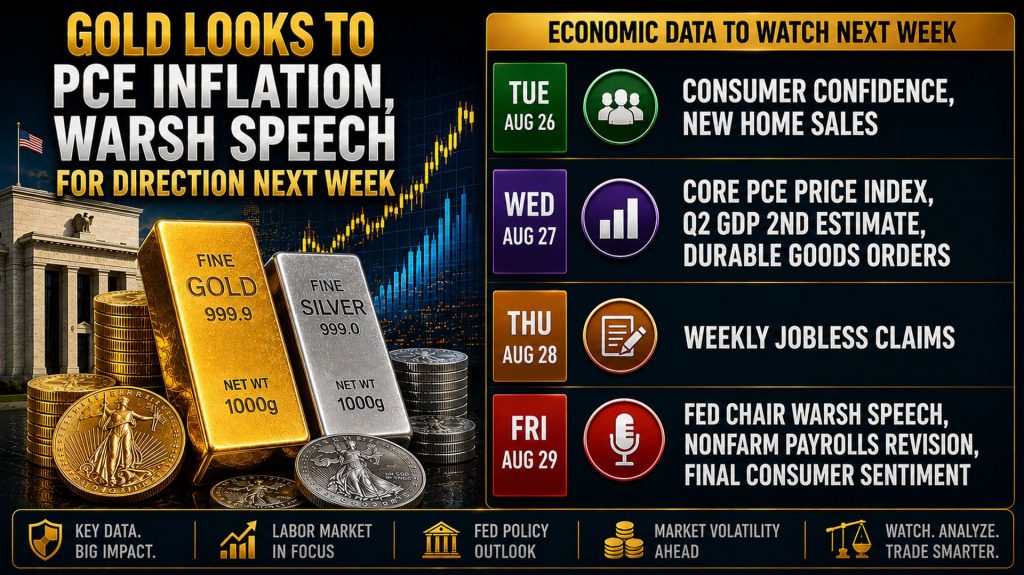
Gold looks to PCE inflation, Jackson Hole for direction next week

(Kitco News) – Gold and silver head into the coming week with investors focused on inflation, economic growth and Federal Reserve policy, as July PCE data and Fed Chair Kevin Warsh’s Jackson Hole speech could drive volatility across precious metals markets.Bullion prices rallied sharply this week as a weaker U.S. dollar, fading expectations for a September Fed rate hike and concerns over the U.S. fiscal outlook supported precious metals. The yellow metal broke above $4,500 an ounce following Wednesday’s Treasury buyback announcement and traded above $4,600 on Friday afternoon, while silver held above $69 an ounce and touched the $70 level.The coming week’s economic calendar will offer fresh readings on consumer confidence, housing, inflation and economic growth, while Friday’s Jackson Hole speech could provide the clearest indication of how new Fed Chair Warsh is weighing persistent inflation against recent signs of weakness in the labor market.The U.S. calendar is quiet Monday before attention turns Tuesday to the Conference Board Consumer Confidence Index and New Home Sales. Housing and consumer confidence offer important signals on the impact of elevated borrowing costs and persistent inflation on households. Further weakness could reinforce expectations that the Fed will remain on hold in September, while stronger readings could support the view that economic activity remains resilient.Wednesday morning brings the week’s heaviest concentration of economic data, with the Core PCE Price Index, the second estimate of second-quarter GDP and Durable Goods Orders all scheduled for release.Core PCE is likely to receive the most attention as the Federal Reserve’s preferred measure of underlying inflation, with another subdued monthly reading likely supporting the argument that policymakers can remain patient. Second-quarter GDP will also be watched for revisions after the advance estimate showed the economy expanding at a 1.5% annualized rate, down from 2.1% in the first quarter, while durable goods orders will provide another look at business investment and manufacturing demand.Thursday brings weekly jobless claims, which remain one of the timeliest measures of labor market conditions. Initial claims fell to 206,000 last week, pointing to relatively limited layoffs even as other employment indicators have shown signs of softer hiring.The week’s main event will likely be Fed Chair Kevin Warsh’s Friday morning speech at the Kansas City Fed’s annual Jackson Hole symposium, with markets looking for clues as to the timing of the Fed’s next move. Warsh has avoided providing explicit forward guidance since taking over as chair, leaving investors focused on how he characterizes inflation, labor conditions and the balance of risks ahead of the September FOMC meeting.Friday morning with also feature the preliminary annual benchmark revision to nonfarm payrolls, which will tell markets whether the previously reported U.S. employment figures have been overstated or understated. The revision could take on added significance following recent signs of weaker hiring and could influence expectations for Fed policy if it points to a materially softer labor market.The week concludes with the University of Michigan’s final Consumer Sentiment reading for August. Preliminary sentiment fell sharply to 51.0 from 55.2 in July, while year-ahead inflation expectations edged up to 4.3%. The final reading will offer another indication of how persistent inflation and economic uncertainty are affecting U.S. households.For precious metals, next week’s releases will largely be viewed through the lens of their implications for Federal Reserve policy. Softer inflation, weaker consumer data or a downward payroll revision could reinforce expectations that rates will remain unchanged and provide further support for gold. Stronger growth data, persistent inflation pressures or a hawkish message from Warsh could revive rate-hike expectations and create near-term headwinds for gold and silver.Economic data to watch next week:Tuesday: Consumer Confidence, New Home SalesWednesday: Core PCE Price Index, Q2 GDP 2nd Estimate, Durable Goods OrdersThursday: Weekly Jobless ClaimsFriday: Fed Chair Warsh Jackson Hole Speech, Nonfarm Payrolls Prel. Annual Revision, University of Michigan Final Consumer Sentiment

Partner News

Economist who called the 2008 crash says the AI bubble has “less than a year to go”

(Kitco News) – Steve Keen has spent two decades telling anyone who’ll listen that markets watch the wrong debt. This week he put a clock on it.”I would give the bubble in AI less than a year to go,” the Australian economist told Kitco News..embed-container { position: relative; padding-bottom: 56.25%; height: 0; overflow: hidden; max-width: 100%; } .embed-container iframe, .embed-container object, .embed-container embed { position: absolute; top: 0; left: 0; width: 100%; height: 100%; }The number at the centre of that call is difficult to verify from outside the companies themselves, and Keen did not provide the underlying data during the interview. His estimate is that revenue from users who’ll actually stick around runs at about a fifth of what these firms are spending.”Those frivolous users are disappearing, and the revenue from serious users, which may be sustained over time, looks like about one-fifth of the cost levels that these firms are caught up in,” he said. “So I expect massive losses coming out of that.”In 2010, readers of the Real-World Economics Review voted on which economist had warned earliest and most clearly about the coming financial crisis. Keen came first. Nouriel Roubini came second. He wrote “Debunking Economics,” built the modelling software Minsky and Ravel, and is writing How Economists Will Destroy Capitalism, which he said Polity Press plans to publish.Not a rerun of 2008Before going further, a qualification Keen made himself, and it matters more than anything else in the interview.He is not forecasting another banking-led collapse.”I’m not expecting a debt crisis this time round in the same way I did back in 2007, because the level of credit demand is quite low, relatively speaking,” he said. Using a series that extended only through the first quarter of 2025, Keen put the share of spending funded by new borrowing at roughly 4% to 6% of GDP. On his data it peaked at 15.4% in the third quarter of 2006.The trigger he’s watching comes from outside the financial system, from disrupted physical supply working its way into company cash flows.”It’s not a financial crisis like 2007. It’s a crisis of being able to service the financial sector debts because you’ve damaged the productive system,” he said. “We’re going to find companies which would normally be able to service their debts quite comfortably, suddenly find they won’t be able to get the inputs to produce the outputs.”What follows, he said, is “a patchwork” of bankruptcies.”Pickleball courts”The comparison he reaches for isn’t 2008. It’s the 1840s.”I think we’re about to see the bursting of a very large bubble on the scale of the railway bubbles back in the 19th century,” he said. “Because so many firms have thrown large amounts of money into data centers and AI.”Companies have borrowed more than $410 billion this year for data centres and other AI investments, according to data compiled by Bloomberg. QTS Realty sold $3.9 billion of bonds to fund a Georgia facility tied to Microsoft at a yield of about 7.23%, Bloomberg reported, noting the investment-grade paper yielded more than some mid-tier junk-rated debt. For context, the U.S. government borrows for 10 years at roughly 4.7%.Keen thinks the lenders will wish they’d charged more. “A lot of those data centres are going to find that 7% looks damn good compared to the losses you’re going to make.”He also pointed to something the housing bubble never had to deal with. A house still shelters people after 30 years. A GPU stops being competitive after three.”When you get data centres, after three or four years, the GPUs that drove that data centre are no longer competitive, so you’re forced to renew the investment again,” he said. “If you are not making the money that justifies it when you go to the renewal stage, you don’t.”Which leads him somewhere unflattering for the buildings themselves. “That’s why I think pickleball courts is a fairly sensible idea of how a lot of these data centres will end up being used.”So far, the market disagrees. August investment-grade issuance set a record for the month, following record totals for June and July, according to Bloomberg data, and demand has kept pace with supply. Buyers keep showing up.Keen’s answer is that they always do, right up until they don’t. “Initially, people are still carried along by the euphoria.” Asked why professional lenders turn up late to cycles like this one, he didn’t soften it. “They don’t understand the cycle.” What it means for goldKeen’s read on the metal is less comfortable than most experts offer.”I always regard gold as a speculative commodity that does well when people are worried about the financial system,” he said. “And so obviously the worries of the financial system are driving gold’s price up right now.”But he had a warning about what happens in a real crisis, when assets that normally move against each other suddenly don’t.”Gold can also fall if people actually find they’ve got calls coming in from other assets which they’re losing money on, and they sell gold to cover those positions,” he said. “So rather than hedging your bets, you amplify your risk.”Asked whether gold protects against a debt deflation, which is what happens when everybody pays down debt at the same time and the economy shrinks faster than the debt does, he said it can. Then came the condition.”If you are levered and you’ve got gold as an asset and you’ve got a debt you can’t service, then you’re likely to sell the gold. So it’s not a one-way bet.”Gold reached its dollar record in late January and has not returned to it.”Private sector debt is the one that matters”The AI call sits inside a framework Keen has held since before the last crash, and it runs against where most of the market is looking.”The conventional theories just obsess about the level of government debt and ignore private sector debt,” he said. “My point has always been that private sector debt is the one that matters. When private debt starts to plunge, that’s what causes serious downturns in the economy.”It comes down to who owns a bank.”The great disadvantage of being a household or a firm is you don’t own your own bank,” he said. “Households and firms don’t own their own banks where the government does, and that makes an enormous difference.”Federal Reserve data shows U.S. household debt peaked near 98% of GDP around 2009 and has since fallen to roughly 68%. Keen doesn’t dispute that households paid a lot down. He disputes that it went far enough. On his figures, aggregate private debt peaked near 170% of GDP and sits around 150% now. After the Great Depression, the same ratio fell by about two thirds.”We’ve still got 85% of the private debt level that applied at the peak of the crisis,” he said.Where the money actually comes fromAsked where the half a million dollars comes from when somebody takes out a mortgage, Keen didn’t hesitate. “It’s created by the bank when it does the loan.””In the real world, banks are not credit rating agencies, they are money creation systems,” he said. Citing work by Richard Vague, Keen said the U.S. money supply went from roughly $5 trillion in 2000 to about $25 trillion by 2024, with more than 90% of that coming from private lending rather than government.”So it’s not the government creating the money that’s maybe creating the inflation. It’s the private sector.”Where he parts with Ray DalioRay Dalio wrote on LinkedIn on Friday that the U.S. government’s financial condition is at an inflection point. He put a debt crisis at roughly three years out and told investors to hold 10% to 15% of a portfolio in gold.Keen said the timing could be similar. He rejects the mechanism.”Even Ray Dalio, whom I’ve got a lot of respect for in general, and he focuses on the role of credit and so do I, his understanding of the accounting of how money is created both by the private sector and by governments is just wrong,” he said.”I do expect some of the same sorts of crises that Dalio’s expecting, but it comes out of the private sector, not out of the government sector, and the timing tends to be similar.”On Washington’s own books, he waved the worry away entirely. The government’s finances, he said, “are rock solid because it can pay for anything denominated in its own currency. The private sector can’t do that.”He doesn’t trust the stress testsThe Federal Reserve reported in June that all 32 large banks in its annual stress test stayed above minimum capital under a scenario that modelled commercial property down 39%, house prices down 30% and unemployment at 10%. Aggregate capital fell 1.6 percentage points, the smallest drop since 2020. Capital, in this context, is the shareholders’ money that absorbs losses before depositors take any.Asked what the test missed, Keen needed four words. “I think it missed money creation.”Then he told a story. Richard Vague, before the crisis, asked a senior bank economist what he made of household leverage and was told that yes, liabilities had risen, but so had assets. As Keen tells it, the line came back as “that’s a trade I’ll take any day.” Vague got out before the crash.”Priced for perfection”Asked what would prove him wrong, Keen named the AI call first, then widened it out. U.S. house prices are above their 2007 levels and going sideways. The cyclically adjusted price-to-earnings ratio, a long-run measure of how expensive stocks are, has been higher just once, in the 2000 bubble.”So I think everything is priced for perfection,” he said. “And we’re not about to experience perfection.”Keen also walks through exactly what happens inside a bank between a missed payment and a failed loan, and why he says the whole system was designed by people who didn’t understand how it works. Watch the full interview on Kitco News above.See live precious metals prices for gold, silver, platinum and palladium — in USD, CAD and 12 more currencies.

Partner News

Gold’s price rally will depend on sustained investment demand, Fed inflation response

(Kitco News) – Gold prices are surging on the back of renewed investment demand and growing worry about the U.S. fiscal outlook, but sticky inflation and the prospect of Fed rate hikes mean the path higher is unlikely to be a straight one, according to Ewa Manthey, Commodities Strategist at ING.In her latest analysis, Manthey said that fiscal risks have given gold fresh momentum, driving prices above $4,600 per ounce.“The latest move followed the US Treasury’s decision to increase its purchases of longer-dated government debt,” she wrote. “The maximum size of buyback operations in the 10-to-30-year segment will rise from $2bn to at least $4bn, with Treasury Secretary Scott Bessent signalling that the programme could be expanded further.”She noted that the impact on the bond market was short-lived, with long-term yields quickly making up most of their decline.“Gold, however, continued to strengthen,” she said. “In our view, gold’s resilience suggests that the rally is not simply a response to lower yields. The prospect of larger Treasury buybacks has refocused attention on government borrowing and fiscal credibility. It has also revived concerns about currency debasement, reinforcing gold’s appeal as a store of value.”Manthey said that renewed dollar weakness and lower short-term yields are contributing to gold’s rebound, while softer U.S. data are reviving expectations that the Fed could start lowering rates in 2027.“The improvement in ETF demand is another positive signal,” she said. “Global gold-backed ETFs attracted $3bn in July, lifting their holdings by 23 tonnes, according to the World Gold Council.”And July’s recovery has continued into August. “Funds tracked by Bloomberg added around 18 tonnes on Thursday alone, their strongest daily accumulation in almost a year,” she wrote.Central bank demand has also remained strong throughout gold’s months-long consolidation.“Reported net purchases reached 51 tonnes in June, taking the first-half total to 102 tonnes, with Poland and China leading the buying,” Manthey wrote. “We expect official-sector buying to continue supporting the market, but further gains will increasingly depend on whether Western investors maintain their renewed interest in gold.”Gold’s nascent rally still faces headwinds, with inflation concerns chief among them.“Rising energy prices are adding to US price pressures and could keep monetary policy restrictive for longer,” she said.“Minutes from the Fed’s July meeting showed that some policymakers favoured an immediate rate increase, while others were prepared to support further tightening if inflation remained elevated.”Manthey pointed to the Fed’s annual Jackson Hole symposium this week as a key focus for markets.“Any indication that policymakers are becoming more willing to raise rates would risk lifting yields and the dollar,” she wrote. “A greater focus on growth or financial stability would be more supportive for gold.”Manthey said the upside risk to ING’s late-year gold price outlook is rising.“Our forecast of $4,150/oz for the fourth quarter (average price) assumes that persistent inflation keeps US monetary policy restrictive and prevents a sustained fall in yields,” she said. “However, renewed ETF buying, a weaker dollar and mounting fiscal concerns are creating increasingly clear upside risks to our outlook.”“Gold’s correction appears to have found a floor,” she added. “Renewed ETF buying and its resilience despite elevated yields suggest the recovery is on firmer footing, but further gains will depend on whether investment demand continues to build and how the Fed responds to persistent inflation.”See live precious metals prices for gold, silver, platinum and palladium — in USD, CAD and 12 more currencies.

Scroll to Top