

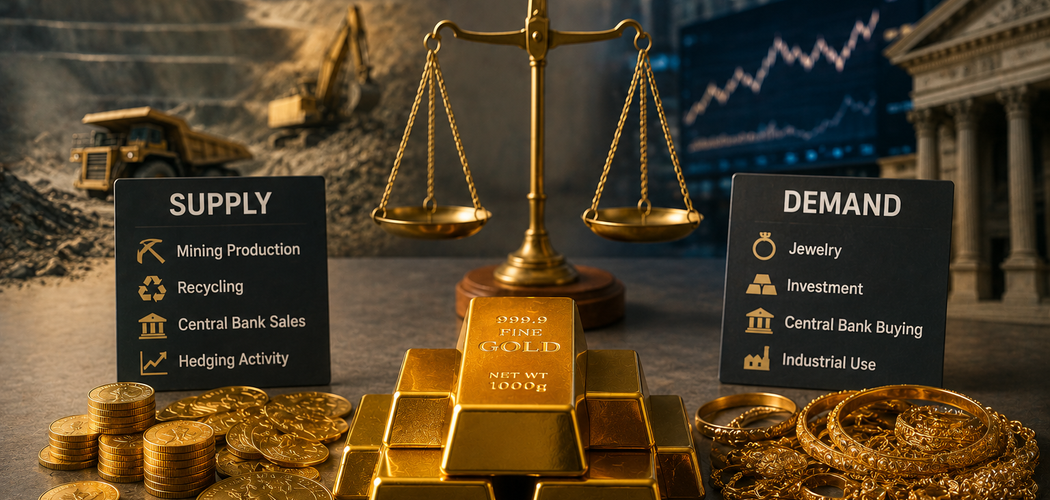
Gold prices can move dramatically, but those movements are not random. Behind every rally or correction is a changing balance between buyers, sellers, available metal, and expectations. Understanding gold supply and demand gives investors a stronger foundation for analyzing what really moves the market.
Unlike many commodities, gold is rarely consumed completely. Much of the metal mined throughout history still exists in jewelry, bars, coins, central bank reserves, and other forms. Therefore, new mine production is only one part of available supply.
Demand is equally diverse.
Consumers buy jewelry, investors purchase bullion and exchange-traded products, central banks build reserves, and manufacturers use gold in technology.
Recent data illustrates how quickly this mix can change. In Q2 2026, global gold demand including over-the-counter activity reached 1,269 tonnes. Mine production reached about 966 tonnes, while recycled supply contributed roughly 326 tonnes.
These different forces interact constantly. Understanding them can help investors interpret price movements without relying entirely on forecasts.
Understanding the Gold Market Balance
At the simplest level, commodity markets depend on supply and demand.
When demand strengthens faster than available supply, prices can face upward pressure. Conversely, weaker demand or increasing supply can create downward pressure.
Gold is more complicated because enormous above-ground stocks already exist.
A farmer cannot recover wheat consumed years ago. However, a gold necklace purchased decades ago can return to the market through recycling.
Therefore, gold supply and demand includes both newly mined metal and existing metal returning to the market.
Demand also shifts between sectors.
Jewelry demand may weaken because prices become expensive. At the same time, investment or central bank buying may increase enough to offset that decline.
This flexible structure helps explain why gold prices can rise even when one major source of demand is falling.
Investors should therefore examine the entire market rather than focusing on one category.
Mine Production Forms the Foundation of New Supply
Mining represents the primary source of newly produced gold.
Gold mines operate across many regions, and their output enters the global market each year.
However, mine supply responds slowly to price changes.
A company cannot simply decide to produce a huge amount of additional gold next month because prices have increased.
Developing a mine can require years of exploration, geological studies, financing, permitting, construction, and infrastructure development.
Existing mines also face physical limitations.
Ore grades can decline, equipment can fail, labor problems can occur, and environmental regulations may affect production.
This slow response makes gold different from products that manufacturers can quickly produce in larger quantities.
In 2025, global mine production reached approximately 3,672 tonnes, according to the World Gold Council, while total supply reached roughly 5,002 tonnes.
Higher Prices Do Not Immediately Create More Gold
Investors may assume that rising gold prices automatically cause production to surge.
Eventually, higher prices can encourage greater investment in mining.
Previously uneconomic deposits may become profitable. Existing producers can also invest in expansion projects.
However, these responses take time.
Mining companies must consider much more than today’s gold price.
Energy, labor, equipment, financing, environmental compliance, and transportation costs affect profitability.
Political conditions also matter.
A promising deposit may be located in a region with unstable regulations or limited infrastructure.
Therefore, higher gold prices can encourage additional supply without creating an immediate flood of new metal.
The World Gold Council’s Q2 2026 outlook similarly noted that elevated prices and healthy margins could support output, but operational constraints and long project lead times limit how quickly mine production can respond.
Recycling Is the Second Major Supply Source
Recycled gold plays an important role in the market.
Old jewelry, unwanted coins, industrial scrap, and other gold-containing products can be refined and returned to circulation.
Unlike mine production, recycling can react relatively quickly to price changes.
When gold prices rise sharply, some owners decide to sell.
Consumers may bring old jewelry to dealers. Investors may liquidate bullion, while businesses can recover more metal from scrap.
Therefore, recycling can function as a flexible source of supply.
In 2025, recycled gold supply reached about 1,404 tonnes, up from roughly 1,365 tonnes in 2024.
However, price is not the only factor.
Economic hardship can encourage households to sell gold. Cultural attitudes, expectations for future prices, and access to gold-backed lending can also influence recycling.
Consequently, high prices do not always produce the same recycling response.
Why Recycling Can Limit Price Pressure
Suppose investment demand suddenly increases.
If mine production cannot respond quickly, the market may appear headed toward a significant shortage.
However, rising prices can encourage existing owners to sell old gold.
That recycled supply helps meet additional demand.
This feedback mechanism is important when analyzing gold supply and demand.
Higher prices can create their own supply response.
However, the response has limits.
If investors and households believe prices will continue rising, they may prefer to hold their gold rather than sell it.
Likewise, wealthy consumers may have little financial need to liquidate jewelry.
The World Gold Council reported that Q2 2026 recycling actually fell 6% from a year earlier, even as mine production increased 2%.
Therefore, recycling must be evaluated alongside investor behavior and local economic conditions.
Jewelry Is a Major Source of Gold Demand
Jewelry has historically represented one of gold’s largest demand categories.
Gold jewelry has both decorative and financial value in many cultures.
Demand can be particularly important across large Asian and Middle Eastern markets.
However, jewelry buyers are sensitive to price.
When gold becomes extremely expensive, consumers may purchase lighter pieces, choose lower-purity products, postpone purchases, or spend the same amount while receiving less gold.
This means spending can remain strong even while the physical amount purchased declines.
That distinction is important.
In 2025, jewelry consumption fell to about 1,542 tonnes from roughly 1,887 tonnes in 2024 as record prices weighed on volumes. Yet the value of global jewelry demand still reached a record US$172 billion.
Price therefore affects both the quantity purchased and the amount consumers spend.
Investment Demand Can Change Very Quickly
Investment is one of the most dynamic parts of the gold market.
Investors can gain exposure through bars, coins, exchange-traded products, futures, and other instruments.
Their behavior can change rapidly.
Concerns about inflation, recession, currencies, geopolitical conflict, or financial instability may increase demand.
Conversely, rising real interest rates and stronger confidence in other assets can reduce interest.
This makes investment demand a powerful driver of gold supply and demand.
Unlike mine production, investment flows can shift within days.
In 2025, investment demand reached roughly 2,175 tonnes, up 84% from 2024. Gold ETF holdings grew by about 801 tonnes, while bar and coin demand reached its highest level in 12 years.
That surge demonstrates how investor behavior can dramatically change the composition of the gold market.
Gold ETFs Can Influence Market Sentiment
Gold-backed exchange-traded products make precious metal exposure accessible through financial markets.
Investors can buy or sell shares without personally storing coins or bars.
Large inflows can signal strong institutional and retail demand.
Likewise, persistent outflows can indicate weakening interest.
However, investors should not interpret ETF flows in isolation.
For example, Q2 2026 saw approximately 45 tonnes of ETF outflows. The World Gold Council linked the weakness partly to changing inflation and interest-rate expectations and a strengthening U.S. dollar, particularly in North America.
At the same time, other demand categories remained important.
Therefore, declining ETF demand does not automatically mean total gold demand is collapsing.
Investors need to examine bars, coins, OTC activity, central banks, and physical markets too.
Central Banks Can Become Powerful Buyers
Central banks hold gold as part of official reserves.
They may purchase it for diversification, financial stability, or reduced dependence on individual currencies and government securities.
This makes gold unusual among commodities.
Governments do not typically maintain large strategic portfolios of precious metals such as silver in the same way.
Central bank purchases can represent substantial physical demand.
In 2025, official-sector purchases reached approximately 863 tonnes. Although that was below 2024’s exceptionally high level, it remained historically elevated.
More recently, Q2 2026 central bank and institutional demand was estimated at about 289 tonnes after revisions to earlier quarterly estimates.
Because central bank decisions may reflect long-term reserve policies, their behavior can differ from short-term traders.
Why Central Banks Buy Gold
Reserve managers often seek diversification.
Holding assets across different currencies and instruments can reduce dependence on one financial system.
Gold offers another characteristic: physical bullion is not another country’s liability.
However, central banks can also reduce purchases.
Therefore, investors should not assume official demand will increase indefinitely.
Changes in central bank buying can materially alter the market balance.
Technology Creates Steady Gold Demand
Gold is not only an investment and jewelry metal.
It also has valuable physical properties.
Gold resists corrosion and conducts electricity reliably. These characteristics make it useful in electronics and specialized technological applications.
Technology demand is smaller than investment or jewelry demand, but it remains significant.
Full-year technology demand totaled about 323 tonnes in 2025, according to the World Gold Council. Electronics accounted for roughly 270 tonnes.
Technology demand remained around 80 tonnes in Q2 2026, with electronics continuing to dominate the category.
Growth in artificial intelligence infrastructure and advanced electronics may support certain applications.
However, manufacturers also seek efficiency.
When gold becomes expensive, companies have an incentive to reduce the amount used wherever technically possible.
Price Changes Can Affect Both Sides of the Market
One reason gold supply and demand is fascinating is that price influences both buyers and sellers.
Higher prices can discourage jewelry consumption.
At the same time, they can encourage recycling.
Mining companies may become more willing to invest in new projects.
Investors behave less predictably.
Some may sell because prices appear expensive.
Others may buy because rising prices strengthen bullish expectations.
Central banks may follow strategic reserve policies that are less sensitive to short-term market movements.
Therefore, price itself becomes part of the feedback loop.
A rally can reduce some demand while encouraging additional supply.
Yet it can also attract new investment.
Understanding these competing reactions helps explain why gold rarely moves in a perfectly straight line.
Interest Rates Influence Investment Demand
Gold held as physical bullion produces no interest.
Therefore, investors compare it with assets that do.
When safe bonds offer high inflation-adjusted returns, gold faces greater competition.
When real yields fall, the opportunity cost of holding gold becomes lower.
This relationship can influence investment demand even when physical supply remains unchanged.
Suppose mine production and jewelry consumption stay relatively stable.
A major shift in interest-rate expectations could still move prices because financial investors rapidly adjust positions.
This demonstrates why supply-demand analysis should include macroeconomic variables.
Gold is both a physical commodity and a global financial asset.
That combination makes its market unusually complex.
The U.S. Dollar Can Influence Global Demand
International gold prices are commonly quoted in U.S. dollars.
Therefore, currency movements can affect affordability.
A stronger dollar can make gold more expensive for buyers using weaker currencies.
A weaker dollar can have the opposite effect.
However, local gold prices depend on both the international price and exchange rates.
For example, gold might fall slightly in U.S. dollar terms while rising substantially in another currency that is weakening.
This can influence jewelry demand, investment purchases, and recycling in individual countries.
Consequently, gold supply and demand should be analyzed both globally and regionally.
The same international gold price can produce very different consumer behavior across countries.
Geopolitical Risk Can Increase Demand
Gold often receives greater attention when geopolitical uncertainty increases.
Wars, trade disputes, sanctions, political instability, and concerns about international financial relationships can encourage investors to seek diversification.
Central banks may also consider geopolitical conditions when managing reserves.
This can strengthen investment and official-sector demand.
However, geopolitical effects are difficult to measure precisely.
Markets may react strongly to one event and barely respond to another.
The duration of uncertainty matters as well.
Short-lived tensions may produce temporary price movements.
Long-term changes in international relationships can have deeper effects on reserve management and investment behavior.
Therefore, geopolitical risk should be treated as one part of the broader demand picture.
Above-Ground Gold Makes the Market Unique
Most gold ever mined has not been destroyed.
It exists in various forms and can potentially return to the market.
This creates an enormous above-ground stock compared with annual mine production.
Therefore, gold scarcity works differently from scarcity in consumable commodities.
The market does not depend solely on how much new metal miners produce this year.
Instead, it depends partly on whether existing owners are willing to sell.
If holders become reluctant to part with their gold, prices may need to rise enough to attract additional supply.
If many holders suddenly want to sell, substantial metal can return through recycling and investment liquidation.
This feature makes investor psychology particularly important.
Mine Disruptions Can Affect Supply
Although global mine supply changes gradually, unexpected disruptions still occur.
Political instability can interrupt operations.
Strikes may reduce production, while extreme weather can affect mines and transportation.
Governments can change taxes, royalties, or mining regulations.
Energy shortages and rising costs may also affect output.
However, gold production is geographically diversified.
A disruption at one mine or in one country does not necessarily create a global shortage.
Investors should therefore consider the scale of any supply event.
A headline about one mining operation may sound dramatic while having little effect on global gold supply and demand.
Large, sustained disruptions across several producing regions would have greater significance.
Producer Hedging Can Affect Available Supply
Mining companies sometimes use hedging to manage future price risk.
A producer may lock in prices for part of future production through financial contracts.
This can provide greater revenue certainty.
Changes in hedging activity can affect how analysts calculate mine-related supply.
However, producer hedging is usually less important to casual investors than mine production and recycling.
It still belongs in a complete market analysis.
For example, producers reducing hedge positions can alter the amount of effective supply available through these arrangements.
Investors do not need to track every corporate hedge.
However, large changes across the mining industry can provide useful context when examining total supply.
Gold Demand Changes Across Economic Cycles
Different demand categories can become dominant at different times.
During strong economic growth, consumers may purchase more jewelry.
Technology demand may also strengthen.
During periods of financial uncertainty, investment demand can become more important.
Central banks may follow longer-term reserve strategies that do not match the consumer cycle.
This diversity helps make gold different from commodities driven mainly by one industrial use.
The World Gold Council describes gold’s varied demand sources as a feature that allows different sectors to rise in importance at different points in the economic cycle.
Therefore, weakness in one sector does not automatically imply a weak overall market.
Investors should identify which demand category is currently driving the balance.
How Investors Can Track Supply and Demand
Investors do not need to monitor every gold transaction.
A few major indicators can provide useful insight.
Start with quarterly mine production and recycling.
Then examine jewelry demand, investment flows, central bank purchases, and technology use.
ETF flows can provide additional insight into financial investor sentiment.
Investors can also monitor bar and coin demand.
Economic variables such as real interest rates, currencies, inflation, and geopolitical conditions help explain why demand categories are changing.
For example, Q2 2026 data showed investment demand weakening sharply from the previous quarter while central bank purchases rebounded and jewelry volumes remained pressured by elevated prices.
Looking at the complete picture prevents one statistic from dominating the analysis.
Avoid Simple Supply-Shortage Narratives
Gold market commentary sometimes focuses on dramatic claims about shortages.
Investors should approach these arguments carefully.
A decline in mine production does not automatically mean the world is running out of gold.
Recycled metal can increase.
Existing investment holdings can return to the market.
Likewise, rising mine production does not guarantee falling prices if demand increases even faster.
The balance matters more than one number.
Investors should also distinguish between temporary shortages of specific products and shortages of gold itself.
For example, strong retail demand may cause particular coins to become difficult to obtain.
Dealer premiums can rise.
That does not necessarily mean the entire global gold market lacks physical metal.
Understanding these distinctions can prevent misleading conclusions.
Why Supply and Demand Matter for Long-Term Investors
Short-term gold prices can respond to headlines, trading positions, and market sentiment.
Over longer periods, physical and financial fundamentals remain important.
Mining determines how quickly new gold enters circulation.
Recycling allows existing metal to return.
Jewelry, investment, central banks, and technology create competing sources of demand.
These forces evolve.
For example, 2025 saw total gold demand, including OTC activity, exceed 5,000 tonnes for the first time in the World Gold Council’s series, while investment demand surged and jewelry volumes weakened.
By Q2 2026, the composition had shifted again, demonstrating why investors should regularly update their assumptions.
Build a Simple Gold Market Framework
Investors can organize analysis into two sides.
On the supply side, track mine production, recycling, and producer hedging.
Ask whether production is growing and whether higher prices are encouraging more recycled material.
On the demand side, monitor jewelry, investment, central banks, and technology.
Then add macroeconomic context.
Are real interest rates rising or falling?
Is the dollar strengthening?
Are investors worried about inflation or geopolitical risk?
Finally, examine price action.
A strong market combined with improving fundamentals may confirm bullish conditions.
Weak price action despite apparently strong fundamentals may suggest the market is focusing on risks that require further investigation.
This framework makes gold supply and demand easier to understand without oversimplifying the market.
Conclusion
Gold prices reflect much more than how much metal miners pull from the ground.
The market combines new mine production with recycled supply and changing behavior among investors, jewelry buyers, central banks, and manufacturers.
Mining responds slowly because developing new projects takes years.
Recycling can react more quickly, although investor expectations and local economic conditions influence how much metal owners sell.
Demand can shift even faster.
Investment flows may change after interest-rate announcements, currency movements, geopolitical events, or changes in inflation expectations.
Central banks add another important source of demand, while jewelry and technology provide additional market depth.
Therefore, understanding gold supply and demand requires looking at the complete system.
No single category determines prices by itself.
Investors who track mining, recycling, jewelry, investment flows, central bank purchases, technology demand, real yields, and currencies can develop a clearer view of market conditions.
Ultimately, gold supply and demand provides a fundamental framework for understanding why prices change and whether those movements are supported by broader developments in the physical and financial gold markets.
FAQ
1. What Are the Main Sources of Gold Supply?
New mine production and recycled gold are the two major sources. Producer hedging can also affect reported supply, although it is generally a smaller component.
2. Who Buys the Most Gold?
Demand comes from several groups, including jewelry consumers, investors, central banks, and technology manufacturers. The leading category can change depending on market conditions.
3. Does Higher Gold Production Make Prices Fall?
Not automatically. Prices depend on both sides of the market. Higher production may be absorbed if investment, jewelry, central bank, or technology demand also increases.
4. Why Does Recycling Increase When Gold Prices Rise?
Higher prices can encourage owners to sell old jewelry, coins, and other gold products. However, recycling also depends on economic conditions and expectations for future prices.
5. What Should Investors Watch When Analyzing the Gold Market?
Investors can monitor mine output, recycling, investment flows, jewelry consumption, central bank buying, technology use, real interest rates, and currencies. Together, these factors provide a stronger gold supply and demand picture.

