

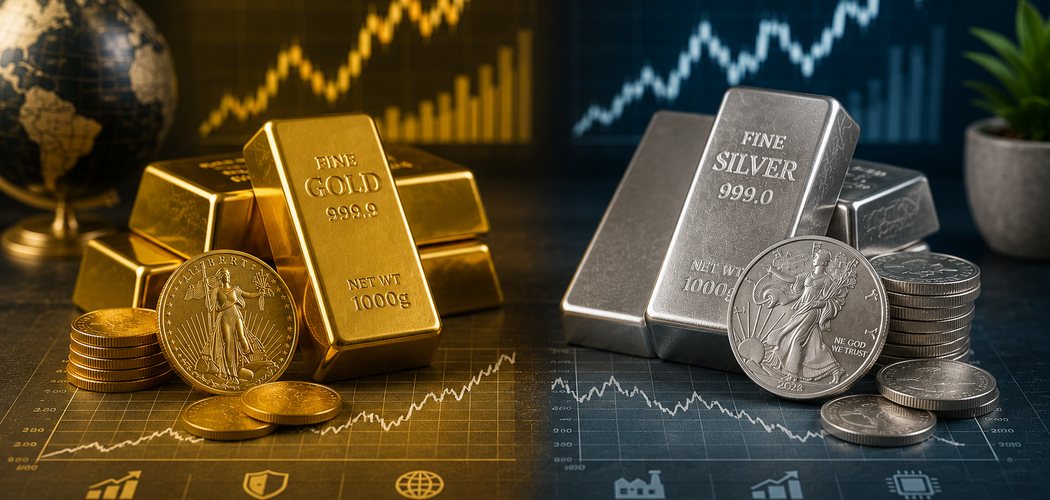
Gold and silver are often grouped together as precious metals. However, they do not behave exactly the same way. Understanding gold vs silver performance requires looking at the different forces that drive demand for each metal.
Gold has a broad demand base that includes investment, jewelry, technology, and central bank reserves. Silver also attracts investors, but industrial applications account for a much larger part of its market.
That difference matters.
During periods of financial stress, gold may benefit from defensive investment demand. Silver can also rise, but concerns about manufacturing and economic growth may limit its performance.
During strong economic expansions, silver can receive support from both investors and manufacturers. As a result, its price may sometimes move more aggressively.
Recent World Gold Council analysis describes gold as the steadier defensive asset and silver as a higher-volatility, more cyclical precious metal.
Neither metal consistently outperforms. Instead, market conditions often determine which one has the advantage.
Why Gold and Silver Behave Differently
The biggest difference begins with demand.
Gold functions partly as a financial asset. Investors purchase bullion and gold-backed products, while central banks hold significant gold reserves.
Jewelry demand provides another major source of consumption.
Silver has investment demand too. However, industry plays a much larger role.
Manufacturers use silver in electronics, automobiles, electrical equipment, power infrastructure, solar technologies, and other applications. Silver industrial demand reached 657.4 million ounces in 2025, according to the Silver Institute.
Therefore, gold vs silver performance can diverge when economic conditions change.
Gold may respond more strongly to financial uncertainty and monetary conditions. Silver often responds to those factors plus expectations for industrial growth.
This dual role can make silver particularly dynamic.
It can also make the metal more volatile.
Gold Often Has a Defensive Advantage
Investors frequently turn toward gold during periods of uncertainty.
Economic recessions, geopolitical conflicts, financial instability, and severe equity-market declines can increase demand for defensive assets.
Gold’s market structure supports this role.
World Gold Council research indicates that gold’s relationship with equities tends to become more negative during major equity selloffs. Its analysis also shows gold has historically provided diversification during several periods of systemic stress.
Silver does not necessarily receive the same benefit.
A severe economic slowdown can reduce expectations for industrial demand.
Therefore, a recession can create two opposing forces for silver.
Precious metal investment demand may increase, while manufacturing demand weakens.
Gold has less exposure to this industrial problem.
That helps explain why it can sometimes outperform silver when investors become highly defensive.
Silver Can Shine During Economic Expansion
Silver’s industrial exposure can become an advantage when economic activity strengthens.
Manufacturers may require more raw materials as production expands.
Technology investment can increase. Automobile manufacturing, power infrastructure, electronics, and other industries can support silver consumption.
If precious metal investment demand is also improving, silver may receive support from two directions.
This combination can lead to strong price movements.
Gold may still perform well during an expansion. However, strong economic growth can sometimes encourage higher interest rates.
Higher real yields may reduce the relative appeal of non-yielding gold.
Consequently, gold vs silver performance during economic expansions can favor silver when industrial demand is strong and monetary conditions do not overwhelm commodity demand.
Still, economic growth alone cannot guarantee silver gains.
Supply, investor sentiment, currencies, and interest rates remain important.
Silver Usually Brings Greater Volatility
Investors should distinguish performance from risk.
An asset that gains 30% can appear more attractive than one that gains 15%. However, the same asset may also experience much larger declines.
Silver generally has higher volatility than gold.
The World Gold Council’s 2026 comparison of the metals highlights gold’s deeper liquidity and lower volatility. It characterizes silver as a higher-beta complement that tends to amplify movements in both directions.
This characteristic can become especially noticeable during powerful precious metal rallies.
Silver may initially lag gold.
As investor enthusiasm increases, silver can accelerate and potentially outperform.
However, corrections can also become severe.
Therefore, investors comparing the metals should consider risk-adjusted performance rather than focusing only on percentage gains.
Higher Returns Do Not Automatically Mean Better Performance
Suppose silver rises 25% while gold gains 15%.
Silver clearly generated the higher return.
However, imagine silver also experienced much larger daily swings and a severe temporary decline.
A conservative investor might still prefer gold’s smoother performance.
The better metal depends partly on the investor’s objectives and tolerance for volatility.
Interest Rates Can Influence Both Metals
Gold and silver do not produce interest when held as physical bullion.
Therefore, interest-bearing investments create competition.
When real interest rates rise, government bonds and other relatively safe investments may become more attractive.
Gold can face pressure as a result.
Silver can experience similar pressure through its investment demand.
However, higher interest rates can affect silver in another way.
Expensive borrowing can slow economic activity.
Businesses may reduce investment, while consumers may spend less. Manufacturing can weaken.
This potentially reduces industrial silver demand.
Therefore, aggressive monetary tightening can create multiple challenges for silver.
When analyzing gold vs silver performance, investors should consider both the financial and industrial consequences of changing rates.
Falling Rates Can Create a Different Environment
Lower interest rates can reduce the opportunity cost of holding precious metals.
If bond yields decline, gold may become relatively more attractive.
A weaker currency can provide additional support under some conditions.
Silver can benefit from these same financial forces.
Furthermore, lower borrowing costs may eventually stimulate economic activity.
Companies can invest more cheaply, while consumers may gain access to less expensive financing.
If manufacturing improves, industrial silver demand can strengthen.
This combination can create a favorable environment for silver.
However, the reason for falling rates matters.
If central banks are cutting because of a severe recession, industrial demand may remain weak for some time.
Gold may initially have the stronger defensive advantage.
Inflation Does Not Affect Both Metals Equally
Gold is often associated with inflation protection.
Investors concerned about declining purchasing power may increase their exposure to physical assets.
However, gold does not rise automatically whenever inflation increases.
Central bank policy matters.
High inflation can trigger interest-rate increases, which may pressure gold through higher real yields.
Silver faces the same monetary forces while also responding to industrial conditions.
Moderate inflation combined with strong economic growth can potentially favor silver because manufacturing remains healthy.
Severe inflation that damages consumer demand and forces aggressive monetary tightening may create a much more difficult environment.
Therefore, gold vs silver performance during inflationary periods depends heavily on the type of inflation and the policy response.
Recessions Can Favor Gold
Recessions generally involve slowing economic activity.
Corporate profits may weaken, unemployment can rise, and investors may become more defensive.
These conditions can support gold demand.
Gold also tends to behave differently from broad commodities during periods of economic stress. World Gold Council research published in August 2026 found gold particularly effective in risk-off environments, while broader commodities have historically performed better during economic recovery phases.
Silver’s industrial exposure can create a disadvantage during a recession.
Factories may reduce output. Consumers can delay major purchases, while businesses postpone investment.
However, silver can recover strongly when markets begin anticipating economic improvement.
Therefore, the transition from recession to recovery can become particularly interesting for relative precious metal performance.
Economic Recoveries May Give Silver an Advantage
Markets often begin recovering before economic statistics look strong.
Investors anticipate future growth.
Manufacturing expectations improve, while businesses prepare for increasing demand.
Silver can benefit from this shift.
Industrial demand expectations strengthen, and investment demand may remain elevated if monetary policy is still accommodative.
Gold can continue performing well, particularly if interest rates remain low.
However, improving confidence can reduce some defensive demand.
This combination can sometimes shift relative momentum toward silver.
Investors studying gold vs silver performance should therefore pay attention to changes in the economic cycle rather than only current conditions.
Markets frequently price the recovery before official data confirms it.
The U.S. Dollar Matters for Both
Gold and silver are commonly quoted internationally in U.S. dollars.
A stronger dollar can make the metals more expensive for buyers using other currencies.
That may pressure demand.
A weaker dollar can create the opposite effect.
However, gold and silver may respond differently to the same currency move because their demand structures differ.
A weaker dollar combined with strong global growth could be particularly supportive for silver.
Meanwhile, a weaker dollar caused by concerns about monetary stability might produce stronger defensive demand for gold.
Investors outside the United States also need to consider their local currencies.
A metal can produce a very different return when measured in pesos, euros, pounds, yen, or another currency.
Central Bank Demand Gives Gold an Advantage
One of the clearest differences between the metals is central bank participation.
Central banks hold gold as part of official reserves.
They may purchase it to diversify reserves, manage financial risk, or reduce dependence on particular currencies and securities.
Silver does not have a comparable role in modern official reserves.
This creates an additional source of structural gold demand.
Strong central bank purchasing can support gold even when some traditional indicators appear unfavorable.
For example, elevated interest rates might normally create pressure.
However, substantial official buying can offset part of that weakness.
This factor should be considered when evaluating gold vs silver performance, especially during periods of changing reserve-management strategies.
Industrial Trends Can Give Silver an Advantage
Silver’s industrial demand can become a powerful long-term driver.
The metal’s high electrical conductivity makes it valuable across modern technologies.
Automobiles increasingly contain electronic components. Electrical infrastructure requires conductive materials, while artificial intelligence infrastructure and power-grid investment can support related demand.
The Silver Institute reported that AI infrastructure, automotive uses, and power-grid investment continued supporting industrial silver demand in 2025, although photovoltaic demand faced pressure from thrifting and substitution.
This demonstrates both sides of silver’s industrial story.
Growing technologies can increase demand.
However, high prices encourage manufacturers to reduce silver usage or find alternatives.
Therefore, investors should not assume that industrial growth automatically creates unlimited demand.
Gold Has Broader Demand Diversification
Gold’s demand comes from several different sources.
Investors purchase bars, coins, and financial products.
Consumers purchase jewelry.
Central banks hold reserves.
Technology also uses smaller quantities.
This diversity can make gold less dependent on one segment of the economy.
World Gold Council research attributes part of gold’s resilience across different economic conditions to its diverse sources of demand.
Silver’s industrial concentration makes it more sensitive to economic cycles.
That does not necessarily make silver inferior.
Instead, the two metals may serve different portfolio purposes.
Gold may provide steadier diversification.
Silver may offer greater cyclical upside along with greater downside risk.
The Gold-to-Silver Ratio Helps Compare Performance
The gold-to-silver ratio measures how many ounces of silver are needed to equal the price of one ounce of gold.
For example, if gold trades at $4,000 and silver trades at $50, the ratio is 80.
When the ratio rises, gold is outperforming silver.
When it falls, silver is outperforming gold.
Traders often monitor this ratio to understand relative momentum.
A high ratio may indicate that defensive gold demand is stronger or that silver is relatively weak.
A falling ratio can occur when silver begins outperforming during a precious metal rally or economic recovery.
However, there is no permanently correct ratio.
Therefore, it should not be treated as an automatic signal that one metal must rise or fall.
Market Stress Can Increase the Difference
During severe market stress, investors often prioritize liquidity and defensive assets.
Gold benefits from a deep global market.
Silver’s market is smaller and generally more volatile.
That difference can become particularly important when investors rapidly change positions.
Gold may therefore provide more consistent defensive behavior.
The World Gold Council’s 2026 research found that gold’s deeper liquidity and broader demand structure support its diversification characteristics during stress, while silver tends to behave more cyclically.
This does not mean silver always falls during crises.
It can rally strongly when monetary easing and precious metal investment demand become dominant.
However, its path may be much less stable.
Bull Markets Can Produce Powerful Silver Moves
Silver has a reputation for producing dramatic movements during strong precious metal cycles.
Gold may initially lead as investors respond to monetary or geopolitical concerns.
As the rally becomes established, additional investors can enter the precious metal market.
Silver’s smaller market can then produce larger percentage movements.
This can cause silver to outperform during certain stages of a bull market.
However, investors should remember the reverse.
When sentiment changes, silver can decline rapidly.
Therefore, gold vs silver performance should be evaluated across full market cycles rather than only during the strongest portion of a rally.
Large upside movements can look impressive while hiding substantial volatility.
Gold May Be Better for Defensive Diversification
Investors seeking diversification during equity-market stress may find gold more aligned with that objective.
World Gold Council research using historical portfolio data through the end of 2025 found that adding gold to hypothetical portfolios improved risk-adjusted returns and reduced maximum drawdowns across multiple time horizons.
Historical results do not guarantee future outcomes.
However, they demonstrate why gold is frequently considered a strategic portfolio asset.
Silver may still provide diversification.
Yet its industrial exposure means it can become more correlated with economically sensitive assets during downturns.
Therefore, silver may function better as a complementary precious metal rather than a direct replacement for gold’s defensive role.
Silver May Suit Investors Seeking More Aggressive Exposure
Risk tolerance changes how investors interpret performance.
Someone focused primarily on preserving capital may prefer gold’s generally lower volatility.
An investor willing to tolerate larger fluctuations may find silver more attractive.
Silver’s industrial exposure and smaller market can produce stronger percentage moves when conditions become favorable.
However, aggressive exposure requires discipline.
Investors should be prepared for significant corrections.
Buying silver simply because it appears cheaper per ounce than gold is not a sound strategy.
Price per ounce says nothing about whether an asset is undervalued.
Instead, investors should evaluate supply, demand, volatility, economic conditions, and portfolio objectives.
Owning Both Metals Can Reduce the Need to Choose
Investors do not necessarily need to predict which metal will outperform.
A portfolio can contain both.
Gold can provide more defensive precious metal exposure, while silver adds industrial sensitivity and potentially stronger cyclical performance.
The allocation does not need to be equal.
A conservative investor may place greater emphasis on gold.
Someone with higher risk tolerance may choose a larger silver position.
Investors can also rebalance.
If silver experiences a major rally and becomes an unusually large portion of the portfolio, some gains can potentially be redirected toward gold or other assets.
This approach uses gold vs silver performance differences as part of portfolio management rather than trying to forecast every short-term move.
Avoid Choosing Based on Recent Returns
One of the biggest investing mistakes is assuming the recent winner will continue winning.
Suppose silver dramatically outperforms gold during one year.
Investors may rush into silver after much of the move has already occurred.
The opposite can happen after gold performs strongly.
Recent performance provides useful information, but it should not determine the entire strategy.
Instead, investors should ask why one metal is outperforming.
Is industrial demand strengthening?
Are investors becoming more defensive?
Are real yields changing?
Is central bank gold demand increasing?
Understanding the underlying drivers provides more useful information than simply following the strongest recent chart.
Use a Market-Environment Framework
Investors can simplify the comparison by thinking about different economic environments.
During severe financial stress, gold may have the stronger defensive profile.
During strong industrial growth, silver may receive additional support.
Falling real rates can benefit both metals.
A combination of easier monetary policy and economic recovery may create especially favorable conditions for silver.
Aggressive monetary tightening can pressure both, although weaker industrial growth may create additional challenges for silver.
High geopolitical uncertainty may favor gold because defensive investment demand becomes more important.
This framework does not predict exact returns.
Instead, it helps explain why gold vs silver performance changes across market cycles.
Do Not Ignore Portfolio Objectives
The best-performing metal is not necessarily the best investment for every person.
A retiree focused on diversification may have different priorities from a younger investor comfortable with significant volatility.
Likewise, an investor who already owns cyclical commodities may not need substantial additional silver exposure.
Someone heavily concentrated in financial assets may value gold’s different market characteristics.
Therefore, investors should evaluate precious metals within the entire portfolio.
Return matters, but so do volatility, liquidity, investment horizon, transaction costs, and diversification.
Choosing between gold and silver should begin with financial objectives rather than a prediction about which price will rise fastest.
Conclusion
Gold and silver share the precious metal label, but their market behavior can differ significantly.
Gold has a broad demand structure that includes investment, jewelry, technology, and central bank reserves. Its deeper market and defensive characteristics can make it particularly useful during periods of financial stress.
Silver combines precious metal investment demand with substantial industrial consumption.
That industrial role can provide an advantage during strong economic expansions, technology growth, and recovery periods. However, it can also increase sensitivity to recessions and manufacturing weakness.
Therefore, gold vs silver performance depends heavily on the economic environment.
Gold may be stronger when investors prioritize safety and diversification. Silver may outperform when precious metal demand combines with improving industrial activity.
Interest rates, inflation, currencies, central banks, industrial trends, and investor sentiment can all change the balance.
Neither metal consistently wins.
For many investors, the better solution may be understanding what each metal contributes rather than trying to select one permanent winner.
Ultimately, gold vs silver performance should be evaluated through complete market cycles and within the context of an investor’s risk tolerance, financial goals, and broader portfolio.
FAQ
1. Does Gold Usually Perform Better During Recessions?
Gold can have an advantage during severe economic stress because defensive investment demand may increase. Silver may face additional pressure if weaker manufacturing reduces industrial demand.
2. Why Is Silver More Volatile Than Gold?
Silver has a smaller, less liquid market and greater exposure to industrial demand. These characteristics can amplify price movements in both directions.
3. Can Silver Outperform During a Precious Metal Bull Market?
Yes. Silver can produce larger percentage gains during some strong precious metal rallies. However, its higher volatility also means corrections can be more severe.
4. What Does the Gold-to-Silver Ratio Tell Investors?
The ratio shows the relative price of gold compared with silver. A rising ratio indicates stronger gold performance, while a falling ratio indicates silver is outperforming.
5. Is It Better to Own Gold, Silver, or Both?
That depends on investment goals. Gold may offer stronger defensive diversification, while silver provides greater industrial exposure and volatility. Studying gold vs silver performance can help investors decide whether one or both metals fit their portfolio.

