

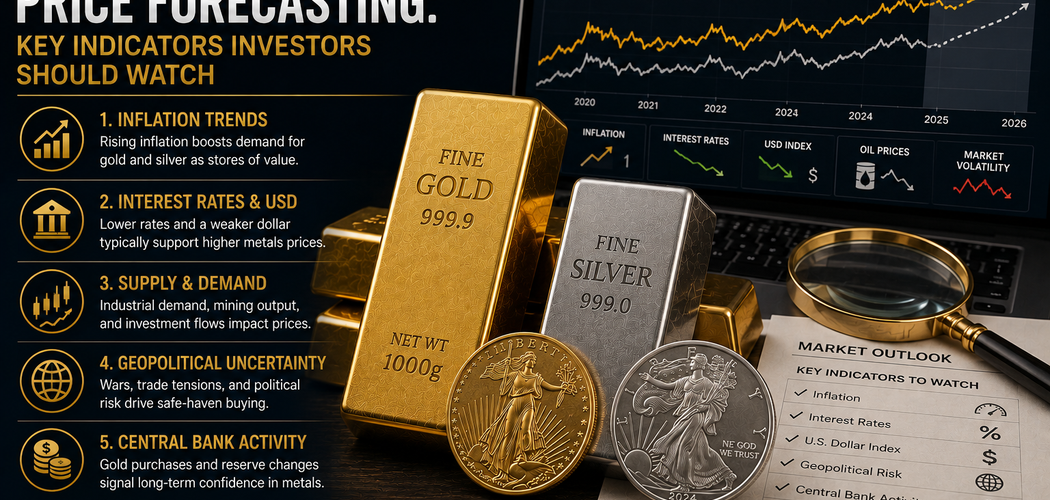
Gold and Silver Forecast: Key Indicators to Watch
Predicting precious metal prices is difficult because gold and silver respond to many forces at once. Interest rates can change investor demand, currencies affect global purchasing power, and economic growth influences industrial consumption. Therefore, a useful gold and silver forecast should focus on key indicators rather than one dramatic price prediction.
Gold and silver also have different market structures. Gold has a strong monetary role and attracts investment from individuals, institutions, and central banks. Silver shares some of these characteristics, but industrial demand has a much larger influence on its market.
As a result, the two metals can move together while producing very different percentage returns.
Investors can improve their analysis by monitoring real interest rates, inflation, the U.S. dollar, central bank policy, investment flows, physical demand, mining supply, and technical trends.
No indicator guarantees future prices. However, combining several signals can create a more informed framework for evaluating precious metal conditions.
Why Precious Metal Forecasting Is Difficult
Financial markets are forward-looking.
Gold and silver prices reflect what investors expect to happen, not simply what is happening today.
Suppose inflation is currently high. That may appear supportive for precious metals. However, investors could already expect inflation to decline sharply over the next six months.
Prices may therefore react to the expected future rather than today’s inflation rate.
The same problem applies to interest rates.
A central bank may keep rates unchanged today while investors anticipate significant cuts later. Bond yields and precious metals can move before the first official reduction occurs.
Therefore, a gold and silver forecast must consider expectations.
Unexpected events create another challenge. Wars, banking problems, political changes, natural disasters, and sudden economic weakness can rapidly alter market sentiment.
Forecasting works best as scenario analysis rather than certainty.
Start With Real Interest Rates
Interest rates are among the most important variables for precious metal investors.
Physical gold and silver do not generate interest.
Therefore, investors compare them with assets such as government bonds and savings products that can produce income.
However, nominal rates alone provide incomplete information.
Real interest rates account for inflation.
Suppose a bond yields 5% while expected inflation is 2%. The investor receives a positive inflation-adjusted return before other factors.
Now suppose inflation expectations rise significantly while the bond yield remains unchanged.
The real return becomes less attractive.
Lower real yields can reduce the opportunity cost of holding gold. Higher real yields can create stronger competition.
For this reason, investors should monitor real yields when constructing a gold and silver forecast.
Still, the relationship is not perfect. Other demand factors can overpower rate effects.
Follow Federal Reserve Policy Expectations
The Federal Reserve influences global financial conditions because the U.S. dollar and Treasury market play central roles in the international financial system.
When investors expect tighter Federal Reserve policy, bond yields may increase.
The dollar can also strengthen under certain conditions.
Both developments may pressure precious metals.
Conversely, expectations for lower rates can reduce yields and potentially weaken the dollar.
That environment can become more supportive for gold.
Silver may also benefit. However, the economic reason behind rate cuts matters.
If rates fall because economic growth is deteriorating rapidly, industrial silver demand could weaken.
Therefore, investors should not simply count expected rate cuts.
A stronger gold and silver forecast asks why policymakers are likely to change rates and how those changes could affect both investment and industrial demand.
Inflation Remains an Important Signal
Gold has a long-standing reputation as a potential store of value.
Therefore, persistent inflation can increase investor interest.
However, inflation does not automatically cause gold to rise.
Central bank responses matter.
If inflation increases and policymakers aggressively raise interest rates, higher real yields can create pressure on gold.
Silver faces another complication.
Inflation can increase production costs for manufacturers that use silver. Higher consumer prices may also weaken demand for manufactured products.
Therefore, investors should examine both the level and direction of inflation.
Is inflation accelerating or slowing?
Are expectations becoming unanchored? Are central banks successfully controlling price growth?
These questions provide more information than a single consumer price index reading.
Watch Inflation Expectations Too
Markets frequently respond to expected inflation before official statistics change.
Bond markets and surveys can provide clues about how investors and consumers expect prices to develop.
If expectations rise significantly, precious metal demand may respond before actual inflation accelerates.
The U.S. Dollar Can Change the Outlook
Gold and silver are commonly priced internationally in U.S. dollars.
Consequently, dollar movements can influence global demand.
A stronger dollar makes dollar-denominated metals more expensive for many buyers using other currencies.
A weaker dollar can make them relatively more affordable.
Therefore, dollar trends deserve a prominent place in a gold and silver forecast.
However, investors should avoid assuming a perfect inverse relationship.
Gold and the dollar can sometimes rise together during periods of severe global uncertainty because both may attract defensive demand.
Local currencies matter too.
An investor outside the United States may experience strong local-currency gold returns even when the international dollar price moves very little.
Therefore, investors should evaluate precious metals in the currency relevant to their own financial goals.
Central Bank Gold Buying Can Influence Demand
Central banks are important participants in the gold market.
They hold gold as part of their official reserves.
Some central banks purchase gold to diversify their reserve assets, manage risk, or reduce dependence on individual currencies.
Large official purchases can create significant physical demand.
Therefore, investors should monitor central bank activity when evaluating gold’s outlook.
This factor can also help explain why gold sometimes performs differently from what interest-rate models alone might suggest.
Silver does not receive comparable demand from central banks because it is generally not held as a major monetary reserve.
This difference is important.
A gold and silver forecast should therefore use some shared indicators while also recognizing metal-specific drivers.
Investment Flows Can Reveal Market Sentiment
Precious metal exchange-traded products provide another useful indicator.
When investors add substantial money to gold or silver products, demand for metal exposure is increasing.
Persistent outflows can indicate weaker investment interest.
Futures markets can also provide information about speculative positioning.
However, high bullish positioning can have two interpretations.
It may confirm a strong trend. At the same time, an extremely crowded market can become vulnerable if investors suddenly take profits.
Therefore, investment flows should be interpreted alongside price action and other indicators.
Physical bullion demand matters as well.
Strong bar and coin purchases can reveal investor concerns that may not appear fully in institutional positioning.
Combining several demand measures provides a broader picture.
Industrial Demand Is Critical for Silver
Silver cannot be forecast using gold indicators alone.
Industrial consumption represents a major source of silver demand.
The metal is valued for its electrical and thermal properties. It appears in electronics, automobiles, solar technologies, electrical infrastructure, and many specialized applications.
Therefore, manufacturing growth can influence silver prices.
Strong industrial activity can support consumption even when investment demand is moderate.
Conversely, a global slowdown may create pressure.
Investors building a gold and silver forecast should therefore monitor manufacturing indexes, technology spending, automobile production, renewable energy development, and broader industrial conditions.
The long-term growth of electrification may support silver consumption.
However, manufacturers can also reduce the amount of silver used in individual products when prices become expensive.
Demand forecasts should account for both growth and efficiency improvements.
Solar Demand Deserves Special Attention
Solar technology has become an important source of industrial silver consumption.
Photovoltaic cells use silver because of its excellent conductivity.
As global solar installations expand, the industry can contribute to silver demand.
However, investors should not assume that solar capacity and silver consumption will always grow at the same rate.
Manufacturers continuously work to reduce material costs.
They may use less silver per cell or develop alternative technologies.
Therefore, a forecast should examine both the number of installations and the amount of silver used per unit.
This principle applies across industries.
Technological growth can increase total demand while efficiency improvements reduce material intensity.
The final effect depends on which trend develops faster.
Mine Supply Changes Slowly
Precious metal supply cannot rapidly expand whenever prices rise.
Developing a new mine can take years.
Companies must identify deposits, conduct studies, secure financing, receive permits, and construct infrastructure.
Gold mine production therefore responds slowly to price changes.
Silver faces an additional issue because a substantial portion of production comes as a by-product of mining other metals.
A mine primarily developed for copper or zinc may produce silver as secondary output.
Consequently, higher silver prices do not necessarily lead immediately to much higher silver production.
Supply constraints can become important in a bullish gold and silver forecast, particularly when demand is rising rapidly.
However, mine supply represents only part of total availability.
Recycling also matters.
Recycling Can Respond Faster Than Mining
Higher precious metal prices encourage recycling.
Consumers may sell old jewelry, coins, silverware, or unwanted bullion.
Businesses can recover precious metals from industrial materials and electronic products.
Therefore, recycling can provide additional supply during strong price rallies.
Gold recycling can become especially significant when local currency prices rise sharply.
Silver recycling can also increase when the economics of recovering metal become more attractive.
This response can limit shortages.
Investors should therefore avoid forecasting supply based only on mine production.
A market experiencing flat mining output may still receive substantial additional material from recycling.
Total supply provides a more complete picture.
Jewelry Demand Matters for Gold
Investment headlines often dominate gold coverage, but jewelry remains an important source of physical demand.
Consumer purchasing patterns can change when prices rise.
Higher gold prices may reduce the amount of jewelry consumers can afford. Buyers may choose lighter products or postpone purchases.
Currency movements also influence local prices.
A strong international gold price combined with a weak local currency can make jewelry particularly expensive.
Therefore, investors should consider consumer demand when building a gold and silver forecast.
Strong investment demand can outweigh weaker jewelry purchases during some periods.
At other times, improving consumer demand can support the market when investment interest is softer.
Gold’s diverse demand structure is one reason its price cannot be explained by a single indicator.
The Gold-to-Silver Ratio Provides Relative Context
The gold-to-silver ratio compares the price of gold with silver.
Suppose gold trades at $4,000 per ounce while silver trades at $50. The ratio equals 80.
A rising ratio means gold is outperforming silver.
A falling ratio indicates stronger silver performance.
Investors sometimes use extreme ratio levels to argue that one metal is undervalued relative to the other.
However, there is no permanent correct ratio.
Industrial demand, monetary conditions, mining supply, investment flows, and market structure evolve over time.
Therefore, the ratio should provide context rather than an automatic trading signal.
It can be particularly useful for understanding whether a precious metal rally is being led by defensive gold demand or broader enthusiasm that is also pushing silver higher.
Technical Trends Can Strengthen a Forecast
Fundamental analysis explains why prices might move.
Technical analysis helps investors evaluate what prices are actually doing.
Support and resistance levels can identify areas where buyers or sellers have previously become active.
Moving averages can help reveal the broader trend.
Momentum indicators such as RSI can show whether recent price movements have become unusually strong.
For example, improving fundamentals combined with a breakout above major resistance may strengthen a bullish case.
Conversely, apparently favorable fundamentals combined with persistent price weakness can indicate that the market is focusing on other risks.
Therefore, a gold and silver forecast can benefit from combining fundamental and technical information.
Price action should not be ignored simply because an economic argument appears convincing.
Geopolitical Risk Can Change Gold Demand Quickly
Gold often receives increased attention during periods of geopolitical uncertainty.
Military conflicts, trade disputes, political instability, and sanctions can affect investor confidence.
These events may increase demand for assets perceived as defensive.
However, geopolitical events are extremely difficult to forecast.
Markets can also react differently depending on the severity and economic consequences of the event.
A brief political dispute may produce little lasting impact.
A major conflict affecting energy supplies, trade routes, or global financial relationships could have much broader consequences.
Silver may benefit from precious metal demand during such periods, but concerns about economic growth can create competing pressure on its industrial outlook.
Therefore, geopolitical risk should be treated as a scenario variable rather than a predictable price catalyst.
Economic Growth Can Separate Gold and Silver
The global growth outlook can produce significant differences between the metals.
During strong economic expansions, manufacturing activity may increase.
That can support silver demand.
Meanwhile, strong growth can encourage central banks to maintain higher interest rates, potentially creating a headwind for gold.
During recessions, the relationship can reverse.
Gold may attract defensive demand while silver faces weaker industrial consumption.
However, monetary policy can complicate the picture.
A recession may eventually cause central banks to reduce rates aggressively, supporting both metals through lower yields.
This is why a gold and silver forecast should consider complete economic scenarios rather than isolated variables.
The same rate change can have different implications depending on the economic environment surrounding it.
Fiscal Policy and Government Debt Can Matter
Monetary policy is not the only government influence on precious metals.
Fiscal policy can also shape investor expectations.
Large government deficits may increase borrowing requirements.
Investors may then consider the potential effects on bond yields, currencies, inflation, and long-term debt sustainability.
These concerns can sometimes support demand for gold as a diversification asset.
However, large deficits do not guarantee higher gold prices.
If government borrowing pushes yields significantly higher, the increased return available from bonds could create competition.
The effect depends on how investors interpret fiscal conditions.
Silver may react indirectly through changes in economic growth, infrastructure spending, or currency markets.
Therefore, government finances belong within the broader forecasting framework, but they should not be treated as standalone signals.
Market Sentiment Can Amplify Price Movements
Fundamentals can create a trend, while sentiment can amplify it.
When gold or silver begins rising rapidly, media attention often increases.
New investors enter the market, analysts raise forecasts, and momentum strengthens.
This process can push prices farther than fundamental models initially suggest.
The same can happen during declines.
Fear and forced selling may accelerate downward movements.
Silver can be especially sensitive because its smaller market often produces greater percentage volatility.
Investors should therefore distinguish between a healthy trend and excessive speculation.
Rapid price gains do not automatically mean a market must collapse.
However, increasingly speculative conditions can increase the risk of sharp corrections.
Sentiment indicators can therefore complement economic and supply-demand analysis.
Build Bull, Base, and Bear Scenarios
One of the most useful forecasting methods is scenario analysis.
Instead of predicting one exact future price, investors can create several possible outcomes.
A bullish scenario might include falling real yields, a weaker dollar, strong central bank purchases, improving investment flows, and constrained supply.
A bearish scenario could involve rising real yields, a stronger dollar, weaker investment demand, and slowing industrial consumption.
The base scenario may contain a mixture of supportive and negative factors.
Investors can then update these scenarios as new information becomes available.
This approach makes a gold and silver forecast more adaptable.
It also reduces the temptation to become emotionally attached to one price target.
Markets rarely follow one perfectly predictable path.
Avoid Overconfidence in Price Targets
Specific price targets can be useful for illustrating scenarios, but they can also create false precision.
No analyst knows exactly where gold or silver will trade months from now.
Unexpected economic data can change monetary policy.
Currencies can reverse direction, while geopolitical events can alter investor behavior overnight.
Supply disruptions can also occur.
Therefore, investors should focus on the assumptions behind a forecast.
If someone predicts dramatically higher gold prices, ask what conditions must occur for that forecast to succeed.
Do they expect lower rates? A weaker dollar? Higher central bank demand?
Likewise, bearish forecasts should identify the forces expected to pressure prices.
Understanding the assumptions is more useful than memorizing the target.
Create a Simple Indicator Dashboard
Investors can simplify precious metal analysis by tracking a small group of indicators consistently.
Start with real interest rates.
Next, monitor the U.S. dollar and major central bank policy expectations.
Follow inflation and economic growth.
For gold, track central bank purchases, investment flows, and jewelry demand.
For silver, add industrial activity and important technology-related demand trends.
Monitor mine production and recycling for both metals.
Finally, examine price trends, support, resistance, and momentum.
This dashboard provides a repeatable framework.
Instead of reacting to every headline, investors can determine whether the broader collection of indicators is becoming more supportive, neutral, or negative.
Update Forecasts When Evidence Changes
A forecast should never become a personal belief that must be defended.
Markets change.
An investor may begin with a bullish outlook because real yields are falling and the dollar is weakening.
Several months later, inflation could accelerate unexpectedly.
Central banks may then signal tighter policy, pushing real yields and the dollar higher.
The original forecast should change.
This willingness to update is essential.
Investors who become emotionally attached to a prediction may ignore evidence that contradicts it.
A disciplined gold and silver forecast remains conditional.
If supportive factors strengthen, the outlook may improve. If those factors disappear, the forecast should become less optimistic.
Flexibility is a strength, not a failure.
Conclusion
Gold and silver prices are influenced by a complex network of monetary, economic, industrial, and market forces.
No single indicator can consistently predict their direction.
Real interest rates can affect the opportunity cost of holding precious metals. The U.S. dollar influences international purchasing power, while inflation shapes expectations about currencies and monetary policy.
Gold also responds to central bank buying, investment flows, and jewelry demand.
Silver adds major industrial drivers, including electronics, vehicles, electrical infrastructure, and solar technologies.
Mine production, recycling, geopolitical risk, fiscal conditions, technical trends, and market sentiment provide additional information.
Therefore, a useful gold and silver forecast should combine several indicators rather than rely on one headline or price target.
Scenario analysis can make this process even stronger. Investors can develop bullish, bearish, and neutral cases and then update them as evidence changes.
Ultimately, forecasting should improve decision-making rather than create certainty. A disciplined gold and silver forecast recognizes uncertainty, tracks the most relevant indicators, and adapts when market conditions change.
FAQ
1. What Is the Most Important Indicator for Gold Prices?
There is no single best indicator. Real interest rates, the U.S. dollar, central bank demand, investment flows, inflation expectations, and geopolitical risk can all significantly influence gold.
2. Which Indicators Matter Most for Silver?
Silver investors should monitor interest rates, currencies, investment flows, industrial production, electronics, solar demand, mining supply, recycling, and broader economic growth.
3. Does a Weaker Dollar Always Make Precious Metals Rise?
No. A weaker dollar can support internationally priced metals, but other forces may be stronger. Real yields, investment demand, economic growth, and market sentiment also matter.
4. Can Technical Analysis Predict Future Gold Prices?
Technical analysis cannot predict prices with certainty. However, support, resistance, moving averages, momentum, and trends can help investors understand current market behavior.
5. How Often Should Investors Update Their Precious Metal Outlook?
Investors can review their outlook whenever important assumptions change. A strong gold and silver forecast should adapt to new information rather than remain fixed when monetary, economic, or market conditions shift.

