

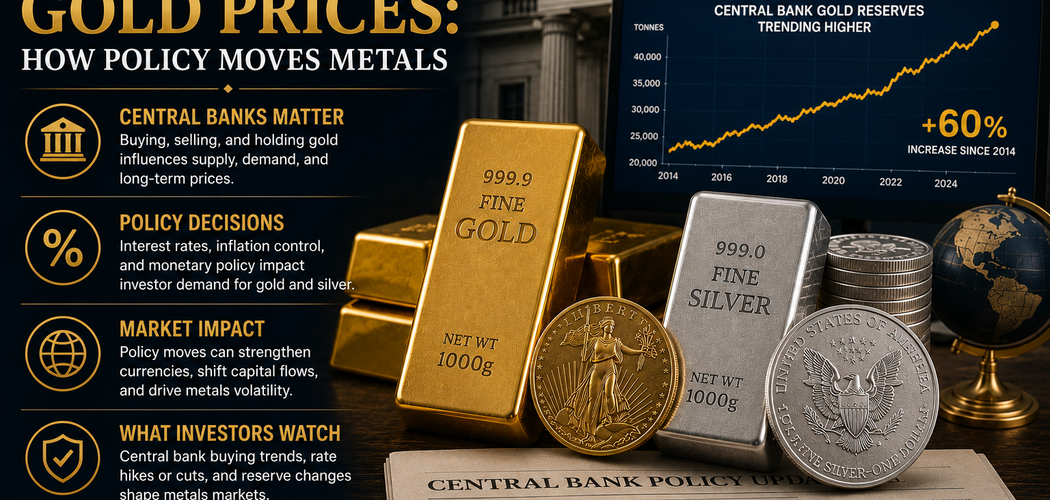
Central banks influence financial markets through interest rates, monetary policy, currency conditions, and their management of official reserves. Understanding central bank gold prices can therefore help investors make sense of major movements in both gold and silver.
The connection is not always straightforward. A central bank can raise interest rates, which may pressure precious metals by increasing returns on bonds and cash. However, the same policy decision might signal serious inflation concerns, potentially increasing demand for gold.
Central banks are also important gold buyers themselves. Many monetary authorities hold gold as part of their international reserves. Their purchases and sales can therefore affect physical demand.
Silver responds to monetary policy too, but it has an additional industrial role. Changes in borrowing costs can affect manufacturing, technology investment, construction, and consumer spending.
As a result, investors need to understand several policy channels rather than focusing only on whether interest rates rise or fall.
Why Central Banks Matter to Precious Metals
Central banks manage monetary conditions within their economies. Depending on their mandates, they may focus on inflation, employment, financial stability, exchange rates, or combinations of these goals.
Interest rates are one of their most important tools.
When inflation becomes too high, a central bank may raise policy rates. Higher borrowing costs can slow credit growth and economic activity.
During economic weakness, policymakers may reduce rates to encourage borrowing and spending.
These decisions affect precious metals because gold and silver do not generate interest when held as physical bullion.
If bonds and savings products suddenly offer attractive returns, investors may have less incentive to hold non-yielding metals.
However, central bank gold prices are influenced by much more than policy rates. Inflation expectations, currencies, liquidity, real yields, and official gold purchases can all affect the outcome.
Interest Rate Increases Can Pressure Gold
Higher interest rates can create competition for gold.
Imagine that safe government bonds offer very little interest. Holding gold may have a relatively low opportunity cost because investors are giving up little income.
Now suppose bond yields increase substantially.
Investors can potentially earn higher returns without taking the same risks associated with equities. As a result, some may shift money away from gold.
This relationship can create downward pressure.
However, investors should not assume that every rate increase causes gold to fall.
Markets often anticipate monetary policy months before an official decision. If investors already expected higher rates, the impact may be reflected in gold prices before the announcement.
Other forces can also outweigh the effect.
Therefore, the reason for a rate increase matters just as much as the increase itself.
Real Interest Rates Provide Better Context
Nominal interest rates do not tell the entire story.
Investors also need to consider inflation.
A bond yielding 5% might look attractive. However, if inflation is also near 5%, the investor’s inflation-adjusted return is much smaller.
This is why real interest rates matter.
Real yields broadly measure returns after accounting for inflation expectations.
Higher real yields can increase the opportunity cost of holding gold. Lower or negative real yields may make non-yielding assets relatively more attractive.
Therefore, investors studying central bank gold prices should monitor how policy decisions affect real yields rather than looking only at headline interest rates.
For example, a central bank might raise rates while inflation expectations increase even faster. In that situation, real monetary conditions may not tighten as much as the nominal rate suggests.
Why Expectations Matter
Financial markets are forward-looking.
Bond yields can change before central banks adjust official rates because traders continuously forecast future policy.
Consequently, gold can move before a central bank meeting.
Investors should therefore follow expectations, economic data, and policymaker communication alongside official decisions.
Rate Cuts Can Support Precious Metals
Lower interest rates can reduce the return available from bonds, savings accounts, and other interest-bearing assets.
This may decrease the opportunity cost of holding gold.
Rate cuts can also influence currencies.
If a country’s rates decline relative to those available elsewhere, its currency may become less attractive to international investors.
For U.S. monetary policy, a weaker dollar can sometimes support gold because the metal is commonly priced internationally in dollars.
Silver may benefit from similar forces.
Furthermore, lower borrowing costs can support economic activity. That can potentially strengthen industrial silver demand.
However, the reason behind rate cuts remains important.
If central banks are cutting rates because a severe recession has begun, weak manufacturing conditions could pressure silver even while lower yields support precious metal investment demand.
The Federal Reserve Has Global Influence
The U.S. Federal Reserve plays an especially important role in precious metal markets.
Gold and silver are commonly quoted internationally in U.S. dollars. Meanwhile, U.S. Treasury securities are central to global financial markets.
Changes in Federal Reserve policy can therefore influence interest rates, currencies, capital flows, and investor sentiment worldwide.
When markets expect tighter Fed policy, Treasury yields may rise and the dollar may strengthen.
Those conditions can create challenges for gold and silver.
When investors expect easier monetary policy, yields may decline. The dollar can weaken under some conditions, while precious metals may become more attractive.
Still, central bank gold prices cannot be explained by the Federal Reserve alone.
The European Central Bank, People’s Bank of China, Bank of Japan, Bank of England, and other monetary authorities can also influence global liquidity and currencies.
Central Banks Are Also Gold Buyers
Central banks influence gold differently from most other commodities because they actually hold the metal as a reserve asset.
Countries maintain international reserves to support financial stability, foreign exchange operations, and confidence in their monetary systems.
Those reserves can include foreign currencies, government securities, and gold.
Gold can provide diversification because it is not the liability of another government or company.
Therefore, some central banks increase their gold reserves to diversify away from heavy dependence on individual currencies or financial assets.
When official institutions purchase substantial quantities, they add another source of physical demand.
This can help support the gold market even when other conditions, such as elevated interest rates, appear unfavorable.
That distinction is essential when analyzing monetary policy.
Why Central Banks Hold Gold
Central banks may hold gold for several reasons.
Diversification is one.
A reserve portfolio concentrated in one currency or type of government security may expose a country to specific financial risks.
Gold offers an alternative reserve asset.
Liquidity is another consideration. Gold has a large international market and can be traded globally.
Central banks may also value its historical role as a monetary asset.
Unlike a government bond, physical gold does not depend on another country making payments.
This does not mean gold is risk-free. Its market price fluctuates, and storage requires security.
Nevertheless, official demand adds a unique dimension to central bank gold prices that does not exist to the same degree for silver.
Silver is generally not held as a major official reserve asset.
Inflation Policy Can Move Gold in Opposite Directions
High inflation creates a complicated environment.
On one side, investors may purchase gold because they worry about declining purchasing power.
On the other side, central banks may respond by raising interest rates.
Higher rates can increase real yields and support the currency, both of which may pressure gold.
Therefore, inflation can create opposing forces.
Suppose inflation rises unexpectedly.
Gold might initially strengthen because investors become concerned about purchasing power.
Then policymakers signal aggressive rate increases.
Bond yields rise, the currency strengthens, and gold gives back some of those gains.
This example shows why monetary policy analysis requires more than one economic variable.
The market is constantly evaluating inflation and the expected central bank response at the same time.
Currency Policy Is Another Important Channel
Central bank decisions can significantly affect currency values.
Interest-rate differences between countries influence where global investors choose to hold money.
If one country offers higher yields than another, its currency may attract additional demand, although many other variables also matter.
For gold and silver, the U.S. dollar deserves particular attention.
A stronger dollar can make dollar-denominated metals more expensive for international buyers using weaker currencies.
A weaker dollar can have the opposite effect.
Therefore, central bank gold prices can move indirectly through foreign exchange markets.
However, gold and the dollar do not always move in opposite directions.
During severe global stress, investors may seek both. Correlations change as economic conditions evolve.
Money Supply Can Affect Investor Expectations
Central banks can influence financial conditions through more than interest rates.
During severe economic disruptions, they may purchase financial assets or provide additional liquidity to markets.
These policies can expand central bank balance sheets and influence longer-term borrowing costs.
Investors sometimes interpret aggressive monetary expansion as supportive for gold.
They may worry about future inflation, currency purchasing power, or financial instability.
However, money supply growth does not automatically translate into immediate precious metal gains.
Economic conditions matter.
If credit demand remains weak or financial institutions hold additional liquidity rather than expanding lending, inflationary effects may be limited.
Therefore, investors should avoid using one measure of money supply as a guaranteed gold signal.
Policy must be considered within the broader economic environment.
Quantitative Easing Can Influence Gold
Quantitative easing generally involves a central bank purchasing financial assets, often government bonds.
These purchases can reduce longer-term yields and increase liquidity.
Lower yields can reduce the opportunity cost of holding gold.
Additionally, investors may become concerned about future inflation or currency weakness when central bank balance sheets expand significantly.
These concerns can support precious metal demand.
However, quantitative easing does not guarantee rising gold prices.
If investors remain confident in economic growth and inflation stays controlled, other assets may attract more capital.
Silver can respond differently again.
Easier monetary conditions may support investment demand while also encouraging economic activity. If manufacturing improves, industrial silver consumption may strengthen.
This combination can sometimes create particularly favorable conditions for silver.
Quantitative Tightening Can Create Headwinds
Quantitative tightening broadly reverses some effects of balance-sheet expansion.
A central bank may allow bonds to mature without replacing them or actively reduce holdings.
This can remove liquidity from financial markets.
Longer-term yields may face upward pressure depending on market conditions.
Higher yields can create competition for non-yielding assets.
Therefore, quantitative tightening may become a headwind for precious metals.
Still, central bank gold prices will depend on why tightening is occurring.
If policymakers reduce liquidity while financial stress increases, investors may simultaneously seek defensive assets.
Likewise, strong official gold purchases can offset some investment weakness.
No monetary policy tool operates independently from the rest of the economy.
Silver Responds Through Industrial Demand
Gold’s relationship with central banks is primarily monetary and financial.
Silver adds an industrial channel.
Higher rates increase borrowing costs for companies and consumers.
Businesses may delay expansion, while households can reduce spending on expensive products.
Construction and manufacturing activity may slow.
These changes can affect demand for materials, including silver.
For example, silver is used in electrical equipment, electronics, automobiles, solar technologies, and many other industrial applications.
Aggressive monetary tightening can therefore pressure silver through both investment and industrial channels.
Lower rates may eventually create the opposite environment.
Cheaper financing can support economic activity, which may strengthen industrial consumption.
This makes silver more economically sensitive than gold.
Policy Surprises Often Cause Stronger Reactions
Markets constantly forecast central bank decisions.
If policymakers do exactly what investors expect, the immediate reaction in gold and silver may be relatively small.
Unexpected decisions can produce much larger moves.
Suppose investors expect rates to remain unchanged, but a central bank unexpectedly raises them.
Bond yields and currencies may adjust rapidly.
Precious metals can react as traders update their expectations.
The opposite can happen after an unexpected rate cut.
Therefore, investors following central bank gold prices should compare the actual policy decision with what markets expected beforehand.
The difference between expectations and reality can matter more than the headline announcement itself.
Central Bank Communication Moves Markets Too
Policy decisions are not the only important events.
Central bankers regularly give speeches, publish economic forecasts, and answer questions at press conferences.
Investors analyze this communication for clues about future policy.
A central bank may leave rates unchanged but signal that increases are likely.
Markets can react immediately.
Likewise, policymakers may maintain current rates while suggesting that inflation is improving enough to allow future cuts.
Gold and silver can move before any actual policy change occurs.
This is why terms such as hawkish and dovish frequently appear in financial coverage.
Hawkish communication generally suggests tighter monetary policy.
Dovish language usually indicates greater willingness to ease policy.
These expectations can affect yields, currencies, and precious metals.
Economic Data Shapes Central Bank Expectations
Investors who follow precious metals should monitor the economic indicators that central banks themselves watch.
Inflation is one of the most important.
Employment data also matters because strong labor markets can influence wages and consumer spending.
Economic growth provides another signal.
Central banks may have more room to maintain restrictive policy when an economy remains strong.
Weak growth can increase pressure to reduce rates.
Consumer spending, manufacturing activity, and financial conditions can also influence policy expectations.
Rather than waiting for central bank meetings, investors can watch how these indicators change the expected policy path.
This provides a more complete framework for analyzing central bank gold prices.
Why Gold Can Rise Even With High Interest Rates
Investors sometimes become confused when gold performs strongly despite elevated rates.
Traditional analysis suggests that high yields should create pressure.
However, interest rates represent only one market force.
Central bank gold purchases can provide significant demand.
Geopolitical uncertainty may encourage investors to seek defensive assets.
Concerns about government debt, currencies, or financial stability can also support gold.
Furthermore, inflation may remain high enough that real yields are less attractive than nominal rates suggest.
Therefore, investors should never assume that one relationship must dominate.
Markets combine many forces simultaneously.
A stronger analysis asks which factors are currently most influential rather than relying on one historical rule.
How Investors Can Track Monetary Policy
Investors do not need to analyze every central bank in the world.
A few indicators can provide useful context.
Start with major policy rates, particularly those set by the Federal Reserve and other large monetary authorities.
Next, monitor government bond yields.
Real yields can provide additional information about the inflation-adjusted return available from fixed-income investments.
Currency indexes can show whether monetary conditions are supporting or weakening the U.S. dollar.
Investors can also follow inflation, employment, and economic growth data.
Finally, monitor official gold demand.
Together, these indicators create a more complete view than focusing only on rate announcements.
Avoid Trading Every Central Bank Headline
Central bank meetings often produce dramatic financial headlines.
However, long-term investors should be careful about reacting to every statement.
Markets can reverse quickly as traders interpret new information.
A single sentence from a policymaker may produce short-term volatility without changing the broader economic trend.
Frequent trading can also increase transaction costs and encourage emotional decisions.
Instead, investors can focus on the direction of monetary policy over time.
Are real rates generally rising or falling? Is liquidity becoming tighter or easier? Is inflation improving? Are official institutions accumulating gold?
These broader questions can provide more useful information than trying to predict every short-term move.
Combine Policy Analysis With Market Fundamentals
Central bank policy is important, but precious metal prices also depend on supply and demand.
Mine production affects available supply.
Recycling can increase when prices rise.
Jewelry consumption remains important for gold, while industrial fabrication plays a major role in silver.
Investment flows can shift quickly.
Geopolitical uncertainty and financial market stress can also influence demand.
Therefore, central bank gold prices should be studied within this larger framework.
A rate cut may appear bullish, but weakening physical demand could limit gains.
Likewise, high rates may appear bearish, yet strong central bank buying or geopolitical demand could support prices.
Combining monetary analysis with market fundamentals produces a more balanced view.
Conclusion
Central banks have enormous influence over financial markets, and precious metals are no exception.
Interest rates affect the opportunity cost of owning non-yielding bullion. Real yields provide additional context because they account for inflation.
Currency movements create another connection.
Central bank policies can strengthen or weaken currencies, which can influence the international affordability of gold and silver.
Official institutions also participate directly in the gold market through reserve purchases.
As a result, central bank gold prices reflect both monetary policy and physical demand from central banks themselves.
Silver responds to many of the same forces, but its industrial role creates additional sensitivity to economic growth and borrowing conditions.
Investors should therefore avoid simple rules such as “rate cuts mean gold rises” or “rate increases mean gold falls.”
Markets react to expectations, surprises, real yields, currencies, inflation, liquidity, economic growth, and physical demand.
By combining these factors, investors can develop a much stronger understanding of central bank gold prices and why monetary policy can produce very different outcomes for gold and silver across economic cycles.
FAQ
1. Do Higher Interest Rates Always Push Gold Lower?
No. Higher rates can increase the opportunity cost of owning gold, but inflation, geopolitical risks, central bank buying, currencies, and financial uncertainty can offset that pressure.
2. Why Do Central Banks Buy Gold?
Central banks may hold gold to diversify reserves, manage financial risk, and reduce reliance on individual currencies or government securities. Gold is also a globally traded reserve asset.
3. How Do Rate Cuts Affect Silver?
Lower rates may support precious metal investment demand and encourage economic activity. However, silver’s reaction also depends on industrial demand, currencies, inflation, and market expectations.
4. Why Can Gold Move Before a Central Bank Meeting?
Financial markets anticipate future decisions. Bond yields, currencies, and precious metals can adjust when investors change their expectations, even before policymakers officially act.
5. What Should Gold Investors Watch From Central Banks?
Investors can monitor policy rates, real yields, inflation, currencies, economic forecasts, and official gold purchases. Combining these indicators gives central bank gold prices analysis much stronger context.

