

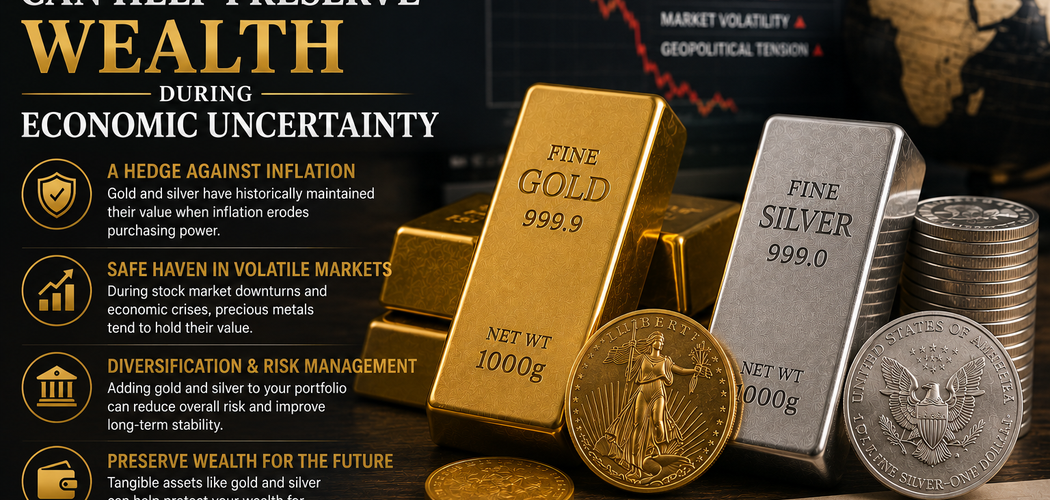
Economic uncertainty can arrive in many forms. Inflation may reduce purchasing power, recessions can weaken businesses, and financial markets can become volatile. During these periods, wealth preservation with gold often attracts attention because precious metals behave differently from many traditional financial assets.
Gold has served as a store of value across centuries. Today, investors, institutions, and central banks continue to own it. Silver also has a long monetary history, although modern industrial demand plays a much larger role in its price.
Still, neither metal guarantees protection from losses.
Gold and silver can decline during economic stress, especially when investors need liquidity or interest rates rise. Therefore, their value in a financial plan comes primarily from diversification rather than certainty.
Investors who understand these limitations can use precious metals more effectively. Instead of treating them as emergency bets, they can consider how metals fit alongside cash, stocks, bonds, property, and other assets.
What Does Wealth Preservation Mean?
Wealth preservation focuses on protecting the long-term purchasing power and usefulness of accumulated assets.
It differs from simply maximizing investment returns.
An aggressive investor may accept substantial risk in pursuit of rapid growth. Someone focused on preservation generally places greater emphasis on diversification, liquidity, stability, and avoiding catastrophic losses.
Inflation is one threat to wealth.
If prices rise faster than the return on savings, purchasing power declines. Market crashes create another risk because investment values can fall quickly.
Currency weakness, business failures, geopolitical events, and unexpected expenses can also affect financial security.
A wealth preservation with gold approach attempts to add an asset with different economic drivers to the portfolio.
However, preservation should never depend on one asset. A resilient strategy usually combines several types of investments and maintains adequate liquidity.
Why Investors Turn to Gold During Uncertainty
Gold has characteristics that distinguish it from stocks and bonds.
A share of stock represents ownership in a company. Its value can depend heavily on profits, growth expectations, and investor confidence.
A bond represents a financial obligation. Its value depends partly on interest rates and the borrower’s ability to repay.
Physical gold is different.
It is a tangible asset that does not represent another party’s debt. It also trades internationally and has a globally recognized market.
These characteristics can become attractive when confidence in financial systems weakens.
Investors may also buy gold when geopolitical risks increase or when they become concerned about currencies.
As a result, demand can rise during some periods of uncertainty.
Still, gold should not be viewed as guaranteed crisis insurance. Its price remains determined by buyers and sellers and can fluctuate substantially.
Gold Can Provide Portfolio Diversification
Diversification means spreading investments across assets that do not always respond to the same forces.
Suppose a portfolio contains only shares in similar companies.
If that industry experiences severe problems, nearly every holding could decline together.
Adding assets with different drivers may reduce this concentration.
Gold responds to real interest rates, currency movements, investment demand, central bank purchases, and geopolitical conditions. These forces differ from the corporate earnings that often drive stock prices.
Therefore, wealth preservation with gold may help reduce dependence on a single economic outcome.
However, diversification does not eliminate risk.
Gold and stocks can sometimes fall simultaneously. Likewise, bonds and precious metals can both struggle when real yields rise sharply.
The goal is not to find an asset that always rises when another falls. Instead, diversification creates multiple potential sources of resilience.
How Gold May Respond During Market Stress
Periods of market stress can create strong demand for liquid assets.
Gold sometimes benefits because investors view it as a defensive holding.
However, its behavior can change during different stages of a crisis.
When panic begins, investors may sell profitable assets to raise cash. Gold can therefore decline alongside stocks for a short period.
Later, expectations of lower interest rates, monetary stimulus, financial instability, or currency weakness may increase demand.
This pattern demonstrates why short-term price movements can be misleading.
An investor focused on long-term preservation should avoid assuming that gold has failed simply because it declines during one turbulent week.
Instead, consider its role across complete economic cycles.
The objective is broader portfolio resilience rather than perfect protection during every market decline.
Inflation Creates a Long-Term Challenge
Inflation gradually reduces what money can buy.
Even relatively moderate inflation becomes significant over decades.
Suppose a household keeps most of its long-term savings in cash. The nominal amount may remain stable, but its real purchasing power can decline as living costs increase.
Investors therefore seek assets that may preserve or increase value over time.
This is one reason wealth preservation with gold remains relevant.
Gold supply grows relatively slowly compared with currencies that governments and banking systems can expand.
However, gold does not track consumer inflation perfectly.
Its price can decline even when inflation is elevated. Interest rates, currency strength, and investor expectations can outweigh inflation concerns over shorter periods.
Therefore, gold may be more useful as a long-term diversification tool than as a precise year-to-year inflation hedge.
Real Interest Rates Matter
Interest rates influence the opportunity cost of holding gold.
Physical bullion does not generate interest.
When safe financial assets offer attractive returns after inflation, investors may prefer those income-producing alternatives.
Real interest rates help measure this trade-off.
For example, suppose a bond yields 5% while inflation is 2%. The investor receives a positive inflation-adjusted return before other considerations.
Now imagine inflation rises above the bond yield.
The real return becomes less attractive.
Lower or negative real rates can reduce the opportunity cost of holding gold. Higher real rates can create stronger competition.
Therefore, investors using wealth preservation with gold should monitor inflation and interest rates together.
Neither variable provides enough information on its own.
Currency Weakness Can Affect Local Gold Prices
Gold is traded globally, commonly using U.S. dollars as the international benchmark.
However, investors experience returns in their own currencies.
Suppose international gold prices remain unchanged while an investor’s home currency weakens substantially against the dollar.
Gold could become more expensive in local currency terms.
This creates a form of currency diversification.
Conversely, a strengthening local currency can reduce local gold returns even if the international price remains stable.
Therefore, investors should evaluate precious metal performance in the currency they actually use.
This is particularly important for long-term wealth preservation because expenses, taxes, and financial goals are usually denominated locally.
Gold’s global market can diversify currency exposure, but it cannot eliminate currency risk entirely.
Why Silver Behaves Differently
Silver shares several characteristics with gold.
It is scarce, tangible, globally traded, and widely available as investment bullion.
However, industrial consumption plays a much larger role in silver demand.
Manufacturers use silver in electronics, electrical equipment, vehicles, solar technology, and many specialized products.
Consequently, economic growth can significantly affect its market.
During an expansion, industrial demand may strengthen alongside investment demand.
During a recession, however, expectations for manufacturing can weaken.
This creates an important distinction for investors pursuing wealth preservation with gold while also considering silver.
Gold generally has a more defensive profile. Silver can provide diversification and potentially stronger gains, but its greater economic sensitivity can also produce larger declines.
Silver Can Add Growth Sensitivity
Silver’s industrial role is not necessarily a disadvantage.
Long-term growth in electrification, electronics, energy infrastructure, and technology may support demand.
Therefore, silver can offer exposure to both precious metal investment trends and industrial development.
The trade-off is higher volatility.
Investors should consider whether that characteristic supports their preservation goals before allocating heavily to silver.
Cash Still Plays an Essential Role
Precious metals should not replace emergency savings.
Cash provides immediate liquidity.
Unexpected bills, temporary unemployment, repairs, medical expenses, and other financial emergencies require money that can be accessed quickly without worrying about market prices.
Physical gold and silver can be sold, but transaction costs matter.
Dealers typically sell bullion above spot prices and may purchase it at lower prices. Therefore, investors can lose money if they must sell shortly after buying.
Storage and transportation can also complicate urgent transactions.
A strong preservation strategy therefore combines liquidity with longer-term assets.
Cash handles immediate needs. Other investments can pursue growth and income. Precious metals may provide another source of diversification.
Physical Gold Has Advantages and Responsibilities
Some investors prefer physical ownership because they directly control the asset.
Coins and bars do not require a brokerage account to exist.
However, physical ownership creates practical responsibilities.
Storage is the most obvious.
Home storage can provide direct access, but theft and security become concerns. Professional vaults may offer stronger protection, although they charge fees.
Insurance can add another cost.
Investors also need to verify authenticity and purchase from reputable dealers.
These expenses should be included when evaluating wealth preservation with gold.
A metal price increase does not represent the investor’s exact return if premiums, storage costs, insurance, and selling spreads reduce the final proceeds.
Financial Gold Products Offer Another Option
Investors do not need to store bullion personally to gain exposure to gold prices.
Exchange-traded products can provide convenient access through brokerage accounts.
They are generally easier to buy and sell than physical bars.
Rebalancing can also be simpler because investors can adjust positions without transporting metal.
However, financial products introduce different considerations.
Management fees can reduce returns. Product structures vary, so investors should understand what assets support the fund and how it operates.
Mining stocks are another possibility, but they are not substitutes for bullion.
Mining companies face operational costs, management decisions, political risks, debt, and production challenges.
Therefore, their shares can behave very differently from physical gold.
Investors should choose the form of exposure that best matches their objectives.
Avoid Concentrating Too Much Wealth in Metals
Fear can lead investors to make extreme decisions.
During periods of economic uncertainty, some people may consider moving most of their savings into gold or silver.
That approach creates a new risk: concentration.
Precious metals do not generate dividends, business earnings, or rental income.
Over long periods, productive assets can play an important role in building wealth.
Stocks provide ownership in companies. Property may generate rent. Bonds can produce interest.
Therefore, wealth preservation with gold generally works better as one component of a diversified portfolio.
The appropriate allocation varies by individual.
Investors should consider income, age, financial obligations, risk tolerance, time horizon, and existing investments before deciding how much exposure is suitable.
Economic Uncertainty Is Difficult to Predict
Investors often know that economic risks exist but struggle to predict when they will become serious.
Recessions can arrive later than expected.
Inflation can remain elevated longer than economists predict. Interest rates may change unexpectedly, while geopolitical events can occur without warning.
This uncertainty makes market timing difficult.
Someone waiting for the perfect moment to buy gold may purchase after a large rally has already occurred.
Alternatively, buying aggressively because of frightening headlines can result in entering near a temporary peak.
A more disciplined approach may involve establishing a strategic allocation and building it gradually.
That way, the plan does not depend entirely on forecasting the next crisis.
Dollar-Cost Averaging Can Reduce Timing Pressure
Dollar-cost averaging involves investing a predetermined amount on a regular schedule.
For example, an investor could gradually build precious metal exposure over several months instead of making one large purchase.
This method spreads entry prices across different market conditions.
When prices decline, the same contribution buys more exposure. When prices rise, it buys less.
However, the method does not guarantee profits or better returns.
If gold rises steadily, investing earlier would have produced stronger performance.
Physical bullion investors should also consider premiums. Frequent small purchases may create higher percentage transaction costs.
Still, gradual accumulation can support a disciplined wealth preservation with gold plan for investors who want to reduce the emotional pressure of choosing one entry point.
Rebalancing Helps Control Risk
Suppose precious metals represent a modest portion of an investor’s portfolio.
Gold and silver then experience a powerful rally.
Their value may increase enough to become a much larger percentage of total assets.
That changes the portfolio’s risk profile.
Rebalancing restores the intended allocation.
An investor may sell some precious metal exposure and redirect the proceeds toward assets that have become underweight.
The reverse can occur after a large decline.
This process encourages discipline.
Rather than buying more after prices have already surged, investors may trim an overweight position.
Rebalancing can be performed periodically or when allocations move beyond predetermined ranges.
The important point is maintaining a portfolio structure based on financial goals rather than market excitement.
Consider Counterparty Risk
Counterparty risk exists when an investment depends on another party meeting its obligations.
Bank deposits, bonds, brokerage arrangements, and many financial contracts involve some form of institutional relationship.
Physical bullion held directly has different characteristics because ownership does not depend on a company’s future profits or a borrower’s repayment.
This can appeal to investors concerned about financial system risk.
However, direct ownership introduces other risks.
The metal can be lost or stolen. Storage providers can create operational considerations, while counterfeit products can be a concern when purchasing from unreliable sources.
Therefore, reducing one type of risk often introduces another.
Good wealth planning identifies these trade-offs rather than assuming any asset is completely risk-free.
Precious Metals Can Support Estate Planning
Wealth preservation may extend beyond one investor’s lifetime.
Gold and silver can potentially be transferred to heirs, making them relevant to long-term family planning.
However, physical ownership requires documentation.
Families should maintain records showing what they own, where appropriate documentation is stored, and how beneficiaries can legally access the assets.
Estate and tax rules vary by jurisdiction.
Therefore, professional guidance may be necessary for significant holdings.
A wealth preservation with gold plan becomes much less useful if future beneficiaries do not know the assets exist or cannot establish ownership.
Financial education matters too.
Heirs should understand why precious metals were included in the family portfolio and how they differ from income-producing investments.
Do Not Ignore Taxes and Transaction Costs
Gross price performance is not the same as the investor’s actual return.
Taxes can affect precious metal investments depending on jurisdiction and ownership method.
Physical bullion can also involve dealer premiums and selling spreads.
Storage and insurance add ongoing costs.
Exchange-traded products may charge management expenses.
Therefore, investors should calculate returns after reasonable costs whenever possible.
This becomes particularly important for frequent traders.
Repeated buying and selling can create expenses that reduce performance.
Long-term investors may face fewer transactions, but storage costs can accumulate over many years.
Understanding these expenses helps investors make more realistic comparisons between precious metals and other investments.
Watch Several Economic Indicators
Investors do not need to predict the economy perfectly, but several indicators can provide useful context.
Inflation shows how purchasing power is changing.
Real interest rates help investors evaluate the relative appeal of non-yielding assets.
The U.S. dollar can influence internationally quoted gold and silver prices.
Central bank policy provides information about monetary conditions.
Investors can also monitor employment, economic growth, credit conditions, and financial market volatility.
For silver, manufacturing activity deserves additional attention because industrial demand is important.
Using several indicators provides a broader view.
A single inflation report or interest-rate decision should rarely determine an entire long-term investment strategy.
Common Wealth Preservation Mistakes
One common mistake is waiting until a crisis becomes obvious before considering diversification.
By that point, defensive assets may already have risen substantially.
Another mistake is treating gold as guaranteed protection.
Gold can experience meaningful declines, even during uncertain economic periods.
Investors may also ignore storage, premiums, taxes, or fund expenses.
Concentrating too heavily in precious metals creates another problem because it sacrifices exposure to productive assets.
Finally, some investors confuse wealth preservation with avoiding all volatility.
Every investment carries risk.
The objective is to create a portfolio capable of handling different economic conditions without depending entirely on one forecast or asset class.
Build a Preservation Plan Before a Crisis
Financial decisions become more difficult when markets are falling rapidly.
Fear can encourage impulsive behavior.
Therefore, investors benefit from creating rules during calmer periods.
Start by maintaining adequate emergency savings.
Next, review the portfolio for excessive concentration.
Then determine whether precious metals could provide useful diversification.
If they do, choose an appropriate allocation and ownership method.
Establish rules for future purchases and rebalancing.
Finally, review the plan periodically rather than reacting to every headline.
A predetermined wealth preservation with gold framework can reduce emotional decision-making when uncertainty increases.
It also keeps precious metals connected to long-term financial objectives.
Gold and Silver Should Serve Different Purposes
Investors who own both metals should understand why each is included.
Gold can serve as the more defensive precious metal holding.
Its demand is strongly connected to investment, jewelry, central banks, currencies, and monetary conditions.
Silver adds industrial exposure.
That can provide stronger performance during periods when manufacturing growth and precious metal demand strengthen together.
However, silver’s volatility can work against preservation goals during economic contractions.
Therefore, investors should not assume equal allocations are necessary.
A preservation-focused portfolio may place greater emphasis on gold while maintaining smaller silver exposure.
Another investor with greater risk tolerance might choose a different mix.
The correct balance depends on the entire financial plan.
Conclusion
Economic uncertainty cannot be eliminated. Recessions, inflation, market declines, currency movements, and geopolitical shocks will continue to challenge investors.
The goal of wealth preservation is not to predict every crisis.
Instead, investors can build portfolios that do not depend entirely on one economic outcome.
Wealth preservation with gold can contribute to that approach because gold has different market drivers from stocks, bonds, and many other financial assets. It is globally recognized, physically durable, and influenced by monetary conditions, currencies, central banks, and investment demand.
Silver can also provide diversification, although its industrial role and greater volatility create different risks.
Neither metal should replace emergency savings or productive investments.
Cash provides liquidity. Stocks, businesses, property, and bonds can provide growth or income. Precious metals may serve as another layer of diversification.
Investors should also account for storage, transaction costs, taxes, security, and rebalancing.
Most importantly, wealth preservation with gold should be part of a deliberate long-term plan rather than an emotional reaction to frightening economic headlines. A diversified strategy built before uncertainty intensifies can provide a stronger foundation for protecting wealth through changing market conditions.
FAQ
1. Can Gold Protect Wealth During a Recession?
Gold may provide diversification during recessions, particularly when uncertainty encourages defensive investment demand. However, it can still decline and should not be considered guaranteed protection.
2. Is Silver Good for Preserving Wealth?
Silver can contribute to diversification, but it usually has greater volatility than gold. Its substantial industrial demand also makes it more sensitive to economic growth and manufacturing conditions.
3. Should Precious Metals Replace Emergency Cash?
Generally, no. Emergency savings should remain liquid and easily accessible. Physical precious metals can fluctuate in price and may involve dealer spreads when sold.
4. Is Physical Gold Safer Than Gold Funds?
Each carries different risks. Physical bullion provides direct ownership but requires secure storage. Funds offer convenience and liquidity but involve fees and financial structures that investors should understand.
5. How Can Investors Use Gold Without Taking Too Much Risk?
Investors can maintain a measured allocation, diversify across other assets, avoid excessive leverage, and rebalance periodically. A disciplined wealth preservation with gold approach should support the broader financial plan rather than dominate it.

