

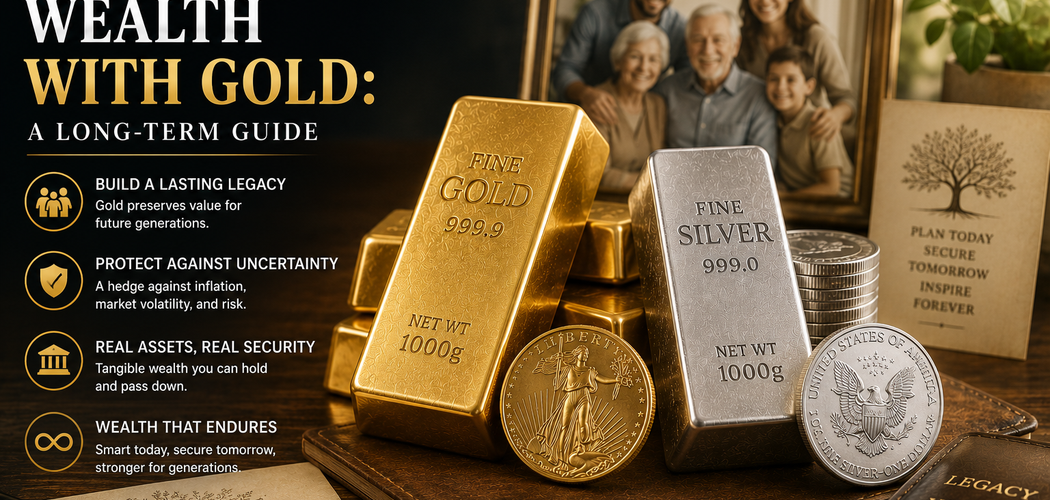
Building wealth that lasts beyond one lifetime requires a different mindset from short-term investing. Families need to consider preservation, growth, ownership, inheritance, and financial education. For some investors, generational wealth with gold can become one part of that broader long-term strategy.
Gold has been valued across cultures for thousands of years. It is durable, globally recognized, and relatively easy to store compared with many physical assets. Silver shares several of these characteristics, although its lower value per ounce and greater industrial demand create important differences.
Neither metal automatically creates wealth. Gold and silver do not generate business profits, dividends, or rental income simply because someone owns them.
Instead, precious metals may help diversify wealth that has already been accumulated through income, businesses, investments, property, or other productive assets.
The key is understanding where metals fit within a family wealth plan rather than expecting them to replace one.
What Generational Wealth Really Means
Generational wealth refers to financial resources transferred from one generation to another.
Those resources can include businesses, stocks, bonds, real estate, cash, precious metals, intellectual property, and other valuable assets.
However, successful wealth transfer involves more than leaving assets behind.
Families also need systems for ownership, recordkeeping, estate planning, financial education, and responsible decision-making.
An inheritance can disappear quickly if the next generation does not understand how to manage it.
Therefore, building generational wealth with gold should include both the asset itself and knowledge about why the family owns it.
Future beneficiaries should understand its role, storage arrangements, approximate value, and how it fits alongside other investments.
This creates continuity rather than simply transferring physical objects.
Why Gold Appeals to Long-Term Families
Gold has several characteristics that can make it attractive for long-term ownership.
First, it is durable. Properly stored gold does not deteriorate in the way many physical goods do.
Second, gold is internationally recognized.
A widely traded bullion product can generally be valued using global market prices. This makes it different from collectibles whose value may depend heavily on changing tastes.
Gold also has high value density.
A relatively small amount can represent substantial financial value. Therefore, storing meaningful wealth in gold generally requires less physical space than storing an equivalent value in silver.
Finally, gold does not represent someone else’s debt.
A physical gold bar does not require a corporation to remain profitable or a borrower to continue making payments.
These characteristics can support a long-term wealth-preservation role.
Gold Should Complement Productive Assets
One of the most important principles of multigenerational planning is diversification.
Gold may help preserve value, but it does not produce earnings.
Stocks represent ownership in businesses that can generate profits. Real estate may produce rent. Bonds can provide interest. A family business can create income and employment.
These productive assets can help wealth grow.
Therefore, generational wealth with gold works best when precious metals complement rather than replace productive investments.
A family concentrating nearly all its assets in gold could miss decades of potential growth from businesses and financial markets.
Likewise, a family holding only stocks or property may become heavily dependent on specific economic conditions.
Combining different assets can create a more resilient structure.
The objective is not to identify one perfect investment. Instead, families can build wealth across assets with different strengths and risks.
Where Silver Can Fit Into the Plan
Silver can provide another form of precious metal exposure.
Like gold, it can be purchased as physical bullion. It also has a long monetary history.
However, silver’s modern market is strongly connected to industry.
Manufacturers use silver in electronics, electrical systems, solar technologies, automobiles, and other applications.
This gives silver potential exposure to long-term trends such as electrification and technological development.
At the same time, industrial sensitivity can increase volatility.
Silver prices can move sharply when expectations for manufacturing or investment demand change.
Consequently, families building generational wealth with gold may use silver as a complementary holding rather than assuming the two metals serve identical purposes.
Gold may provide the more defensive component, while silver adds different demand drivers and potentially greater price swings.
Silver Requires More Storage
Physical storage is one practical difference families should consider.
Silver is worth much less per ounce than gold. Therefore, storing the same monetary value generally requires considerably more weight and space.
That may not matter for a small position.
However, it becomes important as family holdings grow.
Storage costs, transportation, security, and accessibility should all be considered before accumulating substantial quantities of physical silver.
Precious Metals Can Diversify Family Assets
Families sometimes accumulate wealth in one primary asset.
A business owner may have most of their net worth tied to a company. Another family may own substantial real estate. Employees may build most of their investments through stock-market retirement accounts.
Concentration can create risk.
If one industry, company, or asset class performs poorly, a large portion of family wealth can suffer simultaneously.
Precious metals can introduce another source of exposure.
Gold responds to monetary policy, currencies, investor sentiment, central bank demand, inflation expectations, and geopolitical conditions.
These drivers differ from corporate profits or rental income.
Therefore, adding gold may reduce dependence on a single economic outcome.
However, diversification does not guarantee protection from losses. Gold can decline at the same time as other investments.
Its value comes from adding another component to the overall portfolio.
Inflation Is Important Across Generations
A multigenerational plan can span decades.
Over such long periods, inflation becomes extremely important.
Even moderate annual inflation can substantially reduce purchasing power over time.
For example, money that seems sufficient today may purchase far fewer goods and services several decades from now.
Families therefore need to think in real purchasing-power terms rather than only nominal currency amounts.
Gold has historically been viewed as a long-term store of value, which is one reason families may consider generational wealth with gold.
However, gold is not a perfect short-term inflation hedge.
Its price can fall during periods of elevated inflation, particularly when interest rates and real yields rise.
Therefore, families should not assume gold will match consumer prices every year.
Its potential role becomes clearer when considered over longer horizons and alongside other assets.
Currency Diversification Can Matter
Most families hold much of their wealth in assets denominated in their home currency.
That is natural because income, expenses, taxes, and financial accounts generally use the same currency.
However, currencies can lose purchasing power over long periods.
Gold trades globally and is not tied exclusively to one national currency.
For that reason, some investors view it as a form of monetary diversification.
Suppose gold’s international price remains relatively stable while a family’s home currency weakens. The local value of gold may increase.
Of course, the opposite can happen if the local currency strengthens.
Therefore, gold is not guaranteed currency insurance.
Still, owning internationally recognized assets can reduce total dependence on one currency.
For families thinking across multiple generations, that diversification may be worth considering.
Physical Ownership Requires Secure Storage
Families purchasing physical bullion need a clear storage strategy.
Keeping gold at home provides direct access. However, it also introduces theft and security risks.
A quality safe, discreet handling practices, and appropriate insurance may be necessary.
Professional vault storage offers another option.
Specialized facilities can provide security and controlled access. However, storage fees reduce returns over time.
Families should also understand exactly who owns the stored metal and how beneficiaries can access it.
These questions become particularly important for generational wealth with gold because ownership may eventually transfer to heirs.
Poor documentation can create serious problems.
Beneficiaries should not have to search for hidden bullion or guess which institution holds family assets.
Security should protect the metals without making legitimate inheritance unnecessarily difficult.
Keep Accurate Records
Recordkeeping is essential for long-term physical assets.
Families should document what they own, when it was purchased, where it is stored, and how ownership is structured.
Purchase receipts can help establish cost basis.
Records may also include serial numbers for certain bars, photographs, dealer information, insurance documents, and storage agreements.
However, sensitive information should be stored securely.
The goal is to create enough documentation for legitimate owners and beneficiaries without unnecessarily exposing security details.
Tax treatment also varies by jurisdiction.
Therefore, families should retain appropriate transaction records and seek qualified tax guidance when necessary.
A precious metal holding that lasts several decades can become difficult to document if each generation relies only on memory.
Good records preserve information alongside the asset.
Estate Planning Matters
Owning valuable assets is only one part of transferring them.
Families also need to determine how those assets will legally pass to beneficiaries.
Estate planning rules vary considerably by country and jurisdiction. Taxes, probate procedures, inheritance laws, trusts, and ownership structures may all affect the transfer.
Physical bullion can create additional questions.
Who knows where it is stored? Who has legal access? Should several beneficiaries share ownership, or should the metals be divided?
These issues should be considered before they become urgent.
Building generational wealth with gold becomes more effective when the inheritance process is clear.
A qualified estate-planning professional can help families coordinate precious metals with wills, trusts, beneficiary arrangements, and other assets.
Legal and tax advice should reflect the family’s actual jurisdiction and circumstances.
Teach the Next Generation About the Assets
Financial education can be more valuable than the assets themselves.
An heir who receives gold without understanding why it was purchased may immediately sell it. Another may hold it forever even when the family’s financial needs change.
Neither response is automatically correct.
Instead, beneficiaries should understand the original strategy.
Explain why the family owns gold and silver. Discuss diversification, inflation, volatility, liquidity, and the difference between wealth preservation and growth.
Younger family members can also learn how spot prices work, why physical bullion has premiums, and how reputable dealers operate.
Most importantly, teach them that no asset is guaranteed.
Creating generational wealth with gold should include transferring financial judgment rather than simply transferring metal.
Avoid Turning Precious Metals Into a Family Secret
Security matters, but excessive secrecy can create inheritance problems.
If only one person knows that bullion exists, the assets could effectively disappear when that person dies or becomes incapacitated.
Family wealth planning requires a balance.
Sensitive details should not be widely shared. However, appropriate trusted people, executors, or professional advisers should have the information needed to identify and transfer assets.
Documents can also provide instructions without publicly exposing storage details.
The same principle applies to digital financial accounts, property records, insurance policies, and business ownership.
A secure asset that nobody can locate is not an effective inheritance.
Planning for access is therefore part of planning for security.
Avoid Excessive Concentration in Gold
A strong belief in gold can tempt investors to make it the majority of their wealth.
That creates concentration risk.
Gold does not produce income, and its price can experience lengthy periods of weak performance.
Meanwhile, productive assets may continue generating earnings, dividends, rent, or business growth.
Therefore, generational wealth with gold should generally involve a measured allocation rather than an all-or-nothing decision.
Families can periodically review how much of their total net worth precious metals represent.
If a major rally causes gold to become an unusually large portion, rebalancing may be appropriate.
Likewise, changes in property ownership, business value, or financial investments can alter the overall allocation.
The goal is maintaining diversification rather than defending one asset regardless of changing circumstances.
Consider Dollar-Cost Averaging
Families do not necessarily need to build a precious metal position all at once.
Dollar-cost averaging provides another approach.
A predetermined amount can be invested regularly over months or years.
This spreads purchases across different market prices.
When prices decline, the same contribution buys more metal exposure. When prices rise, it buys less.
The strategy cannot guarantee better returns.
If gold consistently rises, investing earlier could have produced stronger results.
However, gradual accumulation can reduce the pressure of choosing one entry point.
Families should also consider transaction costs.
Frequent small physical purchases can create higher percentage premiums. Therefore, less frequent purchases may sometimes be more efficient.
The schedule should balance discipline with reasonable costs.
Think Carefully About Collectibles
Bullion and collectible coins are not necessarily the same investment.
Bullion products derive most of their value from metal content.
Collectible or numismatic coins can carry additional value based on rarity, condition, historical importance, and collector demand.
That extra layer can make pricing more complicated.
A rare coin may perform differently from the underlying gold price. It may also require specialized expertise to value correctly.
For families primarily interested in generational wealth with gold, straightforward bullion can be easier for future generations to understand and value.
That does not mean collectibles are unsuitable.
However, investors should know whether they are buying metal exposure or participating in a collectibles market.
Documentation becomes particularly important when specialized assets are involved.
Liquidity Should Remain Part of the Plan
Long-term families still need short-term liquidity.
Unexpected expenses, taxes, education costs, healthcare, property maintenance, or business needs can require cash.
Precious metals are generally liquid, but selling physical bullion can involve dealer spreads and logistical steps.
Therefore, families should not place every available dollar into long-term assets.
Cash reserves provide flexibility.
Bonds and other liquid financial assets may also support short- and medium-term needs.
This prevents families from being forced to sell gold during an unfavorable market.
A strong wealth plan matches assets with different time horizons.
Cash serves immediate needs. Productive investments can support growth. Precious metals can provide another source of diversification and long-term value storage.
Rebalance as Family Circumstances Change
A wealth plan created today may not remain appropriate forever.
Family businesses can grow or be sold. Property values change. People retire, marry, have children, or relocate.
Investment goals evolve as well.
Therefore, precious metal allocations should be reviewed periodically.
Suppose gold appreciates substantially while other assets remain stable. The family’s metal allocation may become much larger than intended.
Selling a portion and reinvesting elsewhere can restore balance.
Alternatively, precious metals may become underrepresented after years of strong stock-market growth.
Rebalancing encourages systematic decisions rather than emotional reactions.
For generational wealth with gold, periodic reviews also provide an opportunity to update storage records, inheritance instructions, and beneficiary information.
Think Beyond the First Generation
The greatest challenge of multigenerational wealth is not building it. It is preserving its usefulness across changing circumstances.
Future generations will face economic environments that today’s investors cannot predict.
Interest rates could change dramatically. New technologies may reshape industries. Tax rules and currencies may evolve.
Therefore, a family strategy should remain flexible.
Gold and silver can provide continuity because their basic physical properties do not change. However, their appropriate portfolio role can change.
Future beneficiaries should have permission to reassess rather than blindly following decisions made decades earlier.
Successful family wealth combines enduring principles with adaptable strategies.
Diversification, prudent risk management, education, documentation, and responsible ownership can remain valuable even as individual investments change.
Conclusion
Creating wealth that lasts across generations requires much more than purchasing valuable assets.
Families need growth, preservation, liquidity, documentation, education, and a clear inheritance process.
Gold can contribute to this framework because it is durable, globally recognized, relatively compact, and driven by market forces that differ from many traditional investments. Silver can provide additional precious metal exposure while adding greater industrial sensitivity.
However, generational wealth with gold should not mean replacing businesses, stocks, property, bonds, or cash with bullion.
Productive assets remain important for long-term growth. Precious metals can instead provide diversification and another potential store of value.
Families should also plan for practical issues. Secure storage, accurate records, legal ownership, estate planning, taxes, and beneficiary access all matter.
Most importantly, financial knowledge should transfer alongside the assets.
The next generation should understand why the metals exist, what risks they carry, and how they fit into the broader portfolio.
Ultimately, generational wealth with gold is strongest when precious metals form one carefully managed part of a diversified family financial system designed to survive changing markets and changing generations.
FAQ
1. Can Gold Be Passed Down to Future Generations?
Yes. Physical bullion can generally be transferred through inheritance, although legal and tax requirements vary by jurisdiction. Clear records and professional estate planning can make the process easier.
2. Is Silver Suitable for Long-Term Family Wealth?
Silver can provide additional diversification and exposure to industrial demand. However, it is typically more volatile than gold and requires more physical storage for the same monetary value.
3. Should Families Keep All Their Wealth in Precious Metals?
Generally, concentrating wealth in one asset creates significant risk. Productive assets, cash, property, bonds, and other investments can provide growth, income, and liquidity that precious metals do not.
4. Is Physical Gold Better Than Gold Funds for Inheritance?
Each has advantages. Physical gold offers direct ownership, while financial products may provide easier valuation, trading, and account administration. Estate rules and individual family goals should guide the choice.
5. What Is Most Important When Passing Precious Metals to Heirs?
Clear ownership records, secure storage, appropriate estate planning, and financial education are essential. A successful generational wealth with gold plan should transfer both valuable assets and the knowledge required to manage them responsibly.

