

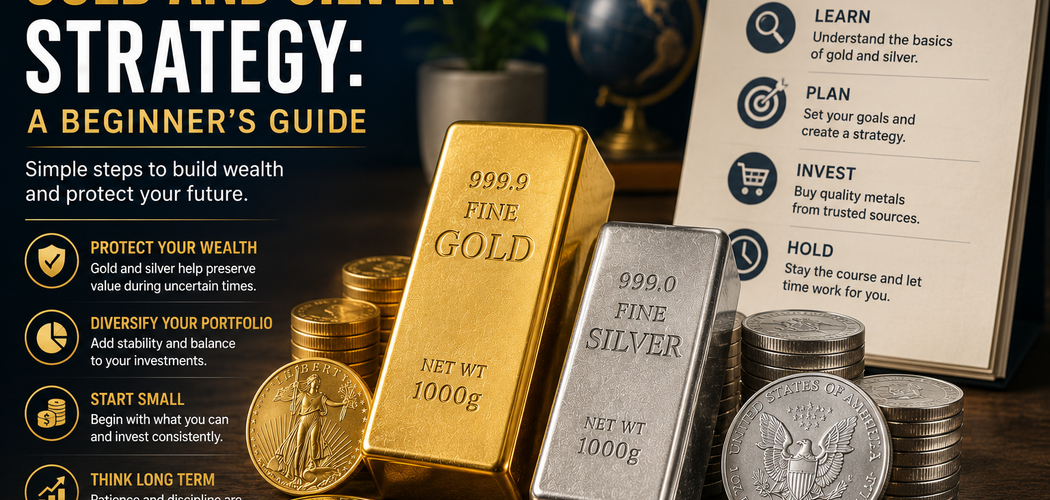
Buying precious metals can seem simple. You choose gold or silver, make a purchase, and wait. However, successful investing requires more planning. A beginner needs a clear gold and silver strategy that explains why the metals belong in the portfolio, how much to invest, and when to review the position.
Gold and silver share several qualities, but they are not identical investments. Gold has a strong monetary role and is held by central banks worldwide. Silver also attracts investors, yet industrial demand has a much greater influence on its market.
As a result, each metal can respond differently to inflation, interest rates, economic growth, and market uncertainty.
Beginners do not need to predict every price move. Instead, they can focus on diversification, reasonable position sizes, costs, and long-term discipline. These fundamentals provide a stronger starting point than trying to identify the perfect time to buy.
Start by Understanding Why You Want Precious Metals
Before buying anything, define the purpose of the investment.
Some investors purchase precious metals because they want additional portfolio diversification. Others worry about inflation, currency weakness, financial instability, or geopolitical uncertainty.
Another investor may simply want exposure to commodities.
These objectives are different. Therefore, they can lead to different investment decisions.
Someone focused on long-term diversification may maintain a relatively stable allocation. Meanwhile, an investor making a short-term prediction about metal prices may trade more frequently.
Beginners should generally avoid building a gold and silver strategy around fear or dramatic economic predictions.
Instead, write down the purpose of the investment.
Ask what gold and silver are expected to contribute to the portfolio. Then consider whether other assets already provide similar benefits.
This simple process can prevent impulsive purchases when precious metal prices suddenly make headlines.
Learn the Difference Between Gold and Silver
Gold and silver often move in the same general direction, but important differences separate their markets.
Gold has a large investment market. Jewelry demand also matters, while central banks hold significant quantities as official reserves.
Consequently, monetary conditions can strongly influence gold.
Interest rates, real yields, currency movements, inflation expectations, and investor confidence all deserve attention.
Silver has many of the same influences. However, manufacturers consume large quantities of silver.
Its electrical conductivity makes it useful in electronics, solar equipment, automobiles, electrical systems, and other technologies.
Therefore, silver can benefit from industrial expansion. It can also face pressure during economic slowdowns.
Beginners developing a gold and silver strategy should recognize this difference instead of treating silver as simply cheaper gold.
Silver Can Be More Volatile
Silver generally experiences larger percentage price movements than gold.
Its smaller market contributes to that volatility. Additionally, investment demand and industrial expectations can change at the same time.
This creates greater upside potential during strong rallies but also increases downside risk.
Beginners should consider whether they can tolerate those swings before establishing a large silver position.
Decide How Precious Metals Fit Your Portfolio
Precious metals should be considered alongside the rest of an investment portfolio.
Stocks can provide long-term growth through corporate earnings. Bonds may generate income. Cash provides liquidity and stability for short-term needs.
Gold and silver offer different characteristics.
Because their prices respond to different forces, precious metals may improve diversification. However, diversification does not guarantee profits or prevent losses.
The appropriate allocation varies by investor.
Age, income, financial obligations, investment horizon, existing assets, and risk tolerance all matter.
Therefore, there is no universal percentage that every beginner should follow.
A sensible gold and silver strategy starts with an amount that will not threaten the broader financial plan if metal prices decline.
Investors should consider how they would react to a significant correction. If normal volatility would cause panic, the position may be too large.
Build Emergency Savings Before Investing
Financial stability should come before precious metal investing.
An emergency fund helps cover unexpected expenses, income disruptions, repairs, or other short-term needs.
Gold and silver should not normally replace that cash reserve.
Although precious metals can be sold, their prices fluctuate. Physical bullion also involves dealer spreads, which means the amount received when selling may differ from the quoted market price.
If an emergency forces someone to sell during a decline, a long-term investment can become a short-term loss.
Therefore, beginners should separate emergency savings from investment capital.
Expensive debt also deserves attention. Paying high interest on debt while investing heavily in metals can create an unfavorable financial trade-off.
A strong foundation makes it easier to maintain a long-term investment plan during volatile markets.
Choose Between Physical Metals and Financial Products
Investors can gain precious metal exposure in several ways.
Physical bullion provides direct ownership. Common options include bars and coins made from gold or silver.
Some investors prefer tangible ownership because they directly control the asset.
However, physical metals create additional responsibilities.
Buyers need secure storage. Insurance may be necessary. Dealer premiums can increase acquisition costs, while selling spreads can reduce proceeds.
Financial products offer another approach.
Gold and silver exchange-traded products can provide market exposure through brokerage accounts. They may be easier to buy, sell, and rebalance.
However, investors should examine fees, product structures, custody arrangements, and objectives.
A beginner’s gold and silver strategy should clearly distinguish between owning bullion and owning a financial product linked to metal prices.
Neither approach is automatically superior.
Understand Spot Prices and Dealer Premiums
New investors often assume that the market price shown online is exactly what they will pay for physical bullion.
Usually, it is not.
The spot price represents a benchmark for the underlying metal. Physical products generally sell above spot because dealers and manufacturers have costs.
This difference is called a premium.
Premiums can vary based on product size, availability, market conditions, and dealer policies.
Smaller products may carry higher percentage premiums because manufacturing and distribution costs are spread across less metal.
Selling prices also matter.
A dealer may purchase bullion below the current retail selling price. Therefore, an investor needs the metal price to rise enough to overcome the spread before generating a profit.
Understanding these costs can prevent beginners from misjudging their returns.
Consider Dollar-Cost Averaging
Choosing the perfect time to buy gold or silver is difficult.
Prices can respond quickly to inflation reports, interest-rate expectations, currencies, geopolitical events, and investment flows.
Dollar-cost averaging offers a simpler approach.
An investor commits a predetermined amount at regular intervals instead of investing everything at once.
For example, someone planning to invest $2,400 might purchase $200 of precious metal exposure each month for one year.
When prices decline, the same contribution buys more exposure. When prices increase, it buys less.
Adding this method to a gold and silver strategy can reduce dependence on one entry price.
However, dollar-cost averaging does not guarantee better returns. If prices consistently rise, investing earlier could produce stronger results.
Transaction costs should also be considered, especially with frequent physical bullion purchases.
Avoid Trying to Predict Every Market Move
Precious metal markets attract bold forecasts.
Analysts may predict enormous rallies, financial crises, currency collapses, or dramatic corrections.
Some forecasts will eventually appear correct. Many others will not.
Beginners should be especially cautious about making investment decisions based on extreme predictions.
Gold and silver prices depend on many variables. Interest rates, inflation, currencies, industrial demand, central bank activity, mining supply, and investor sentiment can interact unpredictably.
Markets also respond to expectations.
By the time an economic trend becomes obvious, prices may already reflect much of that information.
Therefore, a disciplined gold and silver strategy should not require perfect forecasts.
Focus instead on allocation, diversification, costs, and investment horizon.
These factors are easier for an investor to control.
Watch Interest Rates and Real Yields
Interest rates are important because physical gold and silver do not generate income.
When bond yields rise, investors can earn more from interest-bearing assets. This may reduce the relative appeal of precious metals.
Real yields deserve particular attention.
A real yield broadly represents an interest rate after accounting for inflation.
When real yields decline, the opportunity cost of holding gold can decrease. Conversely, rising real yields may make bonds more competitive.
However, these relationships are not perfect.
Gold can rise even when interest rates increase if other forces are stronger. Central bank buying, geopolitical uncertainty, inflation concerns, or currency weakness may offset rate pressure.
Silver adds industrial demand to the equation.
Therefore, beginners should use rates as one indicator rather than a standalone trading signal.
Monitor the U.S. Dollar
Gold and silver are commonly priced internationally in U.S. dollars.
Consequently, currency movements can affect global demand.
A stronger dollar can make precious metals more expensive for buyers using other currencies. A weaker dollar can improve affordability.
However, the relationship can change.
During periods of severe uncertainty, investors may seek both gold and the U.S. dollar. Therefore, both assets can sometimes strengthen together.
For investors outside the United States, local currency movements also matter.
Gold might remain unchanged in dollar terms while becoming more expensive in another currency.
A complete gold and silver strategy should therefore consider purchasing power in the investor’s home currency, not only international spot prices.
Use the Gold-to-Silver Ratio Carefully
The gold-to-silver ratio compares the price of one ounce of gold with silver.
Suppose gold costs $4,000 per ounce while silver costs $50. The ratio would be 80.
Some investors use this measure to compare relative valuations.
A high ratio indicates that gold is expensive relative to silver compared with a lower ratio. Meanwhile, a declining ratio means silver is outperforming gold.
However, beginners should not treat any specific ratio as a guaranteed buy or sell signal.
The relationship changes because gold and silver have different sources of demand.
Industrial growth, central bank purchases, mining conditions, investor sentiment, and monetary policy can all influence the ratio.
It can provide useful context, but it should remain only one part of the analysis.
Diversify Between Gold and Silver
Some investors prefer owning only gold. Others concentrate on silver.
A third approach combines both.
Gold can provide stronger exposure to monetary conditions and defensive investment demand. Silver adds industrial exposure and potentially greater price movements.
Combining the metals can therefore provide diversification within a precious metal allocation.
However, a 50-50 allocation is not automatically balanced.
Because silver can be more volatile, equal dollar positions may contribute different levels of risk.
A beginner building a gold and silver strategy should consider volatility rather than dividing money equally without a reason.
Someone seeking a more defensive position might favor gold. An investor willing to accept greater fluctuations may choose more silver.
The allocation should reflect individual objectives.
Set Rules for Rebalancing
Investment allocations change when prices move.
Suppose precious metals initially represent a modest portion of a portfolio. Gold and silver then experience a major rally.
Without adjustment, metals could become a much larger part of the portfolio.
That increases concentration risk.
Rebalancing can restore the intended allocation.
An investor may sell part of an overweight position and direct the proceeds toward other assets. Alternatively, new contributions can be directed toward underweight investments.
The opposite applies after precious metals decline.
Predetermined rebalancing rules can reduce emotional decisions.
Beginners might review their allocations once or twice per year rather than reacting to daily market movements.
The important point is maintaining the level of risk originally intended.
Know the Risks of Physical Storage
Physical ownership requires a storage plan.
Keeping bullion at home provides direct access but introduces theft and security risks. A suitable safe and insurance may be necessary.
Third-party vaults can provide professional security. However, they charge fees and require investors to trust the storage provider.
Bank storage may be another option in some locations, although access and insurance arrangements vary.
Silver creates an additional practical issue because it requires much more storage space than gold for the same monetary value.
Therefore, investors should estimate future storage needs before making large purchases.
Storage is part of the investment cost, not an afterthought.
Be Careful With Leverage
Leverage allows investors to control a larger position using a smaller amount of capital.
It can increase potential gains, but it also magnifies losses.
Futures, margin accounts, leveraged products, and certain derivatives can expose investors to risks that differ significantly from simply owning bullion.
Beginners may underestimate how quickly leveraged positions can move against them.
A modest decline in the underlying metal can create a much larger percentage loss on leveraged capital.
Therefore, a beginner-focused gold and silver strategy generally benefits from simplicity.
Investors should fully understand any financial product before purchasing it. If the mechanics, costs, or potential losses are unclear, additional research is necessary.
Keep Records of Every Purchase
Recordkeeping may seem unimportant when making the first purchase, but it becomes valuable over time.
Investors should track purchase dates, quantities, prices, premiums, fees, and storage expenses.
These records help calculate the actual cost basis.
They also make it easier to evaluate performance.
Without accurate records, an investor may compare today’s spot price with an incomplete memory of what they originally paid.
Tax requirements can also depend on jurisdiction and investment structure.
Keeping organized documentation from the beginning is much easier than reconstructing years of transactions later.
Review the Strategy Periodically
A good investment plan should evolve as circumstances change.
Income may increase or decrease. Family responsibilities can change. Retirement may become closer, while financial goals shift.
The portfolio itself can also change significantly.
Therefore, investors should periodically review whether precious metals still serve their original purpose.
This does not mean changing the strategy every time gold or silver moves.
Instead, review the underlying goals.
Does the allocation remain appropriate? Have storage costs increased? Has risk tolerance changed? Does the portfolio now have excessive exposure to one asset?
Regular reviews keep a gold and silver strategy aligned with real financial needs.
Common Beginner Mistakes to Avoid
One common mistake is investing too much too quickly.
A new investor may become excited after a strong precious metal rally and commit a large percentage of savings.
Another mistake is ignoring premiums and transaction costs.
Beginners may also buy collectible or complicated products without understanding how their pricing differs from ordinary bullion.
Following dramatic online predictions creates another risk.
Fear-based marketing can encourage investors to believe that one asset is the only protection against economic disaster.
Finally, some beginners forget diversification.
Gold and silver can be useful investments, but neither needs to become the entire portfolio.
Avoiding these mistakes can be just as important as selecting the right metal.
A Simple Beginner Framework
Beginners can make precious metal investing easier by following a straightforward process.
First, establish emergency savings and manage expensive debt.
Next, define why precious metals belong in the portfolio. Choose an allocation based on financial goals and risk tolerance.
Then decide whether physical bullion, financial products, or a combination makes the most sense.
Compare total costs before purchasing.
After that, determine whether to invest gradually or immediately. If using regular purchases, establish a schedule that is affordable and sustainable.
Finally, review the portfolio periodically and rebalance when necessary.
This framework does not require predicting future gold or silver prices.
Instead, it focuses on decisions investors can actually control.
Conclusion
Gold and silver can provide diversification and exposure to economic forces that differ from traditional stocks and bonds. However, beginners should approach them with a clear plan.
A successful gold and silver strategy begins by defining the purpose of the investment. Investors should understand how gold differs from silver, establish reasonable position sizes, and choose suitable ownership methods.
Costs matter too.
Physical bullion can involve premiums, storage, insurance, and selling spreads. Financial products may offer greater convenience but can include ongoing fees and structural considerations.
Beginners should also avoid chasing rallies or depending on dramatic market forecasts. Dollar-cost averaging can provide a disciplined alternative for investors who prefer gradual purchases.
Most importantly, precious metals should fit within a broader financial plan.
Emergency savings, diversified investments, manageable debt, and adequate liquidity remain essential.
A disciplined gold and silver strategy does not need perfect predictions. It needs clear goals, sensible risk management, controlled costs, and regular reviews.
By focusing on those fundamentals, beginners can approach precious metals with greater confidence while avoiding many of the mistakes that come from emotional or speculative investing.
FAQ
1. Should Beginners Buy Gold or Silver First?
There is no universal answer. Gold may appeal to investors seeking lower relative volatility and stronger monetary characteristics. Silver can offer greater industrial exposure but typically experiences larger price swings.
2. How Much Should a Beginner Invest in Precious Metals?
The appropriate amount depends on income, savings, risk tolerance, existing investments, and financial goals. Beginners should avoid investing money needed for emergencies or near-term expenses.
3. Is Physical Bullion Better Than an ETF?
Physical bullion provides direct ownership but requires storage and can involve significant transaction costs. Exchange-traded products offer convenience and liquidity but have fees and structural considerations.
4. Should Beginners Buy Precious Metals Every Month?
Monthly investing can reduce timing pressure and fit naturally with regular income. However, transaction costs and physical bullion premiums should be considered before choosing a purchase frequency.
5. What Is the Biggest Mistake New Precious Metal Investors Make?
Common mistakes include investing too much, chasing price rallies, ignoring costs, and relying on extreme forecasts. A disciplined gold and silver strategy should focus on diversification, manageable exposure, and long-term financial goals.

