

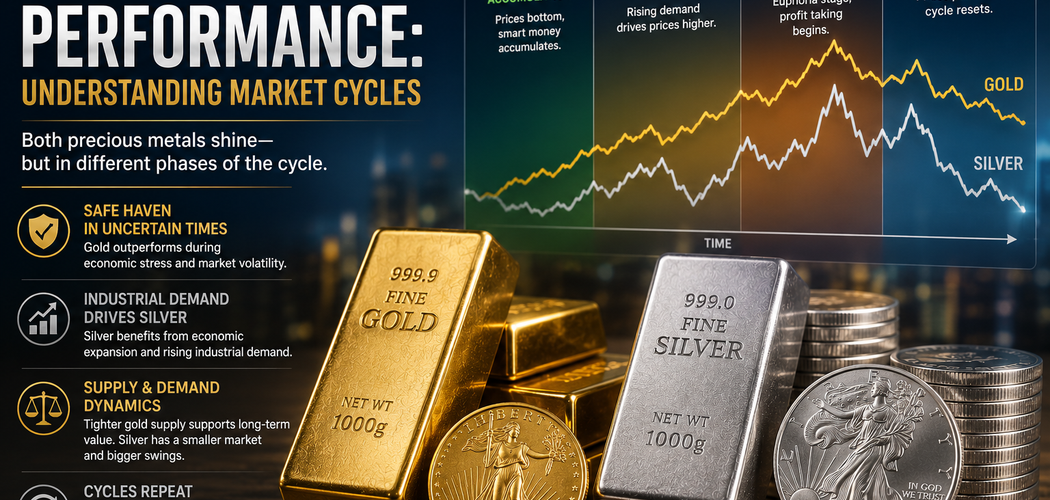
Gold and silver often appear side by side in precious metal portfolios. However, they do not behave in exactly the same way. Understanding gold vs silver performance requires looking beyond daily price movements and examining how each metal responds to economic growth, inflation, interest rates, industrial demand, and market uncertainty.
Gold generally has a more defensive market profile. Investment demand, central bank purchases, jewelry, and monetary conditions influence its price. Silver shares several of these drivers, but industrial use accounts for a much larger part of its demand.
That distinction can create very different market cycles. Silver may outperform dramatically during strong precious metal rallies, yet it can also experience deeper corrections. World Gold Council research published in 2026 describes silver as a higher-volatility, more cyclical metal, while gold has historically provided more consistent diversification during periods of market stress.
For investors, understanding these differences is essential before deciding whether one or both metals belong in a portfolio.
Why Gold and Silver Often Move Together
Gold and silver share several important characteristics.
Both are scarce precious metals. Investors can purchase physical bullion, exchange-traded products, futures, and other forms of exposure. Additionally, both can attract investment when people become concerned about inflation, currencies, or financial instability.
Interest rates also influence both markets.
Physical gold and silver do not generate interest. Therefore, rising real yields can make income-producing assets more competitive. Falling real yields can reduce that opportunity cost.
The U.S. dollar provides another shared influence because both metals are commonly priced internationally in dollars.
These common factors help explain why gold vs silver performance often follows the same broad direction.
Historical data also shows a strong relationship. CME Group research found that gold and silver price changes have generally maintained a strong positive correlation, while silver typically experiences larger movements.
However, correlation does not mean identical returns.
The size and timing of each metal’s movements can differ considerably.
Silver Usually Has Greater Volatility
One of the clearest differences between gold and silver is volatility.
Silver generally experiences larger percentage price movements. During strong rallies, that can produce substantial gains. During corrections, however, losses can also accelerate quickly.
Market size is one reason.
Gold trades in a deeper and more liquid global market. Silver’s smaller market means changes in investment flows can have a larger proportional impact.
Recent World Gold Council analysis found that silver’s volatility has been roughly twice that of gold. It also found that silver’s long-term beta to gold has clustered around 1.3, meaning silver has historically tended to amplify gold’s directional movements.
This volatility is critical when evaluating gold vs silver performance.
A metal that rises faster during favorable conditions may also require a larger tolerance for losses.
Higher Potential Comes With Higher Risk
Suppose gold rises because falling interest rates increase precious metal demand.
Silver may participate in the same rally. However, strong investment flows into the smaller silver market can potentially produce a larger percentage move.
The process can reverse when sentiment changes.
If investors rapidly reduce precious metal exposure, silver may decline more sharply.
Therefore, investors should not compare returns without also comparing risk.
Gold Has a More Defensive Market Structure
Gold’s sources of demand are relatively diverse.
Investors purchase it as a financial asset. Consumers buy jewelry. Technology companies use smaller amounts for specialized applications. Most importantly, central banks hold gold as an official reserve asset.
This creates a market that is less dependent on industrial economic activity.
During periods of financial stress, investment demand can increase even if economic growth weakens.
World Gold Council research indicates that gold’s diversified demand structure helps reduce its sensitivity to the global business cycle. It has also historically shown stronger defensive characteristics than other commodities during risk-off periods.
This characteristic can influence gold vs silver performance during recessions and financial crises.
Gold may attract investors seeking stability. Meanwhile, silver can face competing pressures from safe-haven buying and weaker industrial demand.
That does not mean gold always rises during crises. Liquidity needs, higher yields, or a stronger dollar can still produce declines.
Nevertheless, its underlying demand structure is different.
Silver Is More Sensitive to Economic Growth
Silver has substantial industrial demand.
Manufacturers use it in electronics, electrical systems, automobiles, solar technologies, medical equipment, and many specialized applications.
Therefore, economic expansion can create additional support.
When manufacturing grows, companies may require more silver-containing components. Expanding renewable energy infrastructure and electrification can also contribute to consumption.
However, the relationship creates cyclical risk.
During an economic slowdown, industrial demand expectations can weaken. Manufacturers may reduce production, while consumers postpone purchases of products that contain silver.
This explains why gold vs silver performance can diverge during economic contractions.
Gold may receive defensive investment demand while silver faces concerns about industrial consumption.
The World Gold Council describes silver as a hybrid between a precious metal and an industrial metal, making it more sensitive to cyclical conditions.
What Happens During Precious Metal Bull Markets?
Bull markets can produce interesting differences between gold and silver.
Gold may begin rising first as investors respond to falling real yields, currency concerns, geopolitical uncertainty, or stronger central bank demand.
Silver may initially lag.
However, as confidence in the precious metal rally increases, investors may begin looking for additional exposure. Silver’s smaller market can then magnify incoming investment flows.
This can result in periods when silver significantly outperforms gold.
CME research describes silver as a high-beta version of gold. Historically, silver has often produced larger upward moves when both metals are rallying.
Therefore, gold vs silver performance can change during different stages of the same precious metal cycle.
Early stages may favor gold’s defensive qualities. Later speculative phases can sometimes produce stronger silver performance.
However, investors should never assume this sequence will occur in every cycle.
What Happens During Bear Markets?
The same characteristics that can help silver during rallies can hurt it during downturns.
When precious metal sentiment deteriorates, investment demand may decline.
Higher real interest rates can make bonds more attractive. A stronger dollar may pressure international demand. Meanwhile, improving economic confidence can reduce interest in defensive assets.
Gold can decline under these conditions.
Silver may face the same monetary pressures plus changing industrial expectations.
As a result, its corrections can become more severe.
Historical analysis from CME shows that the gold-to-silver ratio has often risen during precious metal bear markets because silver weakened more sharply relative to gold.
This pattern illustrates why gold vs silver performance should be evaluated across complete market cycles rather than only during strong rallies.
An asset’s upside potential means little if an investor cannot tolerate its downside volatility.
Interest Rates Can Shift Both Markets
Interest rates play an important role in precious metal cycles.
Because physical metals do not generate income, rising yields can increase the opportunity cost of owning them.
Real interest rates are particularly important.
If nominal rates rise while inflation falls, real yields may increase significantly. Investors can then receive more attractive inflation-adjusted returns from bonds.
Gold may face pressure.
Silver can experience similar investment pressure. However, if higher rates accompany strong economic growth, industrial demand may partially offset that effect.
Conversely, aggressive rate increases that damage economic activity can create a more difficult environment for silver.
Gold could eventually benefit if investors expect slower growth and future monetary easing.
These competing forces help explain changes in gold vs silver performance throughout monetary policy cycles.
Investors should therefore consider why rates are changing, not simply whether they are moving higher or lower.
Inflation Can Produce Different Results
Inflation is often associated with precious metal investing.
When consumer prices rise, investors may become concerned about declining purchasing power. Gold and silver can attract demand under those conditions.
However, inflation can influence each metal differently.
Gold’s monetary characteristics may become more attractive when investors question the long-term purchasing power of currencies.
Silver can receive similar investment demand. At the same time, inflation may increase manufacturing expenses and affect industrial consumption.
Central bank responses also matter.
If policymakers aggressively raise rates to control inflation, higher real yields can pressure both metals.
Therefore, inflation alone cannot predict gold vs silver performance.
Investors need to examine monetary policy, economic growth, currency trends, and market expectations together.
The Gold-to-Silver Ratio Offers Useful Context
The gold-to-silver ratio compares the price of gold with the price of silver.
For example, if gold costs $4,000 per ounce and silver costs $50, the ratio equals 80. In other words, one ounce of gold has the same market value as 80 ounces of silver.
Investors often use this ratio to evaluate relative performance.
A rising ratio generally means gold is outperforming silver. A falling ratio usually indicates silver is outperforming gold.
Historically, the ratio has sometimes fallen during strong precious metal rallies as silver accelerates. It has often risen during periods when silver experiences greater weakness.
However, there is no permanent “correct” ratio.
Industrial demand, investment behavior, mine supply, technology, monetary conditions, and market structure all change.
Therefore, the ratio works best as a comparison tool rather than a guaranteed trading signal.
Supply Dynamics Differ Between the Metals
Supply also contributes to different market cycles.
Gold production comes primarily from dedicated gold mines, although some is produced alongside other metals. Recycling provides another important source.
Silver has a different supply structure.
A significant amount of silver is produced as a by-product of mining metals such as copper, lead, zinc, and gold.
Therefore, a higher silver price does not necessarily produce an immediate increase in silver mining.
A mining company focused on copper may base production decisions primarily on copper economics even if its operations also produce silver.
This can limit how quickly silver supply responds to changing prices.
Gold supply also responds slowly because developing new mines requires years of exploration, permitting, financing, and construction.
These differences add another layer to gold vs silver performance during periods of rapidly changing demand.
Market Stress Can Separate Gold and Silver
Financial stress is one environment where the differences between the metals become particularly important.
Gold has historically shown stronger diversification characteristics when stock markets experience severe declines.
Silver does not consistently provide the same protection.
Its industrial exposure can cause it to behave more like a cyclical commodity when investors become concerned about economic growth.
World Gold Council research using historical weekly returns found that gold has demonstrated stronger negative correlation to equities during severe stock market declines, while silver’s industrial characteristics can limit its defensive role.
This distinction is important for investors comparing gold vs silver performance from a portfolio perspective.
Someone seeking crisis diversification may value gold differently from an investor seeking greater upside exposure during a commodity rally.
Economic Recoveries May Favor Silver
The relationship can shift when an economy begins recovering.
Manufacturing activity may improve. Consumer confidence can strengthen, while businesses increase investment.
These conditions can increase demand for industrial commodities.
Silver may benefit because industrial consumption combines with renewed investor confidence.
Gold can still perform during economic expansions. Jewelry and consumer demand may strengthen, while monetary conditions can remain supportive.
However, investors may become less interested in defensive assets when recession risks decline.
As a result, silver can sometimes offer stronger cyclical exposure during recovery phases.
Again, this is not guaranteed.
Interest rates, inflation, currency movements, and supply conditions can change the outcome.
Market cycles rarely follow a perfect textbook sequence.
2026 Shows Why Volatility Matters
Recent price behavior provides a useful example of the difference between these metals.
In 2026, both gold and silver experienced substantial price swings. Yet silver’s movements were significantly larger.
World Gold Council research published in March highlighted silver’s higher volatility and tendency to amplify precious metal market movements.
More recently, an August 2026 bond-market selloff pushed both metals lower as Treasury yields increased. Silver experienced a larger percentage decline during that session, illustrating its higher sensitivity to shifts in market conditions.
Gold itself has also experienced unusually high volatility during 2026. World Gold Council analysis found that gold volatility moved into historically elevated territory earlier in the year before beginning to normalize.
Therefore, investors should remember that “lower volatility” is relative. Gold can still experience substantial swings.
Which Metal Performs Better Long Term?
There is no permanent winner.
The answer depends on the starting price, ending price, time period, and economic environment.
Gold may outperform during periods dominated by financial uncertainty, central bank demand, or defensive investment flows.
Silver may outperform when precious metal investment demand combines with strong industrial growth.
Its greater volatility can amplify favorable trends.
However, comparing returns without considering risk can create a misleading picture.
A metal that generates a larger return while experiencing dramatically larger drawdowns may not suit every investor.
Research from the World Gold Council found that gold historically produced better risk-adjusted portfolio outcomes than equivalent silver allocations in its 20-year hypothetical analysis through 2025.
That does not mean silver lacks value. Instead, it suggests the two metals may serve different portfolio purposes.
Can Investors Hold Both Gold and Silver?
Investors do not necessarily need to choose one metal.
Gold and silver can complement each other because their market characteristics differ.
Gold may form the more defensive portion of a precious metal allocation. Silver can provide greater exposure to industrial growth and potentially stronger price movements.
However, equal allocations may not create equal risk.
Because silver is considerably more volatile, a smaller silver position can sometimes contribute substantial portfolio risk.
Therefore, position sizing matters.
Investors should consider their financial goals, investment horizon, existing assets, and tolerance for volatility.
A conservative investor may prefer greater gold exposure. Someone comfortable with larger fluctuations may consider more silver.
Neither approach guarantees better returns.
How to Compare Gold and Silver Market Cycles
Investors can monitor several indicators when comparing the metals.
First, watch real interest rates and the U.S. dollar. Both can influence precious metal investment demand.
Next, examine global economic growth.
Strong manufacturing conditions may provide additional support for silver, while economic stress can increase gold’s defensive appeal.
Industrial demand deserves particular attention for silver. Electronics, automobiles, renewable energy, and electrical infrastructure can influence consumption.
Central bank purchases are more important for gold because official institutions hold it as a reserve asset.
Investors can also follow the gold-to-silver ratio.
Finally, monitor volatility.
A strong return means something different when it comes with substantially greater price fluctuations.
Using these indicators together creates a stronger framework for analyzing gold vs silver performance.
Avoid Assuming Past Cycles Will Repeat Exactly
Historical market cycles provide useful information, but they are not predictions.
Technology changes silver demand. Central bank policies evolve. Mining supply changes, while financial markets introduce new investment products.
Geopolitical conditions also vary significantly from one cycle to another.
Therefore, investors should use historical patterns as context rather than fixed rules.
For example, silver may have outperformed during a previous precious metal rally. That does not guarantee it will lead the next one.
Likewise, gold’s defensive history cannot guarantee gains during every recession or market crash.
Successful analysis requires adapting to current conditions.
The goal is not to find a pattern that always works. Instead, investors can understand why the metals behaved differently and determine whether those conditions exist today.
Conclusion
Gold and silver belong to the same precious metal family, but their market cycles can be remarkably different.
Gold has a deeper, more liquid market and a more diversified demand structure. Central banks, investors, jewelry consumers, and other buyers contribute to demand. These characteristics can help gold behave more defensively during periods of financial stress.
Silver combines precious metal investment demand with substantial industrial consumption. This gives it greater sensitivity to manufacturing, economic growth, technology, and commodity cycles.
As a result, gold vs silver performance can vary significantly.
Silver may produce stronger percentage gains during powerful precious metal rallies. However, its higher volatility can also produce deeper corrections. Gold may move more steadily and has historically provided stronger defensive diversification during severe market stress.
Neither metal is automatically better.
Investors should consider what role they want precious metals to play. Someone prioritizing stability may prefer gold’s characteristics, while an investor seeking greater cyclical exposure may accept silver’s additional volatility.
Ultimately, understanding gold vs silver performance means looking beyond which metal recently gained the most. Interest rates, industrial demand, currencies, economic growth, market sentiment, supply, and risk tolerance all matter.
Studying complete market cycles provides a much stronger foundation than chasing whichever precious metal happens to be leading today.
FAQ
1. Why Does Silver Usually Move More Than Gold?
Silver has a smaller and less liquid market, while industrial demand creates additional cyclical exposure. Therefore, investment flows and changing economic expectations can produce larger percentage price movements.
2. Which Metal Usually Performs Better During a Recession?
Gold has historically displayed stronger defensive characteristics during severe market stress. Silver may also attract precious metal demand, but weaker industrial expectations can create additional pressure.
3. What Does the Gold-to-Silver Ratio Tell Investors?
The ratio shows how many ounces of silver equal the price of one ounce of gold. A rising ratio indicates relative gold strength, while a falling ratio generally signals stronger silver performance.
4. Can Silver Outperform Gold During a Bull Market?
Yes. Silver’s higher volatility can amplify precious metal rallies, particularly when investment demand and industrial expectations strengthen together. However, the same characteristic can increase losses during corrections.
5. Should Long-Term Investors Own Gold, Silver, or Both?
The answer depends on portfolio goals and risk tolerance. Gold may provide more defensive exposure, while silver offers greater industrial sensitivity and volatility. Comparing gold vs silver performance across full market cycles can help investors understand the different roles each metal may play.

