

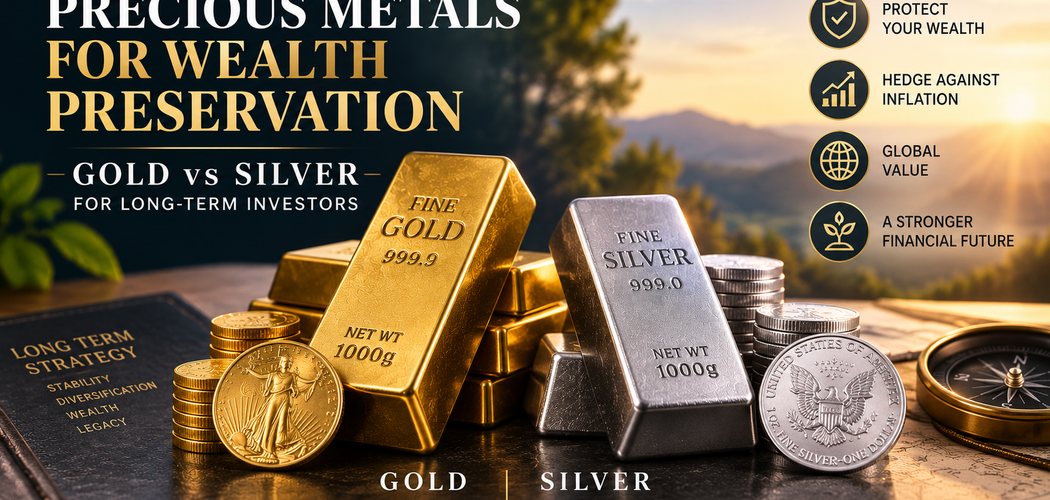
Precious Metals Wealth Preservation: Gold vs Silver
Long-term investors often look beyond short-term returns when building financial security. They may also consider purchasing power, diversification, liquidity, and protection against unexpected economic conditions. For some investors, precious metals wealth preservation provides another tool for addressing these goals.
Gold and silver are the two precious metals most commonly associated with storing value. Both have histories as money, investment assets, and physical stores of wealth. However, they do not behave identically.
Gold has a stronger monetary and reserve role. Central banks hold significant quantities, while investors often seek gold during periods of financial uncertainty. Silver also attracts investors, but industrial demand plays a much larger role in its market.
Therefore, choosing between them requires more than comparing current prices. Long-term investors should understand their different sources of demand, volatility, storage requirements, costs, and potential portfolio roles.
Neither metal guarantees wealth preservation. Still, each can provide useful diversification when used as part of a broader financial plan.
Why Investors Use Precious Metals to Preserve Wealth
Wealth preservation focuses on maintaining financial resources and purchasing power over long periods.
That objective differs from simply maximizing returns.
A growth investor may concentrate on businesses capable of increasing profits. In contrast, someone focused on preservation may prioritize diversification and reducing exposure to severe financial disruptions.
Gold and silver can contribute because they are physical assets with limited natural supplies. Central banks cannot create additional gold or silver through monetary policy.
However, scarcity alone does not guarantee rising prices.
Demand changes constantly, while mining and recycling provide new market supply. Interest rates, currencies, inflation, economic growth, and investor sentiment can also affect prices.
Therefore, precious metals wealth preservation should not rely on the idea that metals only increase in value.
Instead, their potential benefit comes partly from behaving differently from traditional assets under certain economic conditions.
A diversified portfolio can use those differences to reduce dependence on one financial outcome.
Gold’s Role as a Monetary Asset
Gold has an unusually strong connection to the global monetary system.
Although modern currencies are no longer generally backed by gold, central banks continue to hold the metal as part of their reserves. Investors also buy bars, coins, and gold-backed financial products.
Gold’s reserve role distinguishes it from silver.
During periods of uncertainty, investors may seek gold because it does not represent a corporate liability. Physical bullion does not depend on a company generating profits or a borrower making payments.
Gold can also attract demand when investors become concerned about inflation, currencies, government debt, banking stability, or geopolitical events.
These characteristics make gold an important candidate for precious metals wealth preservation.
However, investors should understand its limitations.
Gold produces no interest or dividends. Furthermore, its price can experience long periods of weakness. An investor who buys after a major rally may need substantial time before seeing positive returns.
Gold May Offer Lower Volatility Than Silver
Gold can experience significant price swings, but silver has historically shown greater volatility.
One reason is market size. The silver market is smaller, so changes in investment flows can produce larger percentage movements.
Gold’s substantial reserve and investment demand can sometimes make it the more defensive precious metal.
However, lower relative volatility does not mean low risk.
Gold prices still respond to changing monetary conditions, currencies, real yields, and investor sentiment. Therefore, investors should choose position sizes carefully.
Silver Combines Monetary and Industrial Demand
Silver shares some of gold’s history as money and a store of value. However, modern silver demand has a major industrial component.
Manufacturers use the metal in electronics, electrical systems, automobiles, solar technologies, and other specialized applications.
Silver’s conductivity makes it especially useful where efficient electrical performance matters.
Consequently, silver can benefit when industrial activity and technological investment expand.
This creates potential advantages for long-term investors. Growing electrification, renewable energy, advanced electronics, and digital infrastructure could support consumption.
Yet industrial exposure also creates additional risk.
A global economic slowdown can reduce manufacturing activity. That may weaken industrial silver demand even while investors seek precious metals.
As a result, precious metals wealth preservation strategies should not treat silver as simply a lower-priced version of gold.
The two metals have different economic sensitivities.
Gold vs Silver During Economic Uncertainty
Economic uncertainty is one reason investors consider precious metals.
During financial stress, investors may become less willing to hold risky assets. Gold can sometimes attract additional demand because of its reputation as a defensive asset.
Silver may also benefit from precious metal buying.
However, recession concerns can simultaneously weaken expectations for industrial consumption. This competing pressure can cause silver to behave differently.
For example, severe economic weakness could support gold through defensive investment demand while putting pressure on silver’s industrial outlook.
Additionally, investors sometimes sell both metals during liquidity crises.
When markets experience sudden losses, investors may sell liquid assets to raise cash. Therefore, gold and silver can temporarily decline even when the economic environment appears favorable for safe-haven assets.
Long-term investors should recognize this possibility.
Wealth preservation does not mean eliminating volatility. Instead, it involves constructing a portfolio capable of surviving different market conditions.
How Inflation Affects Gold and Silver
Inflation reduces the purchasing power of money.
For example, if prices rise faster than savings, the same amount of cash purchases fewer goods and services over time.
This is one reason tangible assets can attract attention during inflationary periods.
Gold has a long-standing reputation as an inflation hedge. Silver may also benefit when investors seek physical assets.
However, the relationship is not automatic.
When inflation rises, central banks may respond with higher interest rates. Higher yields can make bonds and savings products more attractive relative to non-yielding metals.
Therefore, precious metals wealth preservation should consider real interest rates as well as inflation.
Real yields broadly measure investment returns after accounting for inflation.
When real yields are low or negative, holding non-yielding metals may carry a smaller opportunity cost. Conversely, high real yields can create stronger competition for gold and silver.
Currency Risk and Purchasing Power
Gold and silver trade globally and are commonly quoted in U.S. dollars.
Currency movements can therefore influence local returns.
Suppose the dollar price of gold remains unchanged while an investor’s domestic currency weakens substantially against the dollar. The local currency value of gold may rise.
The opposite can also occur.
For investors outside the United States, currency exposure can become an important part of precious metal performance.
This does not mean metals provide guaranteed protection against currency depreciation. Exchange rates and metal prices can move independently.
Still, internationally traded physical assets may provide another form of diversification when investors are concerned about long-term currency purchasing power.
This feature can strengthen the case for precious metals wealth preservation within a diversified strategy.
However, investors should evaluate returns in the currency they actually use for expenses and financial goals.
Comparing the Volatility of Gold and Silver
Volatility measures how significantly an asset’s price changes.
Silver can experience dramatic rallies and corrections. Its smaller market and combination of industrial and investment demand contribute to these movements.
Gold can also be volatile, but it may behave more defensively during certain periods.
This distinction matters for long-term investors.
Someone primarily concerned with preserving capital may be uncomfortable with large silver price swings. Meanwhile, an investor willing to accept more volatility may appreciate silver’s potential for stronger percentage movements during favorable conditions.
Neither approach is automatically correct.
Risk tolerance should determine how much exposure an investor accepts.
A precious metals wealth preservation plan should therefore consider not only expected returns but also the investor’s ability to remain committed during market declines.
An allocation that causes panic during normal volatility is unlikely to work effectively over the long term.
Physical Gold vs Physical Silver
Investors seeking direct ownership can purchase physical bars or coins.
Physical gold has a major practical advantage: value density.
A relatively small amount of gold can represent significant monetary value. Therefore, storing a substantial gold position may require less physical space than storing the equivalent value in silver.
Silver is considerably less valuable per ounce. A large investment can therefore become heavy and bulky.
Storage requirements may matter for investors planning to hold metals for decades.
Dealer premiums are another consideration.
Physical products generally cost more than the underlying spot value because manufacturing, distribution, and dealer expenses are included.
Premiums can vary by metal, product, size, and market conditions.
Investors should also consider insurance and secure storage.
Therefore, direct ownership provides independence and tangible possession, but it introduces costs that do not appear on a basic price chart.
Financial Products Can Improve Liquidity
Physical ownership is not the only option.
Exchange-traded products can provide exposure to gold or silver through brokerage accounts. These investments can generally be bought and sold more easily than physical bullion.
That liquidity can simplify portfolio rebalancing.
However, financial products involve different risks and expenses.
Investors should examine management fees, custody arrangements, tracking methods, and product structures before investing.
Mining stocks provide another type of exposure, but they should not be confused with bullion.
A mining company faces labor expenses, energy costs, debt, geological challenges, political risks, and management decisions. Its shares can therefore perform differently from the metal it produces.
For long-term precious metals wealth preservation, investors should choose an ownership structure that matches their priorities.
Direct ownership, liquidity, convenience, costs, and counterparty considerations all matter.
Should Long-Term Investors Own Both Metals?
Investors do not necessarily need to choose between gold and silver.
Holding both can provide exposure to their different characteristics.
Gold may serve as the more defensive component because of its monetary role and central bank demand. Silver can add exposure to industrial growth and potentially stronger price movements.
However, owning both does not mean allocating equally.
A conservative investor might place more emphasis on gold while maintaining a smaller silver allocation. Someone comfortable with greater volatility may choose a larger silver position.
The appropriate balance depends on the rest of the portfolio.
For example, an investor already heavily exposed to cyclical industries may prefer gold’s monetary characteristics. Another investor may specifically want greater exposure to electrification and industrial trends.
The key is understanding why each metal is included.
Diversification Beyond Precious Metals Still Matters
Gold and silver should not become substitutes for an entire investment portfolio.
Stocks can provide ownership in productive businesses. Bonds can generate income. Cash offers immediate liquidity. Real estate and other assets may provide additional diversification.
Each category has different strengths and weaknesses.
Concentrating most wealth in precious metals creates its own risks. Gold and silver do not generate cash flow simply from ownership, and both can experience extended periods of weak performance.
Therefore, precious metals wealth preservation is generally more effective when metals complement other assets.
Diversification should occur across multiple economic drivers.
An investor should also maintain adequate emergency savings before committing substantial capital to long-term assets.
This can reduce the risk of needing to sell metals during an unfavorable market.
Using Dollar-Cost Averaging for Long-Term Holdings
Timing precious metal markets can be difficult.
Gold and silver respond to economic data, monetary policy, currencies, investor sentiment, and geopolitical events. Consequently, short-term movements are hard to predict consistently.
Dollar-cost averaging offers one possible approach.
Instead of investing the entire planned amount at once, an investor purchases smaller amounts at predetermined intervals.
This spreads entry prices across different market conditions.
Regular investing does not guarantee better returns. If prices rise consistently, immediate investment could perform better.
However, gradual purchasing can reduce the emotional pressure associated with choosing one entry point.
For investors building a precious metals wealth preservation position from regular income, this approach may provide structure and discipline.
Transaction costs and physical bullion premiums should still be considered.
Rebalancing Helps Maintain the Intended Risk
Market movements change portfolio allocations.
Suppose an investor initially assigns a modest portion of the portfolio to precious metals. Gold and silver then experience a major rally.
Without adjustment, metals may eventually represent a much larger percentage of total wealth.
That can increase risk beyond the original plan.
Rebalancing restores the intended allocation.
Investors can sell part of an overweight asset and redirect funds toward underweight areas. Conversely, declining metal prices may create an opportunity to restore a target allocation.
Rebalancing encourages discipline.
Rather than buying only after rallies and selling only after declines, investors follow predetermined portfolio rules.
The appropriate review frequency depends on individual circumstances. Some investors review annually, while others rebalance when allocations move beyond established ranges.
Consider Liquidity Before Investing
Wealth preservation also requires access to money when needed.
Physical gold and silver can generally be sold, but the process may take more effort than withdrawing cash from a bank account.
Dealers also use spreads between buying and selling prices.
Therefore, precious metals should not normally replace emergency savings.
An investor who needs money unexpectedly could be forced to sell during a temporary price decline.
Maintaining separate liquid reserves can prevent that situation.
Time horizon matters too.
Money needed for tuition, housing, medical expenses, or other near-term obligations may require more stable and accessible assets.
Long-term precious metal holdings should generally use capital that investors can leave invested through market cycles.
Avoid Common Wealth-Preservation Mistakes
One common mistake is assuming gold cannot lose value.
It can.
Another is believing silver must eventually reach a particular price because it is scarce. Market prices depend on both supply and demand, which continually change.
Investors may also buy after dramatic rallies because they fear missing further gains.
Emotional buying can result in excessive exposure at unfavorable prices.
Ignoring costs is another problem.
Storage, insurance, dealer premiums, spreads, fund fees, and taxes can affect long-term returns.
Finally, some investors concentrate too much wealth in metals because they expect a specific economic crisis.
A durable precious metals wealth preservation strategy should remain useful even when the investor’s economic forecast proves wrong.
Diversification and reasonable position sizing provide greater flexibility.
Think About Decades Instead of Daily Prices
Wealth preservation is a long-term objective.
Daily gold and silver movements can attract attention, but they may have little relevance to an investor with a 20-year horizon.
Instead, long-term investors can focus on broader conditions.
They can monitor inflation, real interest rates, currencies, central bank policies, industrial demand, mining supply, and portfolio allocations.
Personal circumstances matter just as much.
Income, retirement plans, family responsibilities, debt, and liquidity needs change over time. Therefore, investment strategies should evolve too.
Periodic reviews can ensure that precious metal exposure still serves its intended purpose.
The goal is not to predict tomorrow’s price.
Instead, investors can build a portfolio capable of adapting to multiple economic environments.
Conclusion
Gold and silver can both contribute to long-term wealth preservation, but they serve different roles.
Gold has a stronger monetary profile. Central banks hold it as a reserve asset, and investors often seek it during periods of economic or financial uncertainty.
Silver combines precious metal characteristics with substantial industrial demand. That connection can provide exposure to technological growth and electrification, but it can also create greater economic sensitivity.
For many investors, the decision does not need to be gold versus silver. A carefully selected combination can provide exposure to both sets of characteristics.
However, precious metals wealth preservation should remain part of a broader strategy.
Stocks, bonds, cash, real estate, and other assets can provide growth, income, and liquidity that physical metals cannot.
Investors should also consider storage, transaction costs, volatility, and their investment horizon before buying.
Ultimately, the better metal depends on the purpose of the investment. Gold may appeal more to investors prioritizing defensive characteristics, while silver may suit those comfortable with greater volatility and industrial exposure.
A disciplined precious metals wealth preservation strategy focuses on diversification, appropriate position sizing, reasonable costs, and long-term financial goals rather than short-term price predictions.
FAQ
1. Is Gold or Silver Better for Preserving Wealth?
Gold may appeal more to investors seeking defensive and monetary characteristics. Silver offers similar precious metal exposure but has greater industrial demand and often higher volatility. The better choice depends on individual goals.
2. Why Is Silver More Volatile Than Gold?
Silver has a smaller market and greater exposure to industrial demand. Changes in manufacturing expectations and investment flows can therefore create larger percentage price movements.
3. Should Long-Term Investors Own Both Gold and Silver?
Some investors hold both because the metals have different demand drivers. Gold can provide greater monetary exposure, while silver adds industrial sensitivity. However, the appropriate allocation depends on the broader portfolio.
4. Can Precious Metals Protect Against Inflation?
They may help during some inflationary periods, but protection is not guaranteed. Real interest rates, currencies, economic growth, and investor demand can influence performance alongside inflation.
5. How Can Investors Use Metals Without Taking Too Much Risk?
Investors can maintain a reasonable allocation, diversify across other asset classes, keep emergency savings separate, and rebalance periodically. A disciplined precious metals wealth preservation plan should support long-term goals rather than depend on one economic forecast.

