

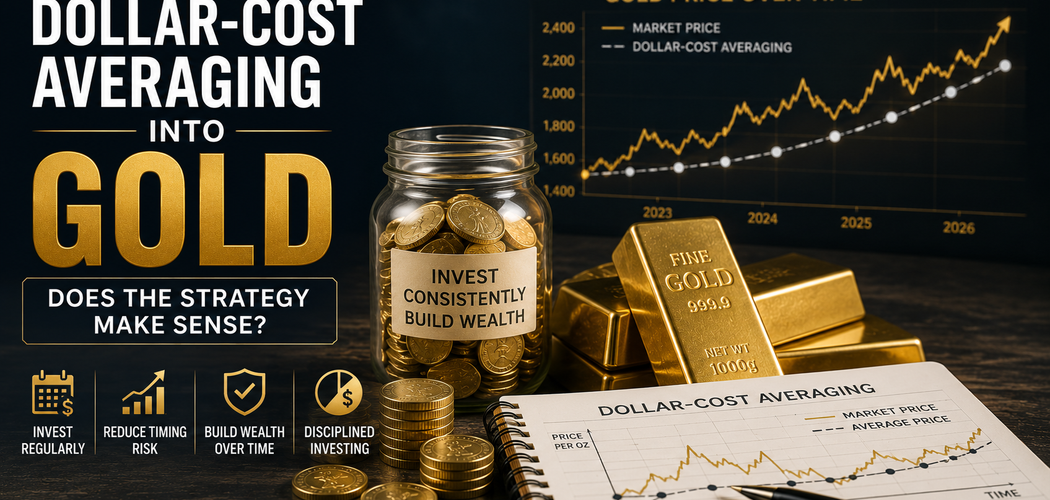
Gold prices can rise or fall quickly, making it difficult to decide when to invest. Dollar cost averaging gold offers a different approach. Instead of trying to identify the perfect entry price, an investor puts a fixed amount into gold at regular intervals, regardless of short-term market movements.
For example, someone with $6,000 available could invest $500 each month for 12 months instead of investing the entire amount immediately. When gold prices are lower, that fixed amount buys more exposure. When prices are higher, it buys less.
This approach does not guarantee better returns. However, it can reduce the emotional pressure associated with market timing. FINRA describes dollar-cost averaging as investing equal portions at regular intervals regardless of market fluctuations. It also notes that the strategy can reduce timing risk, although holding money back can sacrifice potential gains when markets rise.
So, does this approach make sense specifically for gold? The answer depends on an investor’s goals, time horizon, costs, and tolerance for volatility.
How Dollar-Cost Averaging Works
Dollar-cost averaging follows a predetermined schedule rather than short-term market predictions.
An investor first chooses an amount they can invest regularly. They might then purchase gold exposure every week, month, or quarter.
Suppose an investor contributes $200 monthly. If the investment costs $40 per unit, that contribution buys five units. If the price later falls to $25, the same $200 buys eight units.
Conversely, when the price rises, the contribution buys fewer units.
Therefore, dollar cost averaging gold naturally adjusts the amount purchased according to market prices without requiring the investor to predict whether gold is currently cheap or expensive.
The key is consistency.
Investors continue making purchases according to the original schedule unless their financial circumstances or investment goals change.
This structure separates the investment decision from many short-term emotions. Rather than asking whether today’s price is perfect, the investor follows a predetermined plan.
Why Gold Can Be Difficult to Time
Gold responds to many economic forces.
Interest rates, real yields, inflation expectations, currencies, central bank demand, geopolitical uncertainty, and investment flows can all influence prices.
These factors can also move in opposite directions.
For example, geopolitical uncertainty may support demand while rising real interest rates create pressure. A stronger U.S. dollar may weigh on prices while central banks continue buying.
Consequently, even investors who correctly understand the economic environment may struggle to predict short-term price movements.
Market expectations make timing even harder. Prices can move before an economic event occurs because investors have already anticipated it.
FINRA warns that attempts to time markets can lead investors to buy or sell at unfavorable moments, particularly when fear and excitement influence decisions.
Using dollar cost averaging gold removes the requirement to correctly identify every market turning point.
Regular Investing Can Reduce Emotional Decisions
Emotions can influence investment behavior.
When gold rises rapidly, investors may fear missing further gains. They might make unusually large purchases after prices have already increased.
The opposite can happen during a decline.
Falling prices can create fear and encourage investors to delay purchases even when their long-term strategy has not changed.
A predetermined investment schedule can reduce these reactions.
FINRA notes that regular investing can help remove some pressure around deciding when to buy and can reduce the temptation to time the market.
However, discipline remains necessary. Investors need to continue following the plan during both strong and weak markets.
Potential Benefits of Regular Gold Purchases
One benefit of dollar cost averaging gold is simplicity.
Investors do not need to monitor gold prices continuously. Instead, they decide how much to invest and establish a regular schedule.
Another potential benefit is reduced entry-point risk.
Someone investing a large lump sum immediately before a major decline experiences the entire drop. An investor spreading purchases over several months has only part of the planned capital exposed when the decline begins.
Later contributions can then purchase more gold exposure at lower prices.
This does not eliminate losses. If gold continues falling for years, regular buyers can still lose money.
However, the strategy distributes purchases across different market conditions.
It can also create consistency. Investors who receive income monthly may find it easier to allocate a small portion regularly instead of accumulating enough money for a large purchase.
Dollar-Cost Averaging Does Not Guarantee Lower Costs
A common misconception is that regular investing always produces a lower average purchase price.
It does not.
The result depends on how prices move during the investment period.
If gold repeatedly rises, an investor who waits to deploy capital gradually may continue buying at increasingly higher prices. Someone who invested the entire amount earlier would have gained more exposure at the lower initial price.
Therefore, dollar cost averaging gold should primarily be viewed as a method for managing timing risk and investment behavior, not as a guaranteed way to maximize returns.
FINRA specifically identifies this trade-off. Money waiting to be invested often remains in cash or another low-risk asset. If the chosen investment rises during that period, gradually investing can produce lower returns than immediate lump-sum investing.
Investors should understand that risk reduction can come with an opportunity cost.
Dollar-Cost Averaging vs Lump-Sum Investing
The choice between regular purchases and a lump-sum investment depends partly on where the money comes from.
Consider someone who already has $12,000 available for gold.
Investing the full amount immediately provides complete market exposure from day one. If gold rises afterward, the investor benefits from having all the capital invested.
Dollar-cost averaging would keep part of the money outside gold while purchases occur gradually.
However, if gold falls sharply shortly after the first purchase, gradual investing can reduce the initial impact.
Now consider someone who does not have a large amount available. Instead, they can invest $200 from each monthly paycheck.
In that situation, regular investing is not necessarily delaying available capital. The investor simply invests money as it becomes available.
That distinction is important when evaluating dollar cost averaging gold.
The strategy can serve different purposes depending on whether someone already has the capital or is building a position from future income.
Gold’s Portfolio Role Matters
Before deciding how to buy gold, investors should determine why they want it.
Gold can provide diversification because its market drivers differ from those affecting traditional financial assets. The World Gold Council’s 2026 research describes gold as a liquid strategic asset with historically low correlation to many other assets and notes its potential diversification benefits within portfolios.
However, diversification does not mean gold always rises when stocks fall.
Correlations change over time. Gold can also experience substantial corrections.
Therefore, investors should first establish what role gold will play.
Someone seeking a long-term strategic allocation may find regular purchases easier to maintain. Another investor making a tactical trade based on a specific economic forecast may prefer a different approach.
The purchase schedule should follow the investment objective rather than determine it.
How Much Should You Invest Regularly?
There is no universal amount that everyone should invest in gold.
The appropriate contribution depends on income, savings, debt, existing investments, financial goals, and risk tolerance.
Investors should also consider their total gold allocation.
For example, someone who already has substantial precious metal exposure may not need to continue adding at the same rate.
Meanwhile, a new investor building a modest strategic position may prefer smaller regular purchases.
The World Gold Council’s 2026 analysis found that adding gold improved risk-adjusted outcomes and reduced drawdowns in several hypothetical portfolio allocations, but those findings are historical and hypothetical rather than a universal allocation rule.
Therefore, dollar cost averaging gold should fit within a diversified portfolio rather than becoming an unlimited accumulation strategy.
Investors should periodically review whether their allocation remains appropriate.
Physical Gold Changes the Calculation
Dollar-cost averaging can work differently when purchasing physical bullion.
Physical gold often trades at a premium above the spot market price. Dealers need to cover manufacturing, distribution, storage, and business costs.
Small bars and coins may have higher percentage premiums than larger products.
Suppose an investor purchases a very small gold product every week. Repeated premiums and transaction costs could make the strategy less efficient than saving money and purchasing a larger amount less frequently.
Shipping can add another expense.
Secure storage and insurance may also create costs.
Therefore, investors applying dollar cost averaging gold to physical bullion should calculate the total acquisition cost rather than looking only at the quoted gold price.
Monthly or quarterly purchases may sometimes be more practical than very frequent transactions.
The ideal schedule depends on dealer premiums, product size, storage arrangements, and available capital.
Gold ETFs Can Make Regular Investing Easier
Exchange-traded gold products provide another way to gain exposure.
These products can usually be purchased through brokerage accounts. Some brokers also allow fractional investing or automated recurring purchases, depending on the platform and product.
This convenience can make small regular investments easier than repeatedly purchasing physical bullion.
However, investors still need to examine costs.
Gold ETFs and similar products can charge annual expenses. Bid-ask spreads may also affect transaction prices.
Moreover, owning shares in a financial product is different from personally possessing physical bullion.
Investors should understand what the product holds, how it tracks gold, what fees apply, and how shares can be bought or sold.
For dollar cost averaging gold, convenience matters, but the investment structure matters too.
Watch Transaction Costs
Frequent investing can create additional costs.
If a brokerage charges a transaction fee, making 12 purchases per year could cost more than making one purchase.
Likewise, physical gold purchases may involve repeated dealer premiums, shipping charges, or payment fees.
FINRA specifically warns that more frequent transactions can result in additional brokerage fees, which may reduce returns.
Modern commission-free brokerage accounts may reduce this concern for some financial products. However, “commission-free” does not necessarily mean completely cost-free.
Bid-ask spreads and fund expenses can still apply.
Investors should therefore calculate the expected annual cost before choosing a purchase frequency.
A strategy that improves discipline but creates excessive fees may need adjustment.
Consider Keeping Emergency Savings Separate
Regular gold investing should not come at the expense of basic financial security.
An emergency fund serves a different purpose from an investment portfolio.
Cash reserves can cover unexpected expenses without requiring an investor to sell assets during an unfavorable market.
Gold is liquid in many forms, but its price fluctuates. Physical bullion may also involve dealer spreads when selling.
Therefore, investors should generally avoid committing money they may need soon.
A dollar cost averaging gold plan works more effectively when contributions come from money intended for long-term investing.
If financial circumstances change, investors can reassess the schedule rather than continuing purchases that create cash-flow problems.
Rebalancing Can Work With Dollar-Cost Averaging
Regular contributions can also support portfolio rebalancing.
Suppose an investor wants gold to represent a particular portion of a diversified portfolio.
If gold falls while stocks rise, the gold allocation may drop below its target. Future contributions could then be directed toward gold until the desired balance returns.
Conversely, if gold rises substantially, the investor may temporarily direct new contributions toward other assets.
This approach can reduce the need to sell investments solely to rebalance.
FINRA notes that rebalancing can help keep investments aligned with financial goals and time horizons as market movements change portfolio weights.
However, investors should establish clear rules.
Constantly changing contributions based on short-term predictions can turn a disciplined plan into market timing.
When Dollar-Cost Averaging May Make Sense
Regular gold purchases may appeal to several types of investors.
First, beginners may prefer smaller purchases while learning how precious metal markets work.
Second, investors contributing from each paycheck may find regular purchases convenient.
Third, people concerned about buying immediately before a major correction may value spreading their entry points over time.
Finally, long-term investors who want to build a strategic gold allocation gradually may prefer an automated approach.
For these investors, dollar cost averaging gold can provide structure and reduce the importance of short-term market forecasts.
The approach may be especially useful for people who know that fear or excitement affects their investing decisions.
Still, the strategy needs an endpoint or allocation target. Regular buying should not continue indefinitely without considering how large the position has become.
When It May Not Be the Best Strategy
Dollar-cost averaging is not automatically superior.
An investor who already has substantial cash available and expects to hold gold for decades may prefer immediate exposure.
If gold rises consistently during the averaging period, gradual purchases can produce lower returns.
Transaction costs may also make frequent purchases unattractive.
Physical bullion buyers can face another challenge because small transactions may carry relatively high premiums.
Furthermore, investors with excessive gold exposure should not continue purchasing simply because they established an automatic schedule.
Personal financial circumstances matter too.
Someone carrying expensive debt or lacking emergency savings may have higher priorities than accumulating precious metals.
Therefore, dollar cost averaging gold should be evaluated within the investor’s entire financial situation.
Create a Clear Plan Before Starting
A structured plan can make regular investing more effective.
Start by determining the purpose of the gold allocation. Is the goal diversification, long-term wealth preservation, or exposure to a specific economic theme?
Next, choose a target allocation that fits the broader portfolio.
Then decide how much can be invested without interfering with emergency savings or essential expenses.
Investors should also select an appropriate investment vehicle. Physical bullion, ETFs, and other products have different costs and ownership characteristics.
Finally, establish a review schedule.
A quarterly or annual review can help determine whether the strategy remains aligned with financial goals.
Investors should avoid changing the plan after every price movement. The purpose of regular investing is partly to reduce dependence on short-term predictions.
Conclusion
Gold can be difficult to time because its price responds to interest rates, currencies, inflation, geopolitical risks, central bank demand, and investor sentiment.
Regular investing offers one way to manage that uncertainty.
With dollar cost averaging gold, investors commit a fixed amount according to a predetermined schedule. Lower prices result in more exposure being purchased, while higher prices result in less.
The strategy can reduce timing pressure and discourage emotional decisions. However, it cannot guarantee profits or a lower average purchase price.
There are also trade-offs.
If gold rises while capital remains uninvested, gradual investing can underperform a lump-sum purchase. Frequent transactions may also increase costs, particularly when buying physical bullion.
Therefore, investors should focus on the purpose of the strategy.
For someone building a long-term gold allocation from regular income, dollar-cost averaging may offer a practical and disciplined approach. For someone with capital already available, the decision requires weighing immediate market exposure against short-term timing risk.
Ultimately, successful dollar cost averaging gold depends less on predicting prices and more on consistency, reasonable costs, diversification, and alignment with long-term financial goals.
FAQ
1. How Often Should You Buy Gold When Dollar-Cost Averaging?
There is no required frequency. Monthly purchases may be convenient for investors who receive regular income, while quarterly purchases could reduce transaction costs. The schedule should fit the investor’s budget and chosen gold product.
2. Is It Better to Buy Gold Monthly or All at Once?
Neither approach is always better. Lump-sum investing provides immediate exposure and can perform better when prices rise. Regular investing spreads entry points and may reduce the impact of buying immediately before a decline.
3. Can You Use This Strategy With Physical Gold?
Yes. However, physical bullion can involve dealer premiums, shipping, storage, and selling spreads. Investors should make sure frequent small purchases do not create excessive costs.
4. Does Dollar-Cost Averaging Guarantee a Profit?
No. Regular investing cannot prevent losses if gold declines over time. Its main advantage is reducing reliance on one entry price and encouraging disciplined investing rather than guaranteeing returns.
5. Is Regular Gold Investing Good for Beginners?
It can be useful for beginners who want to build exposure gradually and avoid trying to predict short-term market movements. However, dollar cost averaging gold should still fit a diversified portfolio, reasonable budget, and long-term financial plan.

