

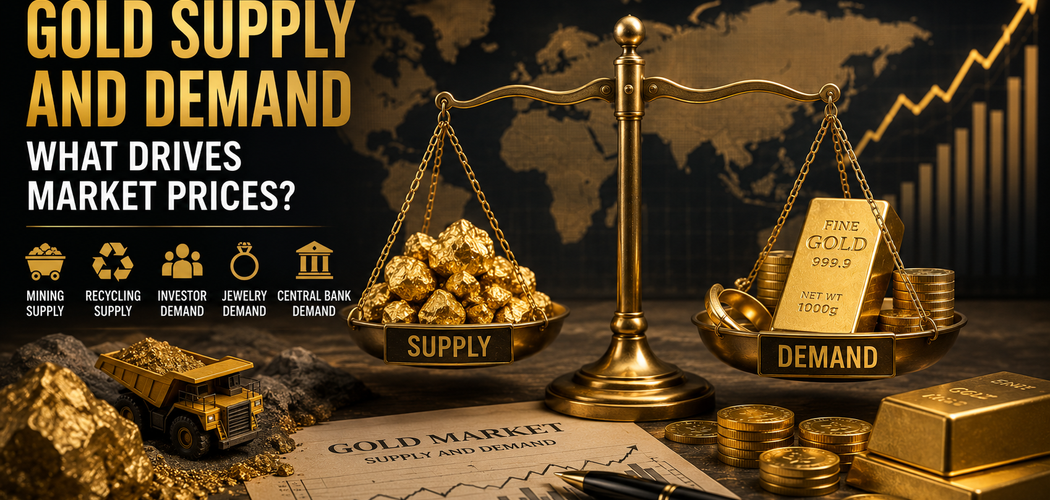
Gold Supply and Demand: What Drives Market Prices?
Gold prices can move dramatically, but those movements are not random. At the foundation of the market sits gold supply and demand, the balance between how much metal becomes available and how much buyers want to acquire. However, unlike many everyday commodities, gold has characteristics that make this relationship unusually complex.
New supply comes primarily from mining and recycling. Meanwhile, demand comes from investors, jewelry consumers, central banks, technology companies, and other buyers. Each group responds to different economic conditions.
Furthermore, most gold ever mined has not disappeared. Large quantities remain in jewelry, bars, coins, reserves, and other forms. Some of this existing metal can return to the market when owners decide to sell.
Therefore, investors need to examine much more than annual mine production. Understanding how these different forces interact can provide a clearer picture of what may support or pressure gold prices.
How the Gold Market Works
Gold trades in a global marketplace. Buyers and sellers operate across countries, currencies, financial exchanges, bullion markets, and retail networks.
The spot price represents the current market price for gold available for relatively immediate settlement. Futures markets, meanwhile, allow participants to trade contracts based on future delivery dates.
Physical gold markets operate alongside these financial markets. Consumers purchase jewelry, while investors buy bars and coins. Central banks also hold substantial reserves.
Consequently, gold supply and demand reflects activity across many interconnected markets rather than one simple exchange.
Prices help balance those markets.
When buyers become more aggressive than sellers, prices can rise. Higher prices may encourage additional recycling or persuade some existing owners to sell. At the same time, expensive gold may discourage price-sensitive buyers.
When demand weakens, prices may decline until new buyers become interested.
This adjustment process happens continuously as investors and consumers respond to changing economic conditions.
Gold Mining Creates New Supply
Mining provides the primary source of newly produced gold.
However, gold mining is a difficult and expensive process. Companies first need to identify promising deposits. They then conduct exploration and feasibility studies before deciding whether a project is economically viable.
Even a promising discovery does not become a mine immediately.
Companies may need government approvals, environmental reviews, financing, infrastructure, equipment, and skilled workers. Developing a large mine can therefore take many years.
This slow development process makes gold supply and demand different from markets where producers can quickly increase output.
A sudden rise in gold prices does not immediately create a surge in production. Existing mines may increase output where possible, but geological and operational limitations remain.
Mining companies must also consider whether higher prices will last long enough to justify expensive expansion projects.
Ore Grades Can Affect Production
Not every gold deposit contains the same concentration of metal.
Ore grade describes how much gold exists within a given quantity of rock. Higher-grade deposits can generally provide more gold from less material.
When grades decline, miners may need to process more rock to produce the same amount of gold. That can increase energy, labor, equipment, and processing costs.
As a result, geological conditions can limit how easily miners increase production.
Mining Costs Matter, But They Do Not Set Prices
Gold mining requires significant resources.
Labor, fuel, electricity, machinery, chemicals, maintenance, financing, and environmental management can all contribute to production costs.
When these expenses rise, lower-margin mines may become less profitable. Companies could postpone expansion or reconsider projects that no longer provide attractive returns.
However, production costs do not create an absolute floor beneath gold prices.
A mining company may continue operating during a period of weak prices for several reasons. Closing and reopening a mine can be expensive. Producers may also have different cost structures, debt obligations, hedging arrangements, and long-term expectations.
Therefore, costs influence future gold supply and demand, but they do not guarantee that market prices will remain above a particular level.
Over longer periods, consistently weak profitability can reduce investment in new production. That may eventually restrict supply growth.
Recycling Provides a Flexible Source of Gold
Mining is not the only source of available metal.
Gold can be recycled repeatedly without losing its fundamental properties. Old jewelry, investment products, electronics, and other items can therefore return to the market.
Recycling tends to respond more quickly to price changes than mining.
When gold prices rise sharply, owners may become more willing to sell jewelry or unused items. Dealers and refiners can then process that material and return the gold to the market.
Economic hardship can also encourage selling. Households may liquidate gold holdings when they need cash, even if market prices are not at record levels.
Conversely, owners may hold onto their metal if they expect prices to rise further.
Recycling therefore acts as a flexible component of gold supply and demand. It can help increase available supply when prices create strong incentives to sell.
However, recycling levels also depend on consumer behavior, economic conditions, and access to gold-buying markets.
Jewelry Is a Major Source of Demand
Jewelry represents an important use of gold around the world.
Demand can be particularly significant in countries where gold jewelry has cultural, financial, or ceremonial importance. Weddings, festivals, gifts, and family savings can all influence purchases.
However, jewelry demand is sensitive to price.
When gold becomes substantially more expensive, consumers may purchase lighter pieces, reduce the amount they buy, or delay purchases. Manufacturers can also adjust designs to use less metal.
Lower prices may produce the opposite response by making gold more affordable.
Income growth matters as well. Rising household wealth can increase jewelry consumption in important markets.
Therefore, investors analyzing gold supply and demand should consider both the gold price and the financial health of major consumer markets.
Currency movements add another layer. Even if the international dollar price remains stable, a weaker local currency can make jewelry significantly more expensive within a particular country.
Investment Demand Can Move Quickly
Investment demand can change much faster than mine production or jewelry consumption.
Investors purchase gold for many reasons. Some seek diversification, while others worry about inflation, currencies, financial instability, or geopolitical risk.
Physical bars and coins provide direct exposure. Meanwhile, exchange-traded products allow investors to gain exposure through financial markets.
Large investment flows can have a meaningful effect on prices.
For example, increasing uncertainty may encourage investors to add gold exposure quickly. Strong demand can then contribute to higher prices.
Conversely, improving economic confidence or attractive bond yields may reduce investor interest.
This makes investment activity one of the most dynamic parts of gold supply and demand.
Investor expectations are especially important because financial markets are forward-looking. Traders may respond to expected changes in interest rates or inflation before those changes actually occur.
Central Banks Can Create Significant Demand
Central banks hold gold as part of their international reserves.
Their motivations can differ from those of ordinary investors. Reserve managers may value gold for diversification, liquidity, long-term stability, or reduced dependence on individual currencies.
When central banks collectively purchase large amounts of gold, they can become an important source of demand.
Their behavior may also influence market sentiment. Investors sometimes interpret sustained official buying as evidence of continued institutional confidence in gold.
However, central banks can sell as well as buy.
Changes in reserve policy, liquidity needs, or economic conditions can affect their decisions. Therefore, official-sector activity should be monitored over longer periods.
Central banks also influence gold supply and demand indirectly through monetary policy.
Interest-rate decisions can affect bond yields, inflation expectations, currencies, and investor behavior. As a result, central banks influence the gold market through both reserve management and economic policy.
Interest Rates Can Change Investment Demand
Physical gold does not generate interest.
Therefore, changes in interest rates can influence whether investors prefer gold or income-producing assets.
When bond yields rise, investors may receive more income from holding government debt or other fixed-income investments. This can increase the opportunity cost of owning gold.
However, real interest rates are often more important than nominal rates.
Real yields broadly account for inflation. If inflation rises faster than interest rates, the purchasing-power return from some fixed-income investments may weaken.
Gold may then become relatively more attractive.
These relationships do not work perfectly every day. Still, they can significantly influence investment demand over time.
Therefore, anyone studying the gold market should examine monetary conditions alongside physical buying and selling.
The U.S. Dollar Influences Global Demand
Gold is commonly quoted internationally in U.S. dollars.
As a result, currency movements can change the cost of gold for buyers outside the United States.
A stronger dollar can make gold more expensive in other currencies. Consequently, some international buyers may reduce purchases.
A weaker dollar can have the opposite effect.
However, the relationship is not automatic. During periods of severe uncertainty, investors may seek both gold and the U.S. dollar.
Local currencies also matter.
For example, gold could remain stable in dollar terms while becoming significantly more expensive in a country whose currency is weakening.
Currency movements therefore influence gold supply and demand by changing affordability and investor incentives across different regions.
Technology Creates Another Source of Gold Demand
Gold is not used only for jewelry and investment.
Its physical properties make it valuable in several technological applications. Gold conducts electricity effectively and resists corrosion, making it useful in certain electronic components.
Computers, communication equipment, medical devices, aerospace systems, and specialized technologies may contain small quantities of gold.
Technology demand is smaller than some major gold demand categories. Nevertheless, it contributes to total consumption.
Economic growth can influence this segment. Strong production of electronics and other high-value products may increase demand.
Manufacturers also have incentives to reduce costs. Therefore, they may attempt to use smaller quantities of gold where technology allows.
This combination of innovation and efficiency means technological demand can evolve over time.
Above-Ground Gold Changes the Supply Picture
One unusual characteristic of gold is that much of the metal mined throughout history still exists.
Gold does not easily corrode or disappear. It remains stored in jewelry, bars, coins, central bank reserves, and other products.
This creates a substantial above-ground stock.
However, not all existing gold is available for sale at the current price.
A family may have no intention of selling inherited jewelry. Central banks may plan to hold reserves for decades. Long-term investors may also ignore short-term market movements.
Therefore, the economically relevant supply depends partly on price and willingness to sell.
This characteristic makes gold supply and demand different from commodities that are consumed and disappear after use.
A higher price can effectively unlock additional supply by persuading existing holders to sell.
Why Higher Prices Can Reduce Demand
Rising gold prices often attract investor attention, but they can also weaken certain types of demand.
Jewelry buyers are particularly price-sensitive. When prices rise faster than household incomes, consumers may reduce purchases.
Retail investors can also become cautious after a sharp rally.
At the same time, higher prices may encourage recycling. Existing owners have a greater financial incentive to sell old jewelry, bars, or coins.
Therefore, rising prices can affect both sides of the market.
They may reduce some demand while increasing available supply.
However, investment momentum can sometimes overwhelm these balancing forces. If investors strongly expect further gains, buying can continue despite high prices.
This is why price alone cannot explain the market. Investors need to understand who is buying, who is selling, and why.
Economic Uncertainty Can Shift the Balance
Economic uncertainty can quickly change investor behavior.
Recession fears, banking stress, geopolitical conflicts, debt concerns, or currency instability may increase interest in gold.
Investors can move capital into gold much faster than mining companies can increase production.
Consequently, a sudden demand increase can create significant price movements.
However, uncertainty does not guarantee higher prices.
During severe financial stress, investors may sell gold to raise cash or meet obligations elsewhere. Therefore, short-term price reactions can appear inconsistent with the broader economic environment.
Longer-term trends often depend on how uncertainty affects interest rates, currencies, inflation expectations, and investor confidence.
These connections demonstrate why gold supply and demand must be evaluated within the wider financial system.
Why Gold Supply Responds Slowly to High Prices
A sustained increase in gold prices can encourage mining companies to explore new deposits and develop additional projects.
Yet the response takes time.
Exploration does not guarantee discovery. Even after companies find economically promising deposits, they need studies, permits, financing, infrastructure, and construction.
Local community concerns and environmental requirements can also influence development timelines.
Moreover, companies may hesitate to approve expensive projects if they believe high gold prices could be temporary.
As a result, mine production can remain relatively stable even during a strong bull market.
This slow response can support prices when demand increases rapidly.
However, years of high prices may eventually encourage enough investment to expand production.
How Investors Can Monitor the Market
Investors do not need to track every ounce of gold entering or leaving the market.
Instead, they can follow several broad indicators.
Mine production can reveal whether new supply is expanding. Recycling data can show whether higher prices are encouraging existing holders to sell.
Jewelry consumption provides insight into physical consumer demand. Meanwhile, bar and coin purchases can reveal retail investment trends.
Exchange-traded product flows can help investors understand changes in financial demand.
Central bank purchases deserve attention because official-sector buying can represent a significant source of demand.
Investors should also watch interest rates, real yields, inflation, and currencies because these variables can change investment behavior.
Looking at these indicators together creates a more complete view of gold supply and demand than focusing only on daily price charts.
Common Mistakes When Analyzing Gold
One common mistake is assuming that limited mine production automatically means prices must rise.
Existing above-ground stocks and recycling can provide substantial additional supply.
Another mistake is focusing only on physical consumption.
Investment flows can change rapidly and sometimes dominate shorter-term price movements.
Investors may also assume that high demand always produces immediate price increases. However, prices already reflect market expectations. Strong demand may have been anticipated before official data confirms it.
Similarly, falling jewelry consumption does not automatically signal a weak market if investment or central bank demand is rising strongly.
The gold market contains several buyer groups with different motivations.
Understanding those differences is more useful than searching for one indicator that explains every price movement.
Conclusion
Gold prices ultimately reflect the interaction between buyers and sellers, but the forces behind those decisions are diverse.
Mining provides new metal, yet production responds slowly because developing mines takes years. Recycling offers a more flexible source of supply because higher prices can encourage existing holders to sell.
Meanwhile, jewelry consumers, investors, central banks, and technology companies create different forms of demand.
Interest rates, inflation, currencies, economic growth, and geopolitical events can change their behavior.
This complexity explains why gold supply and demand cannot be understood by looking at mine production alone.
Investors should examine both physical and financial markets. They should also consider how prices themselves influence consumer purchases, recycling, and investment sentiment.
No single data point can reliably predict gold’s next move. However, understanding the balance between new production, existing stocks, recycling, and major demand sources provides a stronger foundation for analyzing the market.
Ultimately, investors who understand gold supply and demand can interpret price movements with greater context instead of reacting only to headlines.
FAQ
1. Where Does Most New Gold Supply Come From?
Newly produced gold primarily comes from mining. Recycling also contributes substantial market supply when jewelry, bullion, electronics, and other gold-containing products return to refiners.
2. Why Can’t Gold Miners Quickly Increase Production?
Developing mines requires exploration, feasibility studies, permits, financing, construction, and infrastructure. The process can take years, which means production often responds slowly to rising prices.
3. What Creates the Most Demand for Gold?
Major sources include jewelry, investment products, central bank reserves, and technology. The importance of each segment can change depending on prices and economic conditions.
4. Do Higher Gold Prices Increase Supply?
Higher prices can encourage recycling and make additional mining projects economically attractive. However, new mine production usually takes much longer to respond than recycled supply.
5. Why Should Investors Follow Supply and Demand Data?
Tracking mining, recycling, jewelry, investment flows, and central bank activity can help investors understand the forces behind price movements. A broader view of gold supply and demand provides more context than relying on price charts alone.

