

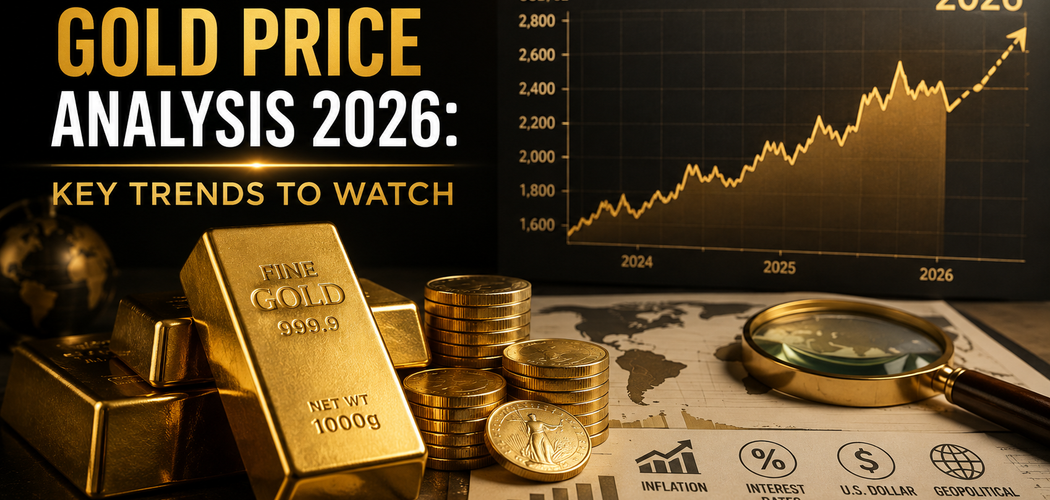
Gold remains one of the world’s most closely watched precious metals. This gold price analysis 2026 examines the forces that could influence its direction, including interest rates, inflation, central bank demand, the U.S. dollar, investment flows, and geopolitical uncertainty. Although gold can respond quickly to headlines, its longer-term movements usually reflect several economic forces working together.
For investors, that makes context essential. A single inflation report or interest rate decision rarely tells the entire story. Instead, investors should consider how monetary policy, economic growth, currencies, and market sentiment interact.
Gold has already experienced substantial volatility during 2026. Therefore, investors should focus less on predicting every short-term move and more on understanding the conditions that could support or pressure the metal during the remainder of the year.
Why Gold Remains Important to Investors
Gold occupies a unique position within global markets. It acts as a commodity, investment asset, store of value, and central bank reserve. Unlike shares of a company, gold does not depend on corporate earnings. Moreover, physical bullion does not require an issuer to meet future payment obligations.
These characteristics can make gold attractive during periods of financial uncertainty. Investors may use it to diversify portfolios, preserve purchasing power, or reduce dependence on traditional financial assets.
However, gold does not generate dividends or interest. Therefore, its attractiveness can change when yields on bonds, savings products, and other investments rise.
This trade-off is central to gold price analysis 2026. Investors need to compare gold with the alternatives available in the broader financial market.
Gold also has several sources of demand. Investors buy physical bars and coins, while others gain exposure through exchange-traded products. Jewelry remains another important market. In addition, central banks hold substantial gold reserves.
Consequently, gold can react differently depending on which group is driving demand at a particular time.
Interest Rates Could Shape Gold’s Direction
Interest rates remain one of the most important factors for gold investors.
Gold itself does not pay interest. Therefore, when interest rates rise, investors may find bonds and other income-producing assets more attractive. This can increase the opportunity cost of holding gold.
However, the relationship is not always simple.
Investors should pay particular attention to real interest rates. Real rates broadly measure interest rates after considering inflation. If nominal rates remain high but inflation also rises, the real return available from some assets may become less attractive.
Conversely, rising real yields can create stronger competition for gold.
This makes monetary policy an essential part of gold price analysis 2026. Investors should monitor not only official rate decisions but also expectations about where rates may go next.
Recent U.S. monetary policy discussions show why this matters. Federal Reserve officials have continued weighing persistent inflation against softer areas of the economy, creating uncertainty around the future path of rates.
Markets Often Move Before Rate Decisions
Financial markets are forward-looking. Therefore, gold can react long before a central bank officially raises or lowers interest rates.
For example, weaker economic data may cause investors to expect easier monetary policy. Bond yields could then decline as those expectations change. Gold may respond even if policymakers have not yet announced a rate adjustment.
The opposite can also happen. Strong inflation or economic growth may increase expectations for tighter monetary policy. As a result, yields may rise and create pressure on precious metals.
Investors should therefore watch expectations as closely as official decisions.
Inflation Remains a Major Market Factor
Gold has long been associated with protection against inflation. When consumer prices rise, money loses purchasing power. Consequently, investors may seek assets that they believe can preserve value over longer periods.
Still, inflation does not automatically cause gold prices to rise.
Central banks may respond to persistent inflation by keeping interest rates elevated or raising them further. That response can strengthen yields and increase competition from interest-bearing investments.
Therefore, a useful gold price analysis 2026 must consider inflation and monetary policy together.
Inflation expectations also deserve attention. Markets often respond to expected economic conditions before official data confirms them.
For instance, investors who expect inflation to accelerate may increase their interest in gold before reported inflation rises significantly. Meanwhile, expectations of falling inflation can reduce some demand for traditional inflation hedges.
The type of inflation also matters. Inflation caused by strong consumer demand may produce different market effects from inflation caused by supply disruptions or geopolitical events.
Investors should therefore avoid assuming that every inflation increase will produce the same gold market response.
Central Bank Buying Provides Structural Demand
Central banks are important participants in the gold market. They hold the metal as part of their reserve portfolios alongside foreign currencies and other financial assets.
Several reasons can encourage official gold purchases. These include diversification, liquidity, risk management, and reducing exposure to individual currencies or financial systems.
Central banks have remained significant gold buyers in recent years. The World Gold Council reported that official-sector demand remained strong in early 2026, while its latest outlook expects central banks to remain significant net buyers through the year.
That makes official-sector activity an important component of gold price analysis 2026.
However, investors should not assume that central banks will purchase the same amount every quarter. Reserve managers make strategic decisions based on their own economic and policy requirements.
Some institutions may buy while others sell. Additionally, purchases can slow when prices rise sharply.
Still, continued demand from reserve managers can provide structural support because central banks often approach gold differently from short-term traders.
The World Gold Council’s 2026 survey also found continued confidence among central banks in gold’s role within long-term reserve management.
The U.S. Dollar Can Influence Gold Prices
Gold is commonly priced internationally in U.S. dollars. Therefore, changes in the dollar can affect the metal’s affordability around the world.
When the dollar strengthens, buyers using other currencies may need more local currency to purchase the same amount of gold. This can reduce demand at the margin.
Meanwhile, a weaker dollar can make gold relatively more affordable outside the United States.
For this reason, currency movements deserve a place in any gold price analysis 2026.
However, investors should avoid treating the relationship as a fixed rule. Gold and the dollar can sometimes rise together.
For example, severe economic or geopolitical uncertainty may encourage investors to seek both dollar assets and gold. Consequently, the normal inverse relationship can temporarily weaken.
Currency trends also depend on interest rates, economic growth, international capital flows, and central bank policies. Investors should therefore examine why the dollar is moving instead of looking only at its direction.
Investment Demand Could Be a Key Driver
Investor behavior can move the gold market quickly. Physical bars and coins represent one form of investment demand, while exchange-traded products provide another way to gain exposure.
When investors become more concerned about economic conditions, demand can increase. Conversely, improving risk appetite may encourage investors to shift toward stocks or other growth assets.
Exchange-traded fund flows can offer useful clues about institutional and retail sentiment. Strong inflows may signal growing demand for exposure, while sustained outflows can suggest declining interest.
The World Gold Council expects investment to remain an important source of gold demand during the remainder of 2026, with Asian investment and over-the-counter activity playing meaningful roles.
Therefore, gold price analysis 2026 should include investor flows alongside traditional economic indicators.
Physical Demand Still Matters
Financial products receive significant attention, but physical gold remains important.
Consumers purchase bars and coins for investment and savings. Jewelry buyers also account for a major part of global demand.
However, high prices can discourage jewelry purchases because consumers receive less gold for the same amount of money. Buyers may choose lighter products or postpone purchases.
Indeed, the World Gold Council expects elevated prices to continue weighing on jewelry volumes during 2026.
Physical demand can also vary significantly between countries. Therefore, investors should avoid evaluating the gold market solely through U.S. financial indicators.
Geopolitical Risk Can Increase Gold Demand
Gold has a reputation as a defensive asset during periods of uncertainty.
Wars, trade disputes, political instability, sanctions, and financial crises can increase investor concern. In response, some investors may reduce exposure to riskier assets and seek perceived stores of value.
However, geopolitical events do not guarantee higher gold prices.
Markets often react based on whether an event changes the economic outlook. A short-lived political dispute may have little lasting effect. In contrast, a conflict that disrupts energy supplies, trade routes, inflation, or economic growth may create a larger reaction.
This distinction matters for gold price analysis 2026 because geopolitical uncertainty has remained an important market theme. The World Gold Council has identified geopolitical risk as one of the forces influencing gold demand and investor behavior this year.
Investors should therefore evaluate the economic consequences of geopolitical events rather than responding only to headlines.
Economic Growth Can Create Mixed Signals
Economic growth can affect gold through several channels.
When the economy is strong, investors may prefer stocks and other growth-oriented assets. Strong growth can also encourage central banks to maintain higher interest rates.
Both conditions can create competition for gold.
On the other hand, slowing economic activity may increase expectations for lower interest rates. Investors may also become more defensive when recession risks increase.
That combination can support gold demand.
Still, economic weakness can initially cause volatility. During severe market stress, investors sometimes sell liquid assets, including gold, to raise cash or cover losses elsewhere.
Therefore, gold price analysis 2026 should consider the severity and nature of economic changes rather than relying on a simple “recession equals higher gold” assumption.
Employment, consumer spending, manufacturing activity, and business investment can all provide useful signals about the direction of economic growth.
Gold Supply Can Respond Slowly
Demand receives significant attention, but supply remains an important part of gold’s long-term market structure.
Mine production supplies newly extracted gold. Recycling provides another source when consumers and businesses sell existing metal back into the market.
However, miners cannot rapidly increase production simply because prices rise.
Developing a new mine can require years of exploration, financing, permitting, construction, and infrastructure development. Existing mines also face limitations related to ore grades, labor, equipment, energy, and operating costs.
Therefore, supply tends to respond gradually.
The World Gold Council expects mine production to increase modestly during 2026, while long project timelines and operational constraints may limit the scale of that response.
Recycling can respond more quickly. Higher prices may encourage holders to sell old jewelry or other gold products.
Still, recycling depends on consumer behavior. Some holders may keep their gold if they expect prices to rise further.
These supply factors add another layer to gold price analysis 2026, particularly when demand changes rapidly.
Technical Trends Can Help Explain Market Behavior
Fundamental analysis explains why investors might buy or sell gold. Technical analysis can help show how market participants are behaving around important price levels.
Traders commonly monitor support and resistance areas. They may also watch moving averages, momentum indicators, trading volume, and previous highs or lows.
Support represents an area where buying interest has previously appeared. Resistance represents a region where selling pressure has historically increased.
However, technical levels are not guaranteed barriers.
A strong economic development can push prices through an established level quickly. Therefore, investors should combine technical observations with fundamental analysis rather than relying on charts alone.
Price momentum can also become self-reinforcing. When gold breaks above a widely watched level, traders may enter because they expect the trend to continue.
Conversely, a breakdown below support can encourage additional selling.
What Could Support Gold During 2026?
Several conditions could create a supportive environment for gold.
Falling real interest rates would reduce the opportunity cost of holding a non-yielding asset. A weaker U.S. dollar could also improve affordability for international buyers.
Meanwhile, persistent inflation concerns could increase demand from investors seeking diversification. Continued central bank purchases could provide another source of structural support.
Economic weakness may also benefit gold if it leads investors to expect easier monetary policy. Likewise, renewed geopolitical instability could increase demand for defensive assets.
The World Gold Council’s mid-year outlook identifies economic deterioration, renewed geopolitical shocks, lower rate expectations, and stronger investor buying as possible upside catalysts.
These factors show why investors should examine several indicators simultaneously.
What Could Put Pressure on Gold?
Gold also faces potential downside risks.
Higher real yields could make bonds and other income-producing investments more attractive. Similarly, a stronger dollar could create challenges for international demand.
Improving economic conditions may reduce safe-haven demand. If geopolitical tensions decline at the same time, investors could become more comfortable holding riskier assets.
Central bank buying could also slow. Because official demand has become an important part of the market, a significant decline could remove a source of support.
Meanwhile, very high gold prices can discourage jewelry purchases and encourage recycling.
For investors conducting gold price analysis 2026, the key is to evaluate whether supportive factors outweigh these potential pressures.
No market environment remains permanent. Therefore, investors should regularly reassess the indicators behind their original expectations.
How Investors Can Monitor Gold in 2026
Investors do not need to follow every market headline. Instead, they can focus on a manageable group of indicators.
Start with interest rates and real yields. These measures can show whether the opportunity cost of owning gold is rising or falling.
Next, watch inflation data and expectations. Persistent inflation can influence both investor demand and central bank policy.
The U.S. dollar is another important indicator because gold trades globally in dollar terms.
Investors should also follow central bank purchases, ETF flows, physical demand, and major changes in mine supply.
Finally, monitor economic growth and geopolitical developments. These factors can change risk appetite and influence expectations for monetary policy.
Using several indicators together provides a more balanced framework than relying on any single forecast.
Conclusion
Gold’s direction during 2026 depends on a complex combination of monetary policy, inflation, currencies, investment demand, central bank activity, economic growth, supply, and geopolitical risk.
Interest rates remain particularly important because they influence the opportunity cost of holding gold. Meanwhile, central bank purchases and investment flows can provide significant demand. Currency movements, especially changes in the U.S. dollar, add another major influence.
At the same time, investors should recognize that no indicator works perfectly. Gold can rise when rates increase, decline during uncertainty, or move differently from historical relationships for extended periods.
Therefore, the strongest approach is to evaluate several market forces together. A disciplined gold price analysis 2026 can help investors understand why prices are moving without depending on short-term predictions.
Rather than trying to forecast every daily change, investors can monitor the economic conditions that shape demand and supply. That broader perspective can make gold market movements easier to interpret and support more informed investment decisions.
FAQ
1. What Are the Most Important Factors Affecting Gold Prices in 2026?
Interest rates, real yields, inflation, the U.S. dollar, central bank purchases, investment demand, economic growth, and geopolitical uncertainty can all influence gold. Their importance can change as market conditions evolve.
2. Do Lower Interest Rates Usually Help Gold?
Lower rates can support gold because they reduce the potential income investors give up by holding a non-yielding asset. However, inflation, currencies, economic growth, and investor sentiment can change the outcome.
3. Why Do Central Banks Buy Gold?
Central banks may hold gold for diversification, liquidity, risk management, and long-term reserve stability. Gold can also reduce dependence on individual currencies or financial assets.
4. Does a Stronger Dollar Always Push Gold Lower?
No. A stronger dollar can create pressure because gold becomes more expensive for many international buyers. However, both assets can sometimes strengthen during periods of severe financial or geopolitical uncertainty.
5. Is Gold Expected to Keep Rising Throughout 2026?
There is no guaranteed direction. Current conditions contain both supportive and negative forces. Investors should monitor rates, inflation, the dollar, central bank demand, investment flows, and global risks instead of relying on a single price prediction.

