

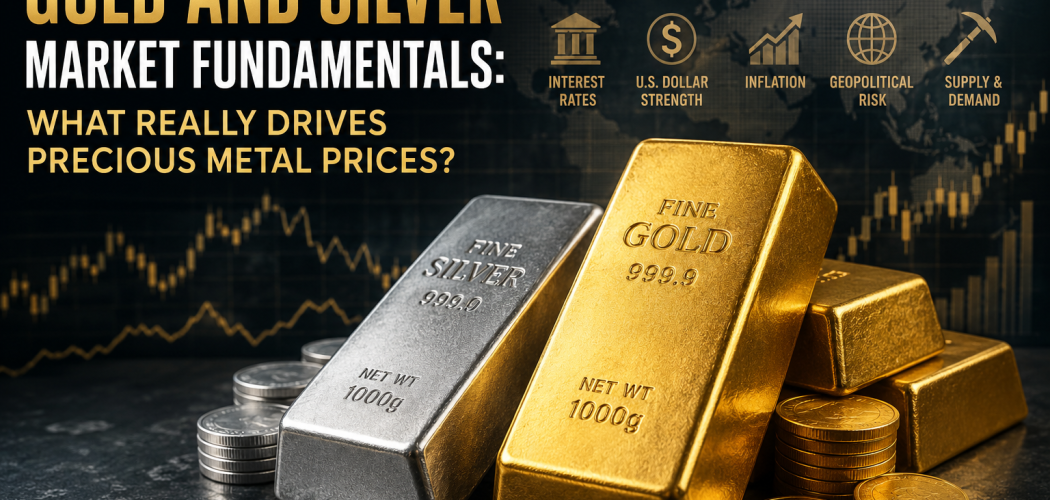
Gold and silver have attracted investors for centuries. However, their prices do not move randomly. Understanding gold and silver fundamentals helps explain why these metals rise during some periods and struggle during others. Interest rates, inflation, currencies, supply, demand, and investor sentiment can all affect their value.
Although people often group gold and silver together, their markets have important differences. Gold acts mainly as an investment, reserve asset, and store of value. Silver shares those roles but also has substantial industrial demand. Therefore, investors need to understand both the similarities and differences between the two metals.
Learning these market forces does not guarantee perfect price predictions. Still, it can help investors interpret market conditions more clearly and make informed decisions.
Why Precious Metals Have Lasting Value
Gold and silver have served as forms of money and stores of wealth throughout history. Today, most countries use fiat currencies rather than precious metals as everyday money. Even so, gold remains an important reserve asset, while both metals continue to attract investors.
Scarcity supports part of their appeal. Unlike currencies, gold and silver cannot be created by a central bank. Mining companies must discover deposits, develop mines, and process ore before new supply reaches the market.
Durability also matters. Gold does not rust or corrode easily. As a result, much of the gold mined throughout history still exists in some form. Silver is also durable, although industrial uses can make some quantities harder or less economical to recover.
These characteristics are central to gold and silver fundamentals. However, scarcity alone does not determine price. Investors must also consider how much metal buyers want and how quickly producers can increase supply.
Gold has another major advantage: central banks hold it as part of their reserves. Silver does not play the same large monetary reserve role. Instead, its industrial applications create a different source of demand.
Supply and Demand Set the Foundation
Like most commodities, precious metals respond to supply and demand. When demand rises faster than available supply, upward price pressure can develop. Conversely, weak demand or abundant supply may place downward pressure on prices.
Mine production represents an important source of new supply. However, producers cannot quickly open a new gold or silver mine when prices increase. Exploration, permitting, financing, construction, and production can take years.
Recycling adds another source. Higher prices can encourage people and businesses to sell old jewelry, coins, electronics, and other metal-containing products. Therefore, recycled supply may increase when prices become attractive.
Demand is more complicated because it comes from several groups. Investors buy bars, coins, exchange-traded products, and other precious metal investments. Jewelry buyers create another major source of gold demand. Meanwhile, manufacturers use silver across electronics, solar technology, electrical systems, and other applications.
For this reason, gold and silver fundamentals require more than simply watching mining output. Investors should examine both sides of the market and understand what is creating new buying or selling pressure.
Why Silver Can Behave Differently From Gold
Silver often experiences greater price swings than gold. One reason is its smaller market size. Changes in investment flows can therefore have a larger effect.
Additionally, silver has a stronger connection to industrial activity. A growing economy may increase demand for products that use silver. On the other hand, an industrial slowdown can weaken that source of demand.
Gold is generally less dependent on manufacturing. Instead, investment demand, monetary conditions, central bank activity, and risk perception often have greater influence.
Inflation and Purchasing Power
Inflation is one of the most discussed drivers of precious metals. When consumer prices rise, the purchasing power of money declines. Investors may then look for assets that could help preserve value over time.
Gold has traditionally attracted attention during inflationary periods. However, the relationship is not automatic. Gold can rise during high inflation, but it can also struggle if other market forces become stronger.
For example, central banks may respond to inflation by raising interest rates. Higher rates can strengthen a currency and increase the appeal of interest-bearing investments. Consequently, those conditions may create pressure on gold even while inflation remains elevated.
Silver faces the same monetary forces but also responds to industrial demand. Therefore, understanding gold and silver fundamentals means examining inflation together with interest rates, economic growth, and currency movements.
Investors should also distinguish between current inflation and expectations. Markets often react before official economic data confirms a trend. If investors expect inflation to accelerate, precious metals may respond before the actual inflation rate rises significantly.
Interest Rates and Real Yields
Interest rates are another major influence on precious metal markets. Gold and silver do not pay interest simply because an investor owns the physical metal. Therefore, higher yields on bonds and savings products can increase the opportunity cost of holding metals.
Real interest rates are especially important. A real rate broadly reflects an interest rate after accounting for inflation. When real yields rise, interest-bearing assets may become more attractive relative to gold.
Conversely, low or negative real rates can support interest in assets that do not generate income. Investors may become less concerned about missing interest when inflation reduces the real return available elsewhere.
However, the relationship can change depending on economic conditions. A rate increase caused by strong growth may affect metals differently from a rate increase designed to control severe inflation.
That is why gold and silver fundamentals should be considered as a connected system. No single indicator can consistently explain every move in precious metal prices.
The U.S. Dollar and Precious Metal Prices
Gold and silver are commonly priced internationally in U.S. dollars. Therefore, changes in the dollar can affect how expensive these metals appear to buyers using other currencies.
A stronger dollar can make dollar-priced metals more expensive for international buyers. As a result, demand may weaken, creating pressure on prices. In contrast, a weaker dollar can make precious metals relatively cheaper outside the United States.
This inverse relationship is common, but it is not guaranteed. Gold and the dollar can sometimes rise together, particularly when investors seek assets they consider relatively defensive during periods of stress.
Currency markets also reflect interest rates, economic expectations, trade flows, and central bank policies. Consequently, investors following gold and silver fundamentals should watch the broader currency environment instead of assuming every dollar movement will produce an equal move in metals.
Why Currency Trends Matter Globally
Precious metals operate in a global market. A gold price that looks stable in U.S. dollars could rise significantly in another currency if that currency weakens.
Therefore, local investors may experience different returns even when they own the same underlying asset. Exchange rates can change both the cost of purchasing metals and the value received when selling them.
Central Banks and Gold Demand
Central banks can play a significant role in the gold market. Many hold gold alongside currencies and other reserve assets. Their purchases or sales can influence demand and market sentiment.
Countries may hold gold for diversification, liquidity, confidence, or reduced dependence on a single reserve currency. When central banks collectively increase their gold holdings, they can create a meaningful source of demand.
Central bank monetary policy matters as well. Decisions involving interest rates, liquidity, and money supply can affect currencies, bond yields, inflation expectations, and investor behavior.
Silver generally does not benefit from official reserve demand to the same degree. Therefore, central bank purchases are much more directly relevant to gold.
Still, policy decisions affect both metals. This makes monetary policy an essential part of gold and silver fundamentals, even though its impact can differ between the two markets.
Industrial Demand and Silver
Silver is unusual because it combines characteristics of a precious metal with those of an industrial commodity. Manufacturers value it for properties such as electrical and thermal conductivity.
The metal appears in electronics, electrical components, solar technologies, automobiles, and many specialized applications. Consequently, technological growth can create additional demand.
Solar energy is an especially notable example. Photovoltaic cells use silver because of its conductive properties. Growth in solar installations can therefore contribute to industrial consumption.
However, manufacturers also have incentives to reduce the amount of silver used when prices rise. Technological improvements may lower silver content per product. In some cases, companies may explore substitute materials.
These competing forces are important when studying gold and silver fundamentals. Growing industries can strengthen demand, while efficiency improvements can limit how much additional metal those industries require.
Gold also has industrial applications, particularly in electronics, but investment, jewelry, and reserve demand generally play larger roles in its market.
Investor Sentiment and Market Uncertainty
Markets are driven by people as well as economic data. Fear, confidence, expectations, and speculation can cause prices to move quickly.
During periods of financial uncertainty, investors may increase their exposure to gold. Concerns about banking stability, geopolitical conflict, recession, currency weakness, or financial market volatility can increase demand.
However, safe-haven behavior is not guaranteed. During severe market stress, investors sometimes sell gold or silver to raise cash or cover losses elsewhere. Prices can therefore fall temporarily even when uncertainty is high.
Silver may experience even sharper moves because of its smaller market and industrial exposure. When investors fear a recession, concerns about weaker manufacturing activity may compete with safe-haven demand.
As a result, gold and silver fundamentals include both measurable economic forces and changing investor psychology.
Exchange-Traded Products and Investment Flows
Modern investors do not need to buy physical bars or coins to gain exposure to precious metals. Exchange-traded products and other financial instruments have made market access easier.
Large inflows into precious metal funds can indicate growing investor demand. Conversely, sustained outflows may show that investors are reducing exposure.
Futures markets also influence short-term price discovery. Traders use futures for speculation, hedging, and commercial risk management. Consequently, changes in positioning can amplify short-term market movements.
Physical and financial markets remain connected, but they are not identical. Retail coin premiums, for example, can rise even when the international spot price remains relatively stable.
Investors studying gold and silver fundamentals should therefore distinguish between spot prices, futures activity, investment fund flows, and physical market conditions.
Mining Costs and Production Challenges
Mining companies face significant costs. Labor, energy, equipment, financing, environmental requirements, and ore quality all affect the economics of production.
When production costs rise sharply, some mines become less profitable. Companies may delay projects or reduce investment in marginal operations. Over time, this can restrict supply growth.
However, mining costs do not create a guaranteed floor under market prices. Producers can continue operating at weak margins for various reasons. In addition, existing inventories and recycled metal can supplement mine supply.
Ore grades matter as well. Lower grades generally require companies to process more material to produce the same amount of metal. That can increase energy use and operating costs.
New mines also require substantial capital and time. Therefore, gold and silver fundamentals often develop over years rather than weeks. Supply cannot always respond quickly to sudden changes in demand.
Economic Growth and Recession Risks
Economic growth affects gold and silver in different ways. Strong growth can support industrial silver demand. At the same time, healthy economic conditions may reduce demand for defensive assets such as gold.
A recession can reverse those forces. Industrial activity may weaken, potentially reducing silver consumption. Meanwhile, economic uncertainty may increase investor interest in gold.
Yet recessions also influence interest rates and government policy. Central banks may cut rates or provide additional liquidity to support the economy. Those measures can change real yields and currency expectations.
This interaction explains why precious metal markets can be difficult to predict from one economic statistic. Investors need to consider the broader environment.
Understanding gold and silver fundamentals provides a framework for connecting economic growth, monetary policy, industrial activity, and investment behavior.
Geopolitical Events and Global Risk
Wars, political disputes, trade tensions, sanctions, and other international events can influence precious metals. Investors often reassess risk when geopolitical uncertainty rises.
Gold may attract demand when confidence in financial markets or currencies declines. However, the size and duration of the reaction depend on how investors view the event.
Short-lived tensions may cause only temporary price movements. A larger crisis that changes energy markets, trade flows, inflation, or monetary policy can have a longer-lasting effect.
Silver can also react to geopolitical risk, but industrial concerns may influence its response. For example, disruptions to global manufacturing can reduce demand expectations even while investors seek defensive assets.
Therefore, geopolitical headlines should not be evaluated in isolation. Their economic consequences often matter more than the headline itself.
How Investors Can Evaluate Precious Metal Markets
Investors do not need to predict every daily price move. Instead, they can monitor several important indicators together.
Start with inflation and real interest rates. Next, examine the U.S. dollar and central bank policy. Then consider mine supply, recycling, investment flows, and physical demand.
For silver, industrial conditions deserve extra attention. Manufacturing trends, renewable energy growth, electronics demand, and technological changes can influence consumption.
For gold, central bank purchases, investment demand, currency trends, and monetary conditions often deserve greater weight.
Market sentiment should also remain part of the analysis. Futures positioning, fund flows, volatility, and risk appetite can reveal how investors are responding to economic conditions.
Most importantly, avoid relying on one indicator. Gold and silver fundamentals work together, and their relative importance changes over time.
Conclusion
Precious metal prices reflect a complex balance of economic, financial, industrial, and psychological forces. Supply and demand provide the foundation, but interest rates, inflation, currencies, central banks, economic growth, and investor sentiment can quickly change market conditions.
Gold and silver also serve different roles. Gold remains closely linked to investment demand, monetary conditions, and reserve management. Silver combines precious metal demand with substantial industrial consumption. As a result, the two metals can sometimes move together and sometimes follow very different paths.
Understanding gold and silver fundamentals does not remove market risk or guarantee accurate forecasts. Instead, it gives investors a stronger framework for interpreting price movements. By looking at several indicators together, investors can better understand what may be driving the market and avoid reacting to a single headline or short-term price move.
FAQ
1. What Usually Causes Gold Prices to Rise?
Gold can rise for many reasons, including falling real interest rates, a weaker dollar, increased investment demand, central bank purchases, inflation concerns, or greater economic uncertainty. However, no single factor controls the price at all times.
2. Why Is Silver Often More Volatile Than Gold?
Silver has a smaller market and substantial industrial demand. Therefore, changes in manufacturing expectations or investment flows can create larger percentage moves. Its dual role as an industrial and precious metal also makes its price sensitive to more economic forces.
3. Does Inflation Always Push Precious Metal Prices Higher?
No. Inflation can increase demand for stores of value, but interest rates and currency movements also matter. If central banks respond with aggressive rate increases, higher real yields may reduce the appeal of non-interest-bearing metals.
4. How Does a Strong U.S. Dollar Affect Gold and Silver?
A stronger dollar can make precious metals more expensive for buyers using other currencies. That can create downward pressure on demand. However, the relationship is not perfect, and both the dollar and metals can sometimes rise during periods of uncertainty.
5. What Indicators Should Precious Metal Investors Watch?
Investors can monitor inflation, real yields, interest rates, currency movements, central bank policies, mine production, investment flows, and economic growth. Silver investors should also follow industrial demand. Together, these indicators provide a broader picture of gold and silver fundamentals.

